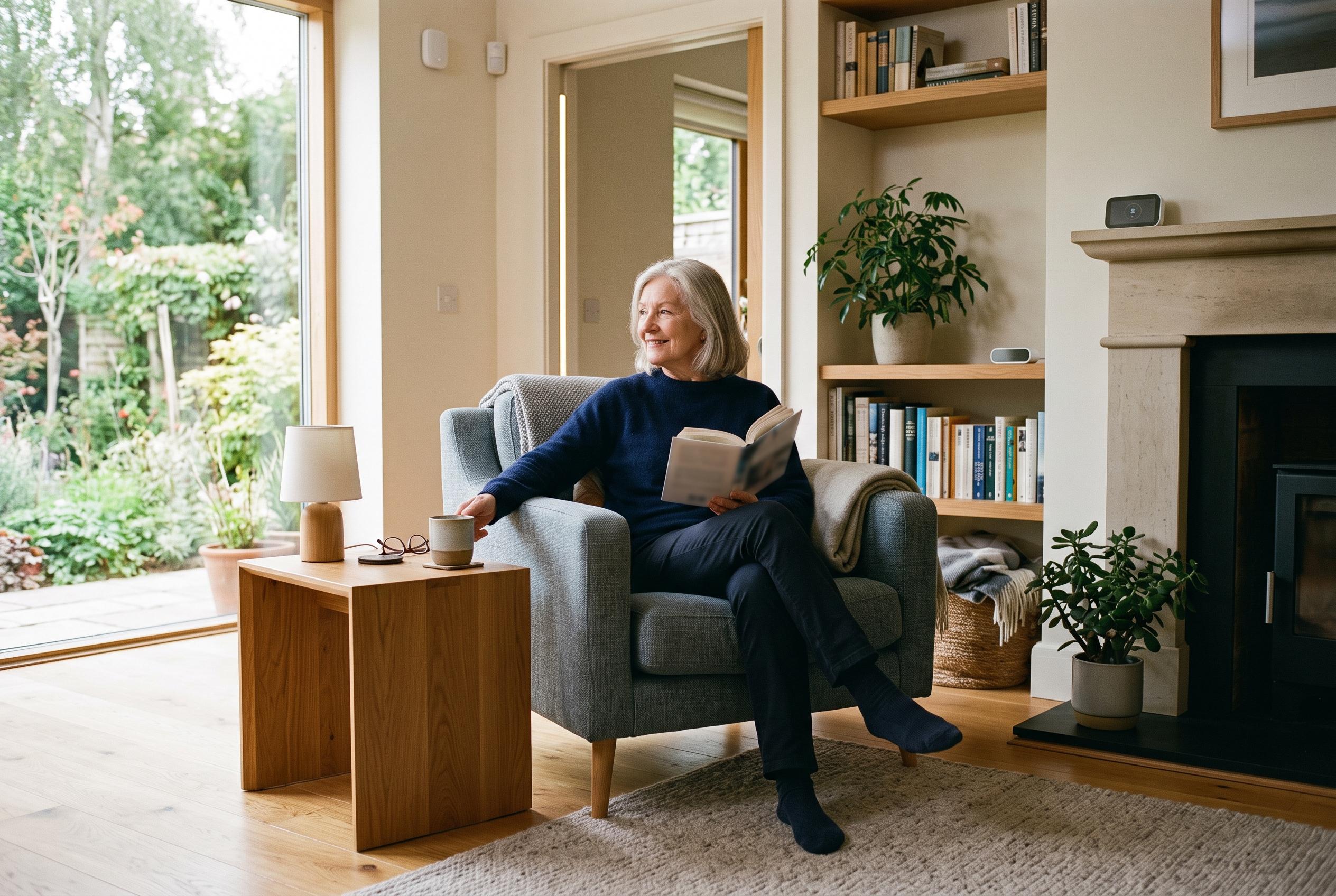

Innovative sensor-based systems are shifting smart home tech beyond basic controls, offering continuous support for older adults to live independently while maintaining safety, dignity, and quality of life.
Smart home technology aimed at older people is moving beyond remote light switches and app-controlled thermostats towards something closer to continuous home-based support. A Canadian project involving the National Research Council, Carleton University, Bruyère Health Research Institute and industry partners is developing systems that use sensors to track heart rate, breathing, body movement and changes in routine, with the intention of alerting carers or emergency services when something appears wrong. Dr Pengcheng Xi, a senior research scientist with the NRC, said “Ongoing assessment of an older adult’s well-being is vital for supporting aging in place” and that earlier detection could “reduce hospitalizations and improve health management”. JMIR’s 2026 overview argues that this matters because independent living depends not only on immediate safety, but also on dignity and day-to-day quality of life. (nrc.canada.ca)
The pressure to make homes more supportive is already clear. The Washington Post reported in May 2026 that 75 per cent of more than 3,000 respondents in a 2024 AARP survey hoped to remain in their homes for as long as possible. In Canada, the NRC cites federal data showing that about nine in 10 people aged 65 or older live in private homes and nearly one-third live alone. A 123-page Monash University-listed report published by McLean Care in 2021 adds another dimension: older people in rural, regional and remote areas may have the most to gain because they generally face weaker access to services and poorer health and wellbeing outcomes. (washingtonpost.com)
At the consumer level, the most practical systems remain relatively simple. Forbes Health describes a smart home as one built around internet-enabled devices such as bulbs, switches, thermostats and security systems, often linked through hubs including Amazon Echo, Google Nest or Aeotec, then controlled by app, voice command or Bluetooth. Alexis Abramson, a gerontologist and spokesperson for Comfort Keepers, told Forbes that older adults need to plan for “potential decreased mobility, increased risk of falls and reduced vision”. She added that family members can sometimes monitor safety if access is shared deliberately, though that depends on trust and clear permission from the person living in the home. (forbes.com)
Real-world accounts suggest voice control can be more than a convenience feature. The Washington Post described how Saul Morse, 78, who uses a wheelchair because of post-polio syndrome, had linked an Amazon Alexa device to his contacts. When his wife had a stroke one night and his phone was elsewhere in the house, he used the speaker to reach his adult children, who then called 911. But the same article stressed the limits of the technology. Ashwin Kotwal, a geriatrician at the University of California, San Francisco, said that once someone is struggling to get out of bed, use the toilet or bathe independently, in-person help is usually needed. Wendy Rogers of the University of Illinois Urbana-Champaign said digital tools are often more effective in supporting medication routines, cooking, finances, hobbies and social contact than in replacing hands-on care. (washingtonpost.com)
That broader view of “safety” also runs through clinical commentary. JMIR wrote in February 2026 that home technology should be judged not only by whether it can summon help after a fall, but also by whether it supports medication adherence, spots functional or cognitive decline, helps manage chronic illness, and reduces inactivity or social isolation. The article says clinicians should assess barriers to adoption and match devices to a person’s goals and values, rather than simply choosing whatever offers the most surveillance. James Giordani, a social worker and older-adult technology specialist, gave a stark example when he recalled his grandmother falling and breaking her hip and remaining on the floor for “about 12-16 hours” before help arrived. (jmir.org)
Evidence on adoption suggests older adults are not indiscriminately buying everything labelled “smart”. A 2019 survey of 445 community-dwelling adults aged 60 and over found that so-called brisk adopters were more likely to be women, aged 60 to 70, living in two-level homes, living with body-function impairments, having a history of falls and already being comfortable with information and communication technology. The same research found that 41.6 per cent of people aged 60 to 70 were brisk adopters, compared with 30.6 per cent of those aged 71 and above, while 40.7 per cent of people in two-storey homes fell into that group, against 30.8 per cent in single-level homes. Ownership was most strongly predicted by marital status, home security and overall technology ownership. (pmc.ncbi.nlm.nih.gov)
The details of that study are especially revealing because they show what older adults actually prioritise. Participants owned an average of 3.2 of the 13 listed devices, wanted roughly three more, and rejected six. The most popular interests were plainly defensive: water leak detectors, which 41.8 per cent wanted; automatic stove shut-off, at 38.0 per cent; backup generators; and motion-sensing lights. By contrast, remote home monitoring, smartphone control of lights and appliances, motion-activated cameras, voice assistants and emergency alerting systems were among the least desired options. The authors said worries about usability, reliability, trust, privacy, accessibility and affordability continued to shape adoption. That helps explain why NRC researchers are emphasising privacy-preserving AI analysis, and why Australian researchers have argued that design for older users in rural and remote communities must be tied to wellbeing and service access, not novelty alone. (pmc.ncbi.nlm.nih.gov)
The emerging consensus is that smart homes are most useful when they remove specific frictions rather than attempt to automate old age itself. Haisam Sourchi of Alavida Lifestyles told Forbes that “There are myriad smart home tools that can help with almost every level of home maintenance,” but the stronger evidence suggests older residents benefit most when technology starts with clear risks such as poor lighting, leaks, cooking hazards, missed medication or delayed access to help. The more ambitious health-monitoring systems now under development may extend that model, but the reporting across medicine, consumer advice and academic research points in the same direction: the home works best when technology supports judgement, routine and human care instead of pretending to replace them. (forbes.com)
Disclaimer: This content is intended for informational purposes only. Readers are advised to exercise their own judgement, conduct due diligence, or consult a qualified expert before acting on any information provided.