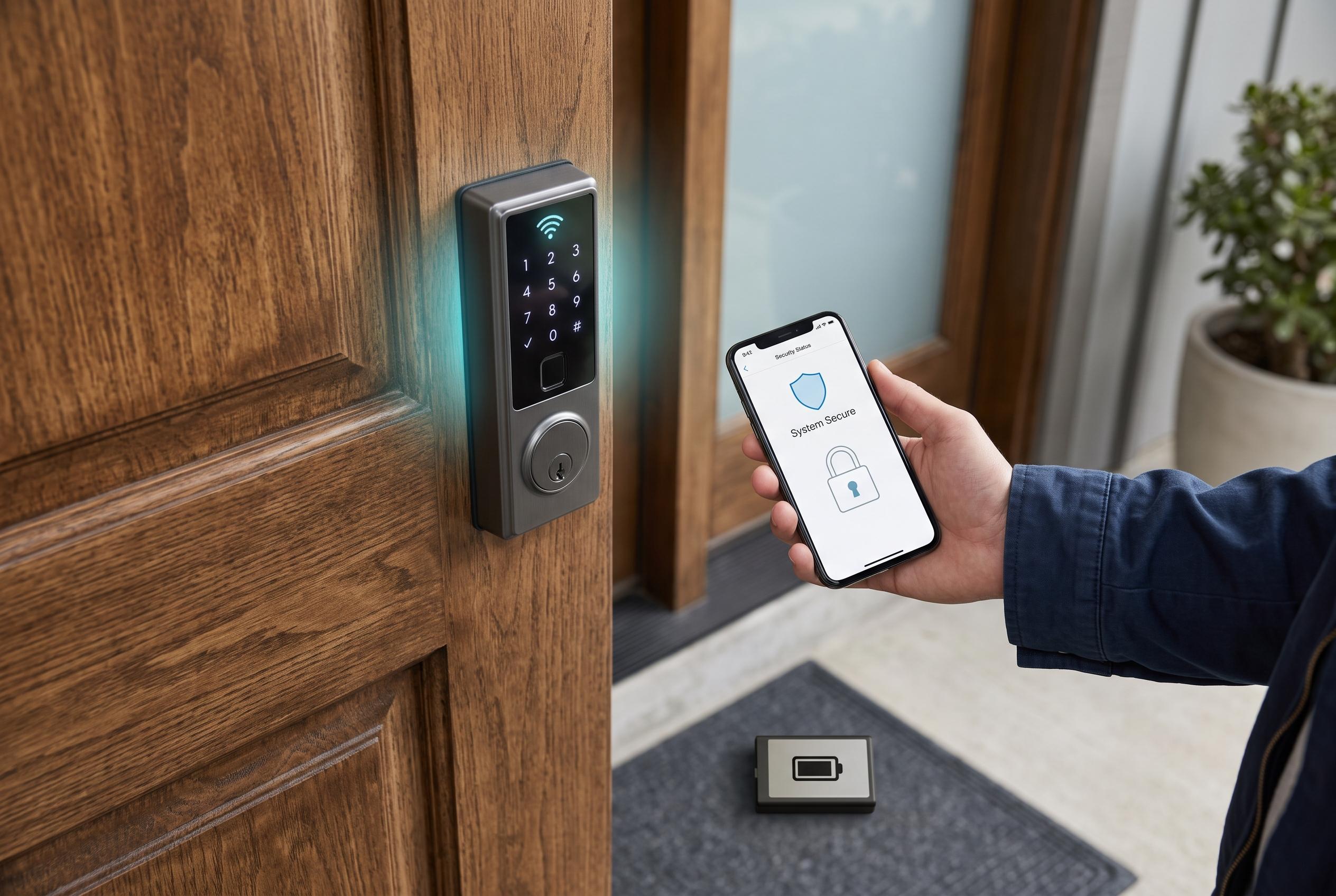

While offering advanced features, smart locks face significant drawbacks including battery dependence, connectivity issues, and higher costs, raising questions about their practicality compared to traditional mechanical locks.
Smart locks are often sold as a simple upgrade from a conventional deadbolt, but the trade-off is more complicated than it first appears. How-To Geek argues that the biggest drawback is basic reliability: a standard lock is largely mechanical, whereas a connected lock depends on electronics, power and software all working at the same time. That extra functionality can be useful, but it also introduces more points of failure.
Battery dependence is one of the most obvious weak spots. Because most smart locks cannot be hard-wired in a practical way, they rely on batteries, and when those batteries fail, the lock may stop doing far more than just losing its smart features. A conventional lock can still be opened with a key, but a dead smart lock may leave users dealing with a device that is effectively out of action until power is restored. Guides from Keyplusys, Welock and other smart-lock manufacturers make the same point, noting that low temperatures, heavy use and weak battery warnings all matter in real-world use.
Connectivity is another issue. Remote control, app-based access and automation depend on wireless links such as Wi-Fi, Bluetooth, Zigbee or Z-Wave, and those systems do not always behave well when the network is unstable. Ciirus warns that some locks also depend on separate hubs or bridges, adding another layer that can fail. In practice, that means a smart lock can be secure and still be inaccessible at the exact moment it is needed. Physical fit is also important: if a door is misaligned, ajar or requires the handle to be lifted before the latch will engage, the electronics cannot compensate.
Cost is the other major drawback. How-To Geek notes that a basic replacement lock is inexpensive, while quality smart locks often move into triple-digit pricing. That makes the value calculation harder, because several features can be copied in other ways. A door sensor can report whether a door is open, a keypad can provide PIN entry and a video doorbell can show who is outside. The feature that remains hardest to replace is remote locking and unlocking, which may be enough for households that genuinely need it, but not for everyone.
There is also a security question, although it is often overstated. A smart lock is not automatically easier to defeat than a mechanical one, and the more common risks are not Hollywood-style hacks but configuration mistakes, weak passwords, poor automation rules or exposed smart-home accounts. Still, the number of digital and mechanical components does widen the attack surface. That is why smart locks tend to make the most sense in specific settings, such as short-term rentals or homes where temporary access needs to be granted and withdrawn regularly. For many households, a conventional lock remains the simpler and more dependable choice.
Disclaimer: This content is intended for informational purposes only. Readers are advised to exercise their own judgement, conduct due diligence, or consult a qualified expert before acting on any information provided.