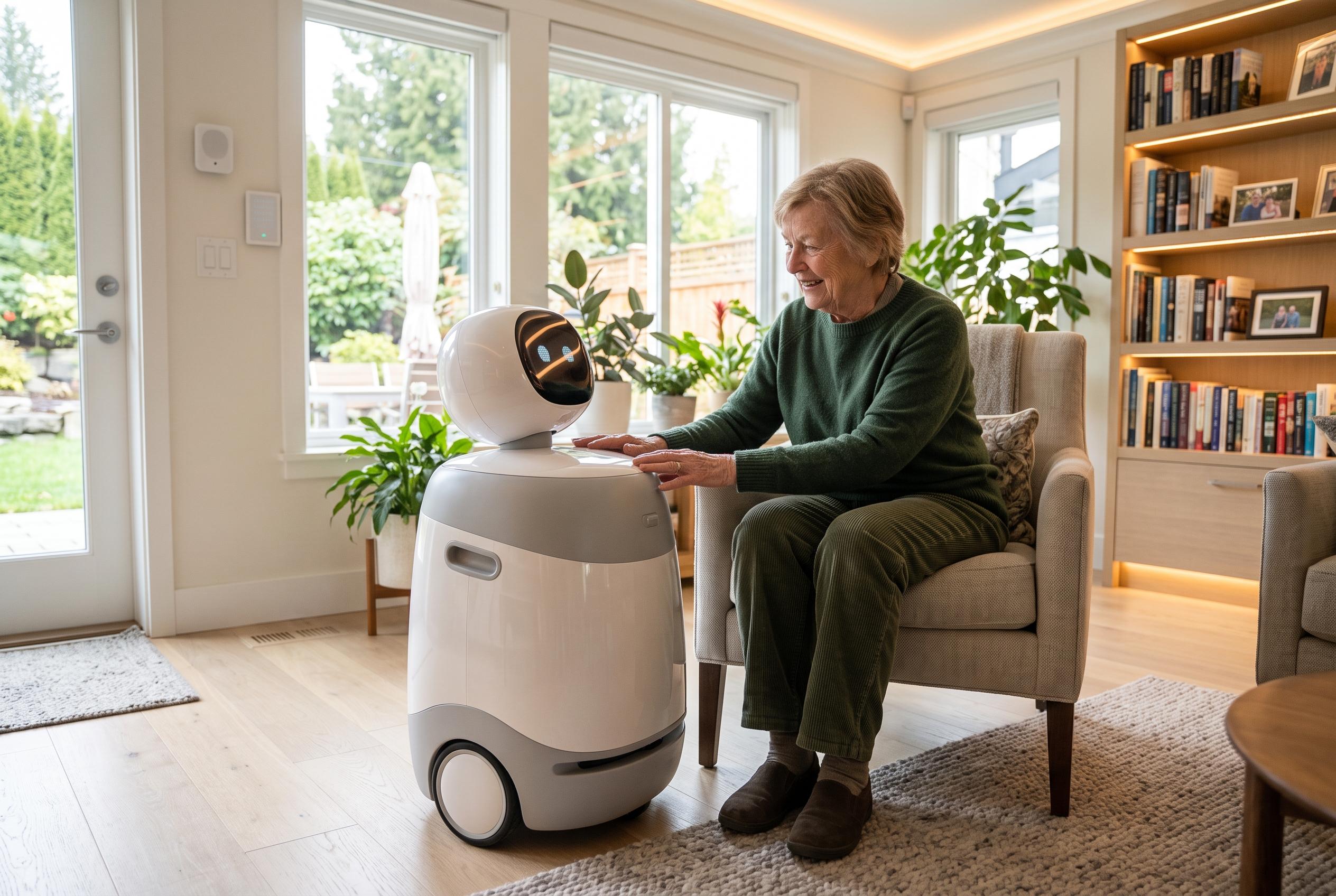

At IFA 2026 in Berlin, Tuya unveils Doova, an AI-powered home companion robot designed to support independent living for the elderly, highlighting a shift towards integrated AI systems for household management and safety.
Tuya has used IFA 2026 in Berlin to push a broader message than a single product launch: the company wants to be seen not just as a smart-home software supplier, but as a builder of physical AI systems for everyday domestic use. At the centre of that effort is Doova, a home companion robot aimed at older people who live alone, alongside the European debut of Tuya’s AI Home, AI Robot and AI Energy ranges under the “Hey Tuya” banner. The company says the display is intended to show how cloud services, connected devices and developer tools can be combined into practical household products rather than remaining inside apps and voice assistants. (prnewswire.com)
The clearest use case is emergency response. MarketScreener and StockTitan, in separate summaries of the launch, said Doova uses LDS LiDAR, a four-microphone sound-source localisation system and AI skeletal-recognition software to detect a fall or other urgent event. A user can call “Hey Tuya, help”, after which the robot is meant to find them, move to their side and assess the situation. If there is no response within 60 seconds, it can trigger a two-way live video alert to family members so help can be arranged remotely. (marketscreener.com)
Tuya is also presenting Doova as a daily companion rather than a single-purpose alarm. StockTitan said the robot’s conversational functions are powered by a multimodal large language model that can read documents, warn about suspected scams and manage reminders. Sina Finance added that Doova has a soft, curved body, a high-definition display and animated facial expressions, while Localpost.homes described it as a short wheeled machine with no arms. That combination suggests a narrower ambition than the classic robot-butler idea: Doova is closer to a mobile sensor, screen and voice interface than a humanoid helper able to manipulate objects around the home. (stocktitan.net)
That distinction matters because much of the product’s value lies in co-ordinating the home rather than physically working in it. According to Sina Finance and Localpost.homes, Doova can serve as a moving smart-home hub for lights, curtains and household appliances, including kitchen and bathroom devices. Daily AI Brief said it can also scan rooms, compile safety reports and send them to a phone. Sina Finance reported that Tuya is using a room-centre patrol method rather than a wall-following route, with 360-degree checks at each stop, an approach aimed at making home monitoring more comprehensive without relying on fixed cameras alone. (finance.sina.com.cn)
The wider IFA display suggests Tuya sees Doova as one node in a much larger platform. Alongside the robot, the company is demonstrating sleep speakers that use millimetre-wave radar to detect when someone has fallen asleep, pet devices that analyse vocalisations and breathing, and an AI energy system that draws on live and dynamic tariff feeds from more than 800 electricity providers and over 1,000 tariff-service providers across Europe. It is also showing an end-to-end Matter line-up of modules, bridges and cloud services. Matter is the interoperability standard intended to let smart-home devices work across brands and platforms. Humanoids Daily noted that Tuya is positioning Doova inside this broader AIoT ecosystem rather than as a standalone household gadget. (prnewswire.com)
Software and tooling are an equally large part of the pitch. Tuya says the latest version of Hey Tuya uses a multi-agent architecture to interpret ordinary requests such as “Turn on the dining room lights” or “I’m leaving — activate monitoring” and then carry out actions across several devices together. It is pairing that with TuyaOpen, Tuya Cobuilder and Tuya AI Coding, tools intended to let manufacturers, developers and less technical users turn natural-language ideas into working AI hardware services. Seen in that light, Doova is as much a demonstration of Tuya’s control layer as it is a consumer robot: the company is effectively arguing that the real opportunity in home robotics may lie in orchestration software as much as in the machine moving around the room. (prnewswire.com)
The case is not complete. Humanoids Daily noted that Tuya had not disclosed a price, launch timing, battery endurance or the local privacy architecture behind the robot, while Localpost.homes argued that a mobile device equipped with cameras and sensors introduces a separate trust issue from the convenience it promises. Those gaps matter especially in elder care. A product of this kind will be judged not only on companionship and automation features, but on whether families are comfortable with how data is collected, how alerts are routed and how much supervision is effectively being delegated to a machine. (humanoidsdaily.com)
Even so, the Berlin launch gives a clear view of where Tuya thinks the next smart-home market is heading. Rather than promising a general-purpose domestic robot, the company has chosen a more limited and arguably more plausible proposition: a wheeled companion that can watch, talk, remind, connect relatives and control existing connected devices. As Daily AI Brief and Humanoids Daily both indicated, the appeal rests on senior independence, routine assistance and household co-ordination. Whether that becomes a viable category will depend less on the spectacle of robotics than on price, privacy and proof that the system is dependable when something genuinely goes wrong. (dailyaibrief.com)
Disclaimer: This content is intended for informational purposes only. Readers are advised to exercise their own judgement, conduct due diligence, or consult a qualified expert before acting on any information provided.