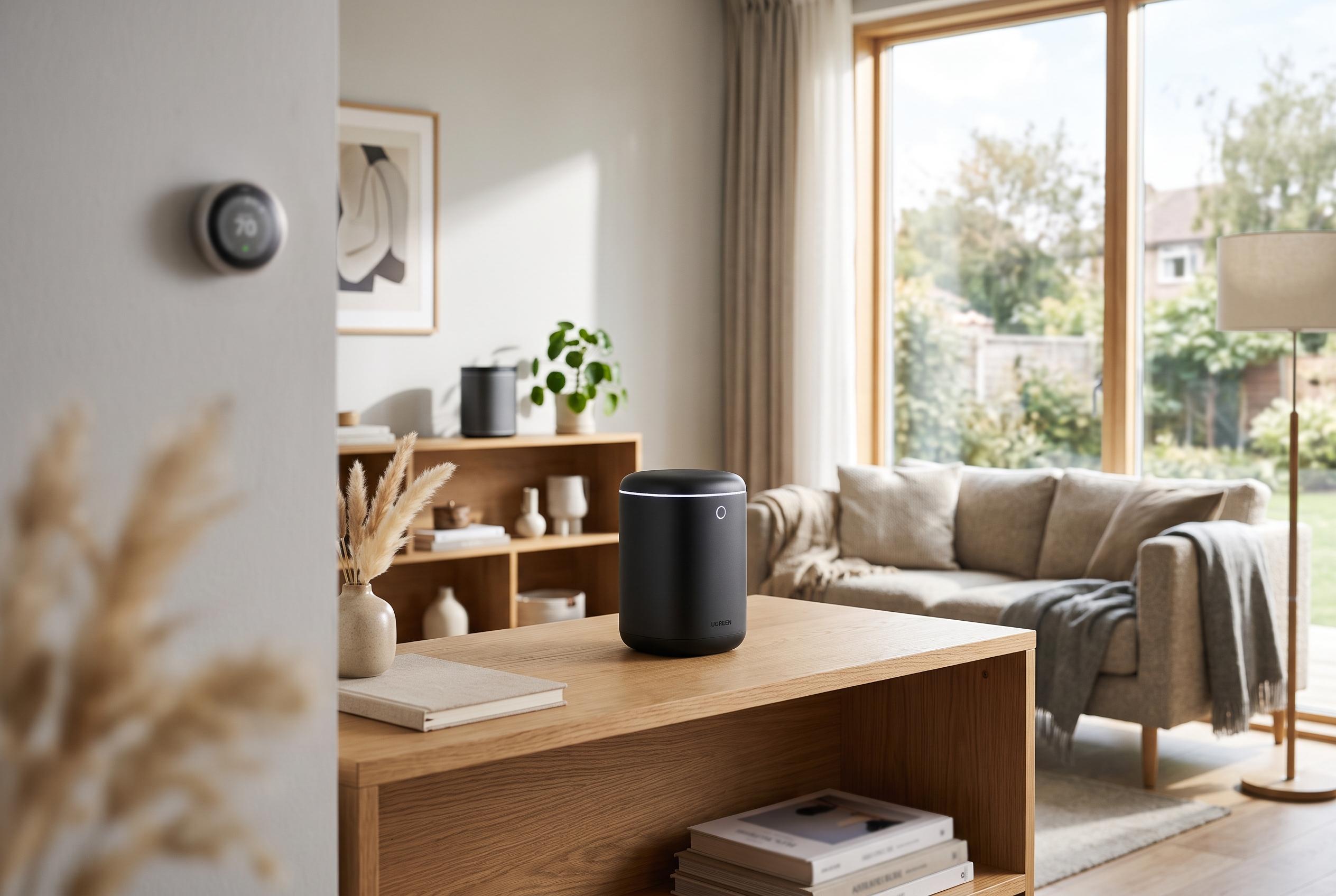

UGreen launches the HomeAgent HA100, a hybrid device merging local AI-powered security, storage, and smart home management, signalling a potential shift in home technology. Its localisation and privacy focus set it apart, but software maturity remains key to its future success.
UGreen is moving beyond its established NAS business and into the wider AIoT market with a product that tries to merge storage, video surveillance and smart home control in one box. The HomeAgent HA100 is the first model in that line-up, and it is built around a local-AI design that keeps processing on the device rather than pushing camera feeds, voice requests and personal media out to a cloud service. That approach is central to UGreen’s pitch, especially as privacy concerns continue to shape buying decisions in the home-security and smart-home sectors. According to UGreen’s launch material, the wider HomeAgent family will also include the HA100 Pro and the MasterAgent MA100, with the latter aimed at much heavier AI workloads.
The HA100 itself is based on Rockchip’s RK3588 chip and ships with 16GB of memory, three drive bays and an optional T20 AI accelerator card. UGreen says the add-in card contributes a further 20 TOPS of AI performance, on top of the chip’s built-in neural processing unit. The machine also includes four PoE ports for cameras, a 2.5GbE network connection, an HDMI output, a front display and a microphone array, which makes it look more like a hybrid appliance than a conventional NAS. UGreen’s own comparison between the HA100 and its NASync DH2300 and DH4300 Plus models suggests the new product is aimed at users who want more camera and voice hardware than a standard storage box would provide.
In use, the strongest impression is that the HA100 is designed first as a surveillance hub and second as a general-purpose NAS. The review found that the beta mobile app could discover ONVIF cameras on the local network and that H.265 support broadened compatibility beyond what had previously been possible on some UGreen NAS devices. A Reolink RLC-811A was added without difficulty, and even streams from a Reolink RLN8-410 NVR could be brought into the system. One camera still needed manual RTSP setup, so the experience was better than a basic NVR, but not yet fully seamless. UGreen’s bundled SynCare cameras also paired quickly, with the PoE model connecting directly through the HA100 and the indoor unit joining over Wi-Fi.
The AI functions are where the device begins to justify its positioning. The software can recognise people, vehicles, pets and package events, while also creating short caption-style notifications from camera activity. Face recognition is handled separately and is accompanied by a consent screen that explains the data stays local, apart from encrypted remote-view relaying. UGreen also lets users tune alert categories in more detail than many rival camera systems, with options for scene changes, intrusion, obstruction, fire detection and device movement. Some of the more ambitious features, including voice notifications and stranger alerts, were not yet active during testing, which suggests the software is still being rolled out in stages.
Away from security, the HA100 borrows much of the familiar UGOS experience from UGreen’s NAS range. Photos, cloud-drive syncing, music and file management are all present, and the Photos app appears to benefit from the extra hardware, with people recognition completing quickly on a large library. The system can also pull data from services such as OneDrive and Google Drive, which makes it useful as both a backup target and a migration tool. Even so, the review notes that the current software is incomplete: there is no web interface yet, some NAS functions are missing, and Docker support is absent, limiting the app ecosystem compared with more mature NAS platforms.
That leaves pricing as the key factor. UGreen has not confirmed UK availability or cost for the HA100, its Pro variant, the MasterAgent MA100 or the accompanying cameras and smart speaker. That matters, because the hardware looks capable enough to compete with separate NAS and NVR products, but its value will depend on whether UGreen prices it above its NASync range without pushing it into the territory of more established storage and surveillance systems. For now, the HA100 looks technically promising: a well-built, local-AI home hub with serious potential, but one that still needs software polish before it can be judged as a finished product.
Disclaimer: This content is intended for informational purposes only. Readers are advised to exercise their own judgement, conduct due diligence, or consult a qualified expert before acting on any information provided.