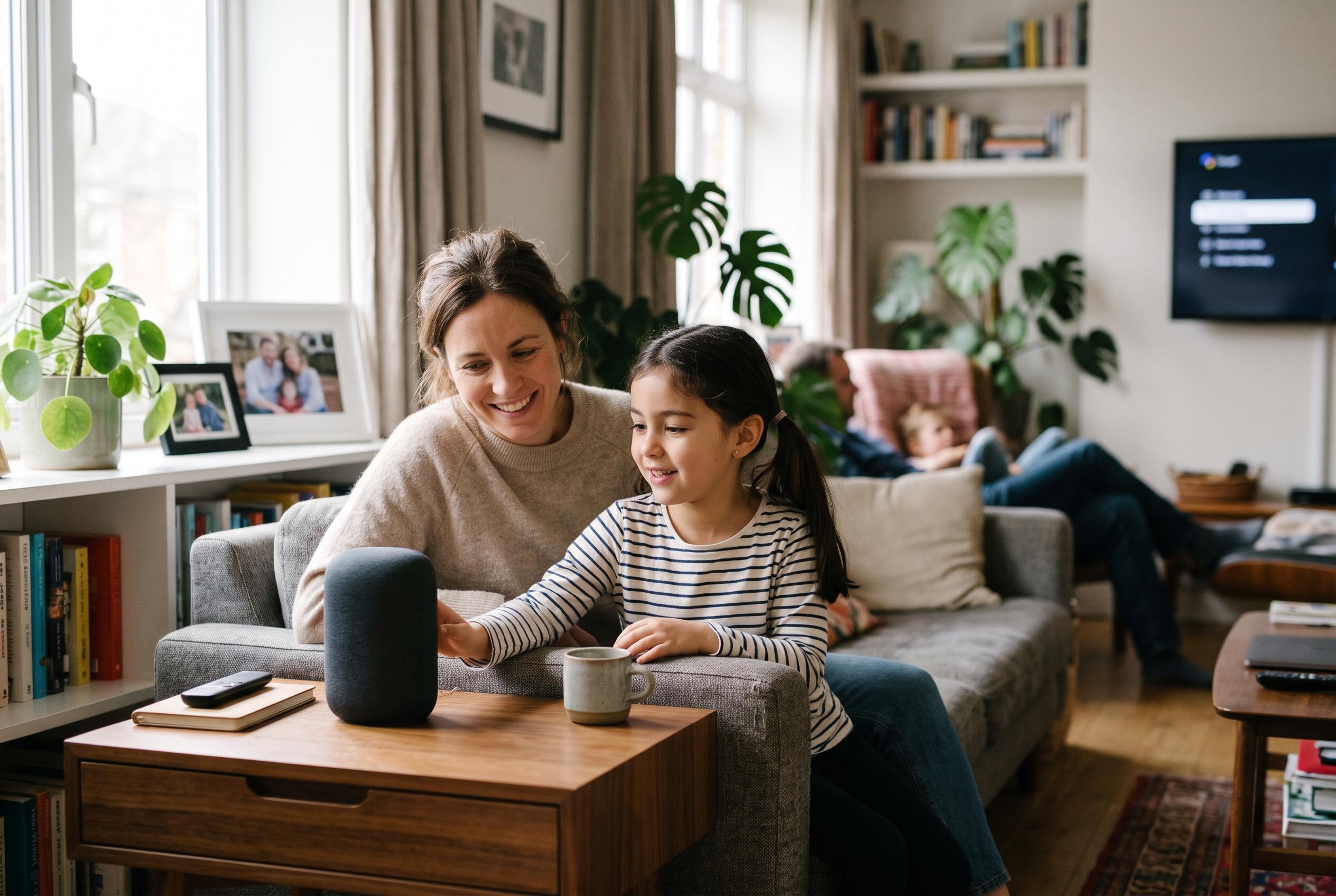

As conversational AI expands what children can access by voice, parents are being pushed beyond simple command blocking towards supervised profiles, purchase approvals, enforced routines and tighter privacy settings.
Families trying to make voice assistants safer for children now face a more complex task than simply blocking a few commands. The central problem is that a child who can speak can often reach far more than they could through typed search, and the rise of conversational AI has made that gap wider. In the household described in the lead article, the practical answer is to move from ad hoc supervision to account-level controls: one supervised profile per child, purchase approvals, bedtime limits and settings that continue to work when an adult is not in the room.
That approach matters because the main risks are ordinary, not exotic. A child can use voice search to reach material they would not find by typing, accept an assistant’s answer without judgement, or trigger accidental purchases and live-audio features such as calls and drop-ins. Amazon’s long-running Alexa controls remain the most complete out of the box, while Google’s tools become more useful once Family Link and Voice Match are properly configured. Apple’s HomePod still offers the least child-specific control, which means parents need to rely more heavily on manual restrictions and supervision.
On Android tablets, Google’s Family Link remains the key control layer. According to Google’s support guidance, parental controls can be applied through Family Link and the Google Home app, with Voice Match required for some device features. The lead article argues that the strongest setup is to give each child a separate supervised account, turn on downtime and school-time schedules, and approve app or purchase access individually. It also notes a useful detail: disabling search in YouTube Kids can indirectly shut down voice-based wandering, because the assistant can no longer pull in open-ended results.
Amazon’s Echo family still offers the most developed child mode. The lead article says Amazon Kids can be switched on from the Alexa app, with daily limits, bedtime rules and approved-contact calling available through the parent dashboard. Amazon’s own support materials are more limited in the supplied material, but the broader point stands: a child cannot simply talk their way out of Kids mode, because turning it off requires a parent account. That makes the device safer for younger children, particularly when it is paired with voice purchasing switched off on every other Echo in the home.
The privacy issue is now just as important as content filtering. The lead article points to Amazon’s 2023 civil penalty over children’s Alexa recordings and to later changes that removed some local-recording options from specific Echo models in 2025. More broadly, the story is no longer only about what an assistant says back. Voice snippets can be stored, reviewed or processed in the cloud, which means the safest setup is still the least generous one: short auto-delete windows where available, microphone mute when the speaker is not in use, and the assumption that any bedroom device can create a privacy trail unless parents deliberately reduce it.
A separate market has emerged around child-safe AI assistants, suggesting that some families want more than tightly constrained versions of Google or Amazon. Yoome says it is built for children aged six to 17 with real-time content monitoring, parental oversight and no advertising. Mimzi says it supports children from three to 15 with moderation, age-adaptive profiles and parent review tools. Lumo takes a voice-first approach without a screen, while Piepie and HeyLoLo also emphasise family dashboards, safety layers and age-appropriate responses. These products may appeal to parents who want guided AI rather than general-purpose assistants, but they also underline the same point made by the lead article: the safest system is the one with clear boundaries, visible parental control and no assumption that the child will self-regulate.
For most households, the most effective rule remains simple. Put every child on a separate supervised profile, lock purchases, set device-enforced bedtime limits and keep voice-enabled devices out of private spaces when possible. Then add a house rule that software cannot enforce: no personal information, no private conversations and no assumption that the assistant is a friend. The technology can help, but the long-term protection comes from combining the right settings with direct parental oversight.
Disclaimer: This content is intended for informational purposes only. Readers are advised to exercise their own judgement, conduct due diligence, or consult a qualified expert before acting on any information provided.