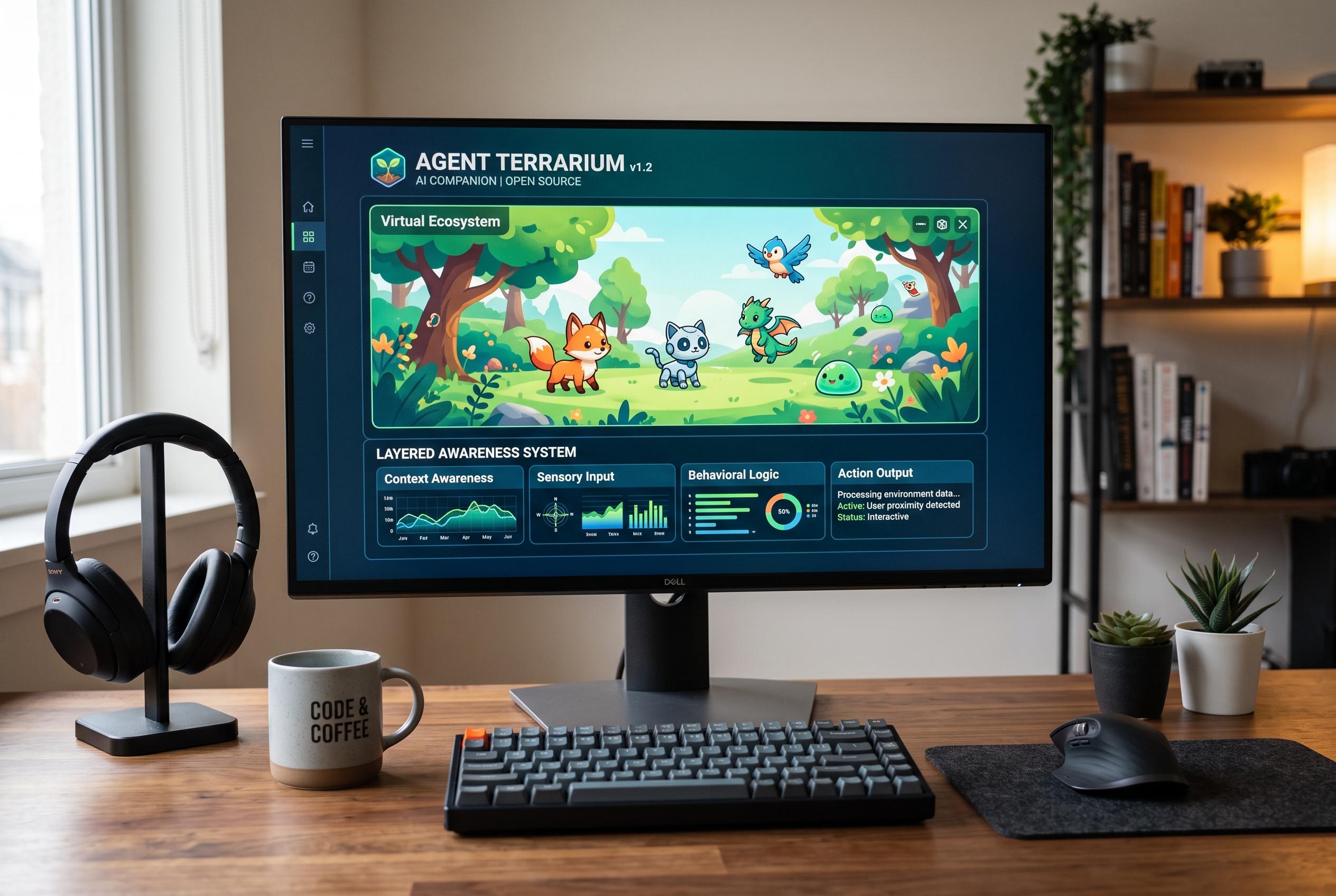

Microsoft engineer Alexander Klas introduces Agent Terrarium, an open-source desktop companion featuring animated agents that move, react, and interact within a layered awareness system, aiming to make AI interfaces feel more human and engaging.
Microsoft engineer Alexander Klas’s Agent Terrarium starts from a simple criticism of modern AI interfaces: chat boxes and command-line streams are efficient, but they can feel sterile. His answer is an open-source desktop companion in which agents inhabit a small animated world, moving around the screen, reacting to events and occasionally behaving like curious digital pets. The aim is not productivity alone, but presence. According to Klas, the project is also a way to explore a larger question: in an era when code generation is increasingly commoditised, the harder skill is judging what is worth building and making it feel considered.
The system is built around a strict separation between simulation and presentation. All core behaviour, including physics, movement, event handling and AI dispatch, runs in Rust at 20Hz, while a React interface acts only as a viewer through Tauri IPC and Canvas 2D rendering. That renderer-agnostic design means the same simulation crate can support the desktop app, a terminal interface and an in-progress VS Code extension. In practice, that gives the project a level of portability that is still rare among agent tools, many of which are tied to a single interface or runtime.
Agent Terrarium’s most distinctive feature is its awareness model. Instead of treating an agent as a simple request-and-response endpoint, the app gives each character a layered understanding of its surroundings. At the lowest level, it can only see direct messages. Higher levels add world events, social interactions and finally full state snapshots of the environment. From there, agents can speak, emote, move or run away. The result is a more reactive system in which a thrown ball, a new arrival or a change in weather can trigger visible behaviour rather than merely another text reply.
That approach contrasts with other Rust-based agent projects that focus on orchestration, scale or deployment. OpenFang, for example, is built as a multi-agent framework with scheduled execution, knowledge graphs, a dashboard and extensive tool and channel support. Rig takes a different route, offering a modular library for production-grade LLM work across many providers, with structured output and typed tools. thClaws emphasises local execution and sovereignty, while Aether and Construct position Rust as a base for flexible coding agents and persistent multi-agent workflows. Agent Terrarium is narrower in purpose, but also more opinionated: it treats the interface itself as part of the experience, not just the plumbing underneath.
The app also leans heavily into personality. Agents can be configured with separate models, prompts, work directories and awareness settings, and the backend can switch between GitHub Copilot, OpenAI-compatible services or an offline “Echo/NPC” mode. That flexibility allows a coding assistant to share space with a decorative character that simply wanders and reacts. The project also adds weather, day-night transitions and themed environments, with local conditions reflected in the scene. Rain, snow, fog and storms can appear automatically, and each theme includes procedural lofi music generated in the browser through the Web Audio API.
Customisation extends to appearance and interaction. Agents have equipment slots for hats, face accessories, neckwear, body items and back items, and users can drag files into the terrarium to attach them to a task prompt. Visual assets are defined through declarative JSON packages, which can be hot-reloaded from a local packages directory. That makes the system unusually extensible for a desktop toy, while the forward-compatible asset format means older versions can skip elements they do not recognise rather than breaking.
Klas says the next step is a VS Code extension that embeds the same simulation inside the editor. That would put the terrarium exactly where many users already spend their day, without changing the core engine. The codebase is open source, built with Copilot as a development partner and designed for contributors who want to experiment with the relationship between software agents and interface design. Its broader argument is less about novelty than about human factors: if agents are going to become ordinary tools, they may also need to feel a little less like machinery.
Disclaimer: This content is intended for informational purposes only. Readers are advised to exercise their own judgement, conduct due diligence, or consult a qualified expert before acting on any information provided.