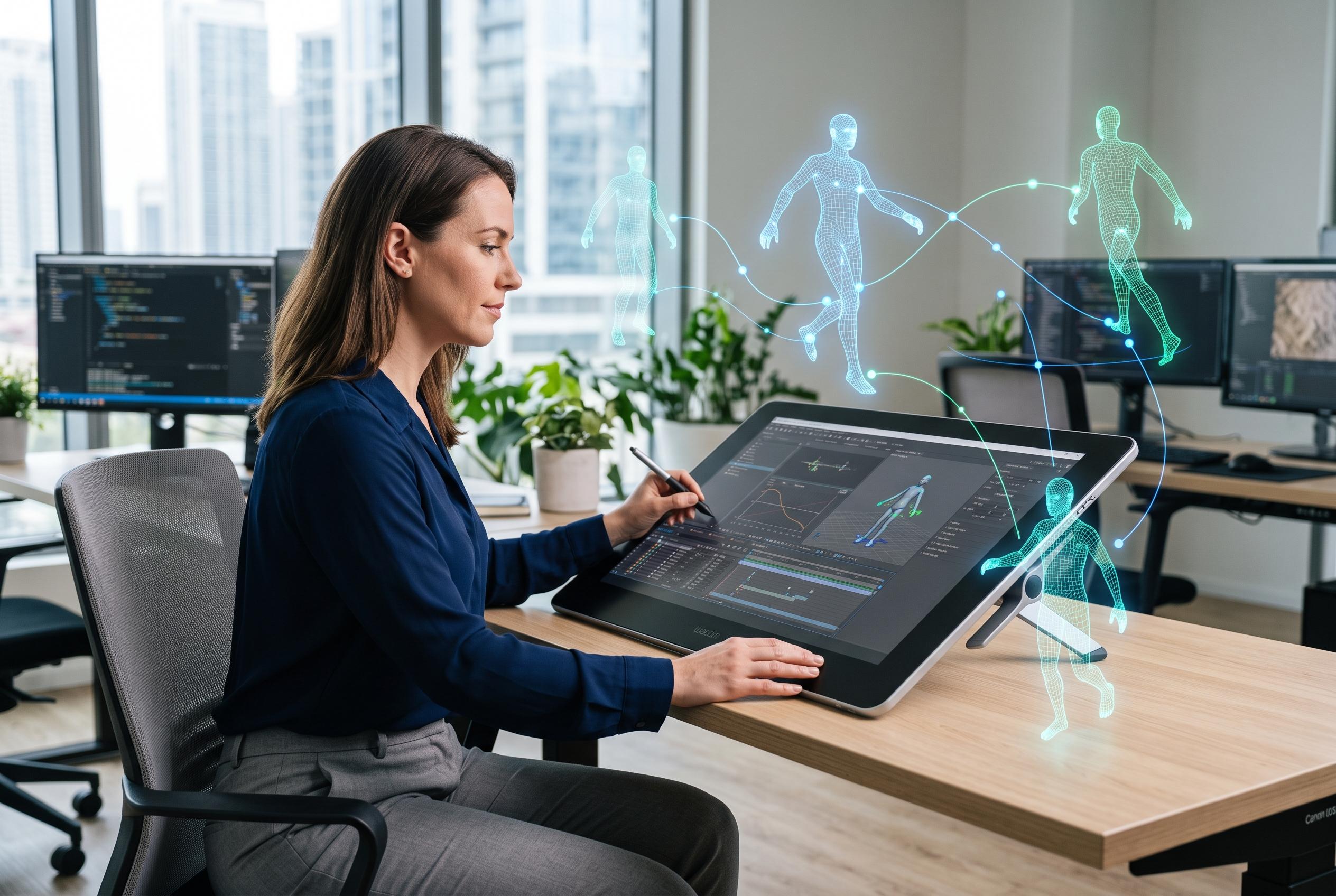

Advancements in AI tools are transforming the landscape of 3D character animation, with new solutions spanning from video capture to post-production refinement, disrupting traditional workflows.
Turning ordinary video into 3D character motion has become far more practical as AI tools have matured, but the category is still split between two distinct jobs. One is extracting movement from footage and turning it into usable motion data for a rigged character. The other is keeping that character coherent once it is inside a finished scene. Film Threat’s round-up makes that distinction clear, noting that the tools differ sharply in how they handle capture, cleanup and downstream production.
DeepMotion remains one of the most established options for the core motion-capture task. According to the company, Animate 3D converts 2D video into 3D animation for games, films and other creative work without suits or dedicated hardware. DeepMotion also says its system supports formats including FBX, BVH, GLB and MP4, and that it can track full-body movement, facial motion and hand gestures. Its API extends that workflow to developers, adding physics simulation, multi-person tracking and automatic retargeting to custom characters.
For creators who want the fastest possible route from existing online footage to a usable avatar animation, Vmotionize is designed around convenience. The platform accepts links from YouTube or TikTok, as well as local files, and converts them into motion for VTuber and VRM workflows. That makes it more of a creator tool than a production-house system, but it lowers the barrier to entry for people working with streaming avatars and lightweight character pipelines.
Other tools focus on collapsing more of the pipeline into one place. V2Fun combines character generation, automatic rigging and motion extraction in the browser, while 3D AI Studio starts from text or an image, builds a character and then adds markerless motion capture. Plask Motion is notable for handling up to five people in one clip, and Rokoko Vision offers a free cloud-based entry point for users who want to test video-driven motion before paying for more advanced capture.
Move.ai targets a higher-end production niche. Film Threat describes its multi-camera setup, using two to six tripod-mounted iPhones, as a way to produce skeletal motion data with a quality close to suit-based or optical systems, while the company’s Dex technology adds hand and finger tracking. RADiCAL, by contrast, leans into immediacy, streaming motion from a webcam straight into tools such as Blender, Unreal, Unity or Maya. Both are aimed at creators who want more control than a simple upload-and-wait workflow can provide.
Cascadeur stands apart from the rest because it does not extract motion from video at all. Instead, it uses AI-assisted physics posing to help animators build convincing movement from scratch, which can be useful when the action is too dangerous, expensive or impractical to film. At the other end of the workflow, invideo agent is framed as a finishing tool rather than a capture tool, keeping a video-derived character visually consistent across scenes and shots once the motion has already been created elsewhere. Together, those two tools show how the market now spans both creation and post-production, not just mocap extraction.
Disclaimer: This content is intended for informational purposes only. Readers are advised to exercise their own judgement, conduct due diligence, or consult a qualified expert before acting on any information provided.