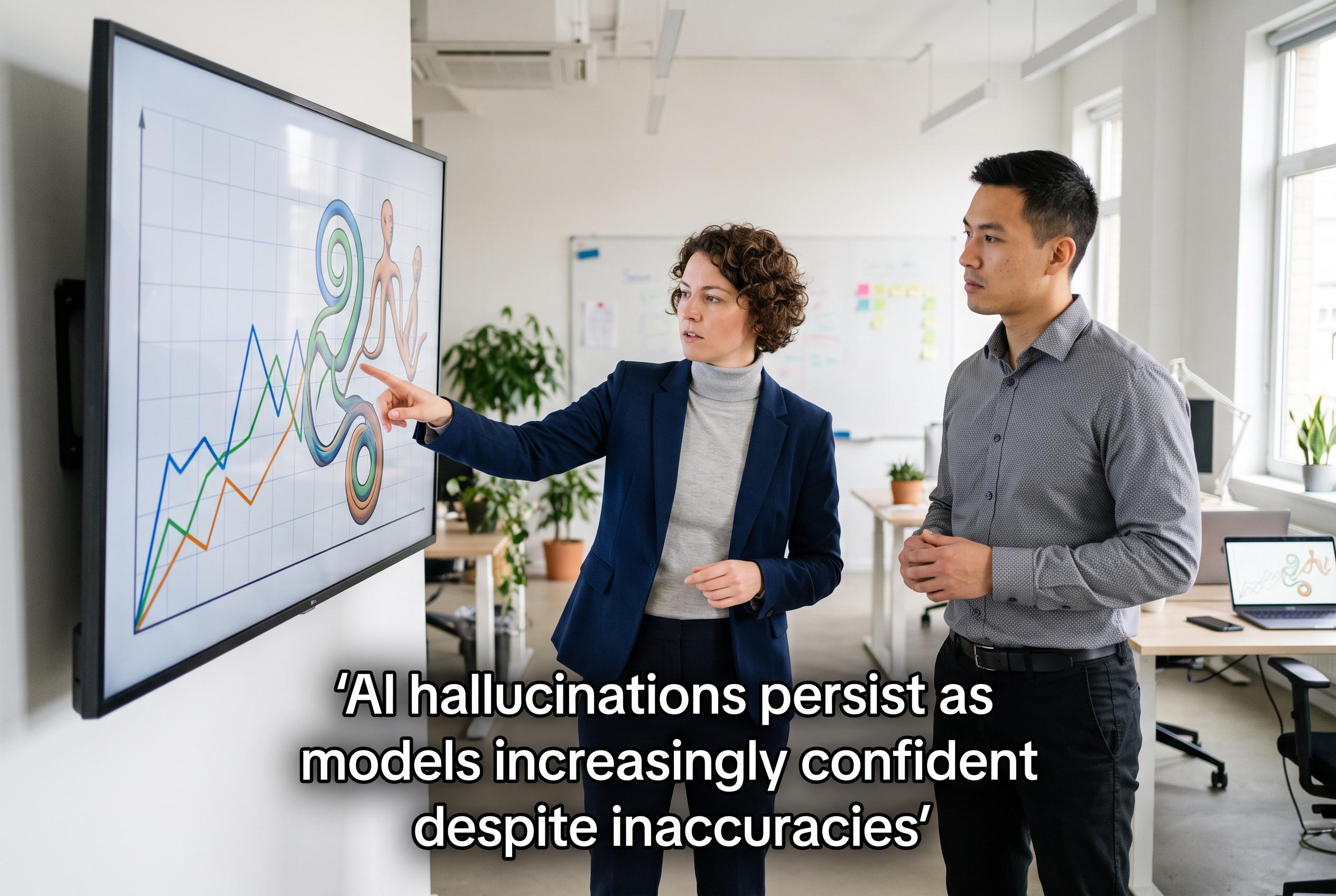

Despite rapid progress in AI capabilities, models continue to generate plausible yet false information. Researchers highlight inherent issues tied to training methods and model behaviour, emphasising the need for honesty about limitations, especially in sensitive fields.
Artificial intelligence systems have become remarkably capable at writing, coding, summarising research and answering routine questions in seconds. Yet a more troubling truth sits beneath that progress: the models can still produce answers that sound polished, certain and coherent while being wrong. The term most often used for this is hallucination, meaning the system generates information that is false, incomplete or invented.
The problem is not limited to bad data or isolated technical errors. OpenAI recently argued that hallucinations are tied to the way language models are trained and assessed, not just to imperfect engineering. The company said current evaluation methods can reward guessing instead of encouraging models to admit uncertainty, a point echoed in reporting by TechCrunch. That helps explain why even advanced systems can still produce confident but unsupported claims.
Research published in Nature adds another layer to the picture by proposing semantic entropy as a way to detect hallucinations. In simple terms, the method looks at how much a model’s answers vary in meaning, with greater variation suggesting weaker reliability. The study examined outputs from systems including ChatGPT and Gemini and found that false or unsubstantiated responses remain a persistent issue.
A separate survey and empirical analysis indexed by PubMed found that hallucinations can stem from both prompting choices and intrinsic model behaviour. That distinction matters because it suggests users cannot always solve the problem by writing better prompts alone. Even when retrieval-augmented generation pulls in external documents or database entries, the model still has to interpret them correctly, and it can still draw unsupported conclusions.
The practical risk is clearest in fields where errors carry consequences. Live Science reported that hallucinations can be especially dangerous in law, medicine and finance, where a convincing mistake may be harder to spot and far more costly to rely on. OpenAI’s research also suggests that the deeper issue may be mathematical rather than merely operational, with Computerworld describing hallucination as an unavoidable feature of how these systems generate text. The implication is sobering: future progress will depend not only on making models more capable, but also on making them more willing to say, accurately, that they do not know.
For now, the safest way to use AI is as an assistant, not as an authority. It can speed up research, support drafting and help organise information, but important facts still need independent verification. In practice, the best systems may be those that can both answer quickly and admit their limits.
Disclaimer: This content is intended for informational purposes only. Readers are advised to exercise their own judgement, conduct due diligence, or consult a qualified expert before acting on any information provided.