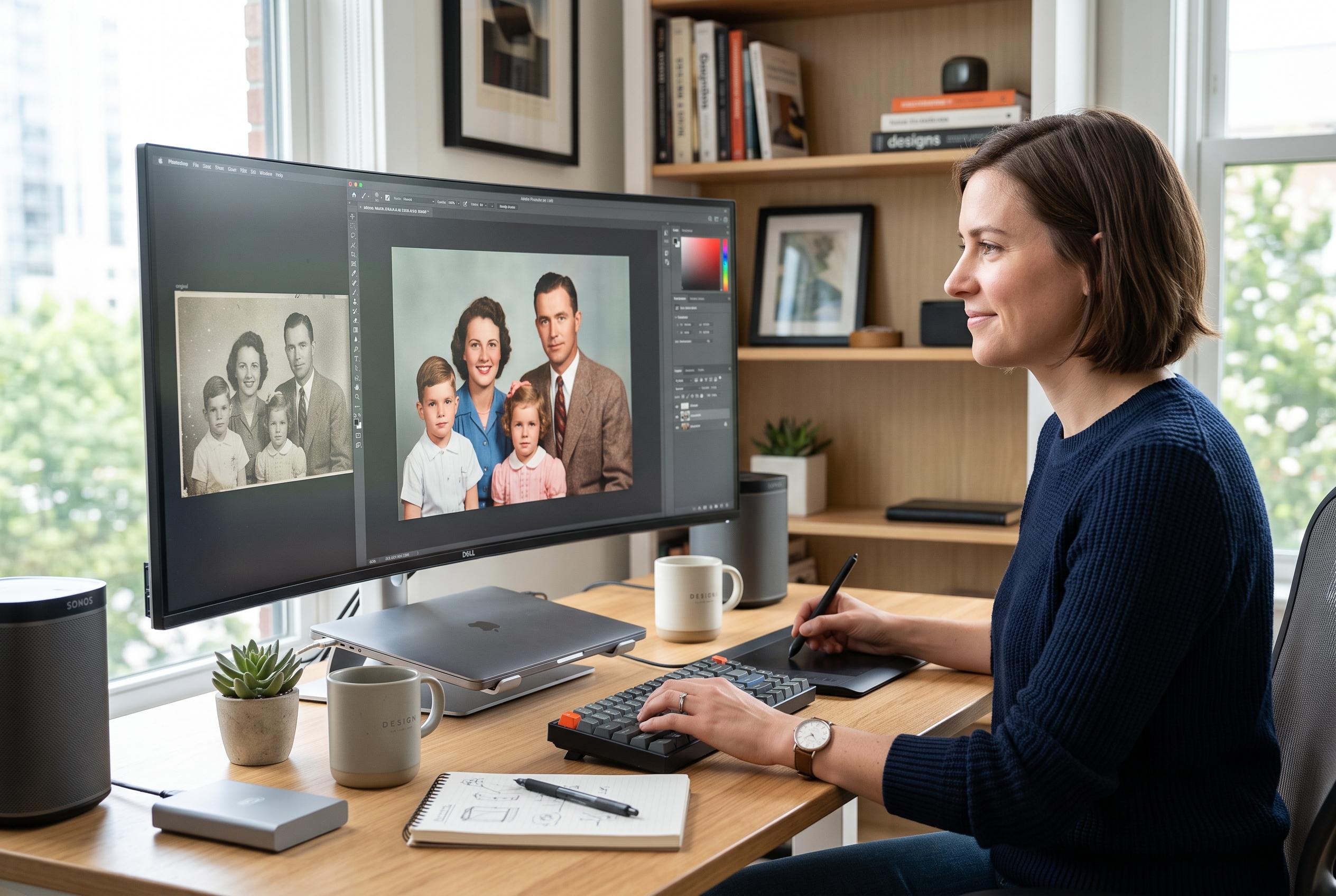

Advancements in AI are transforming photo and visual design workflows by automating restoration, upscaling, and cleanup tasks, shifting the focus back to artistic judgement while significantly reducing manual labour.
Artificial intelligence is reshaping image editing by shifting work that once took hours into a faster, more iterative process. In photography and visual design, that means underexposed frames, soft focus, noise and cluttered compositions can now be corrected with less manual effort, allowing creators to spend more time on selection, sequencing and visual judgement. According to the supplied material, the change is not about replacing craft but about reducing repetitive labour that used to sit at the centre of post-production.
One of the clearest gains is restoration. AI systems can analyse patterns in a damaged or low-quality image and reconstruct detail that would previously have required extensive retouching. That makes faded family photographs, low-light event shots and noisy files more usable, while also giving designers a way to revive older visual assets for new campaigns or presentations. In practical terms, the technology can improve colour, exposure and texture without forcing editors to rebuild every flaw by hand.
Upscaling is another major shift. Where older workflows often broke down when a small image needed to be used in a larger format, modern tools can generate additional visual information instead of merely stretching pixels. The result is a higher-resolution file that can work across websites, pitch decks and large-format layouts. The material also points to tools such as an 8k photo upscaler AI as examples of how teams can create a single stronger source file and adapt it across multiple outputs.
Cleanup tasks are also being compressed. Watermarks, logos and background distractions that once demanded careful cloning or masking can now be removed more quickly with AI-assisted object removal. The same principle extends to moving images, where tools designed to remove watermark from video can track unwanted marks across frames and rebuild the surrounding scene. That broader capability matters for creators who routinely handle both stills and short-form video.
Recent reporting suggests the shift is already embedded in day-to-day work. A 2025 survey cited by TechRadar found that 64% of clients did not notice a difference between AI-edited and manually edited images, while only 1% gave negative feedback. Digital Camera World also reported a study showing that 83% of photographers now use AI in some part of their workflow, most often for editing, culling and planning rather than full creative control. The pattern is consistent: AI is becoming a support layer for production, while artistic direction, branding and story remain human decisions.
Disclaimer: This content is intended for informational purposes only. Readers are advised to exercise their own judgement, conduct due diligence, or consult a qualified expert before acting on any information provided.