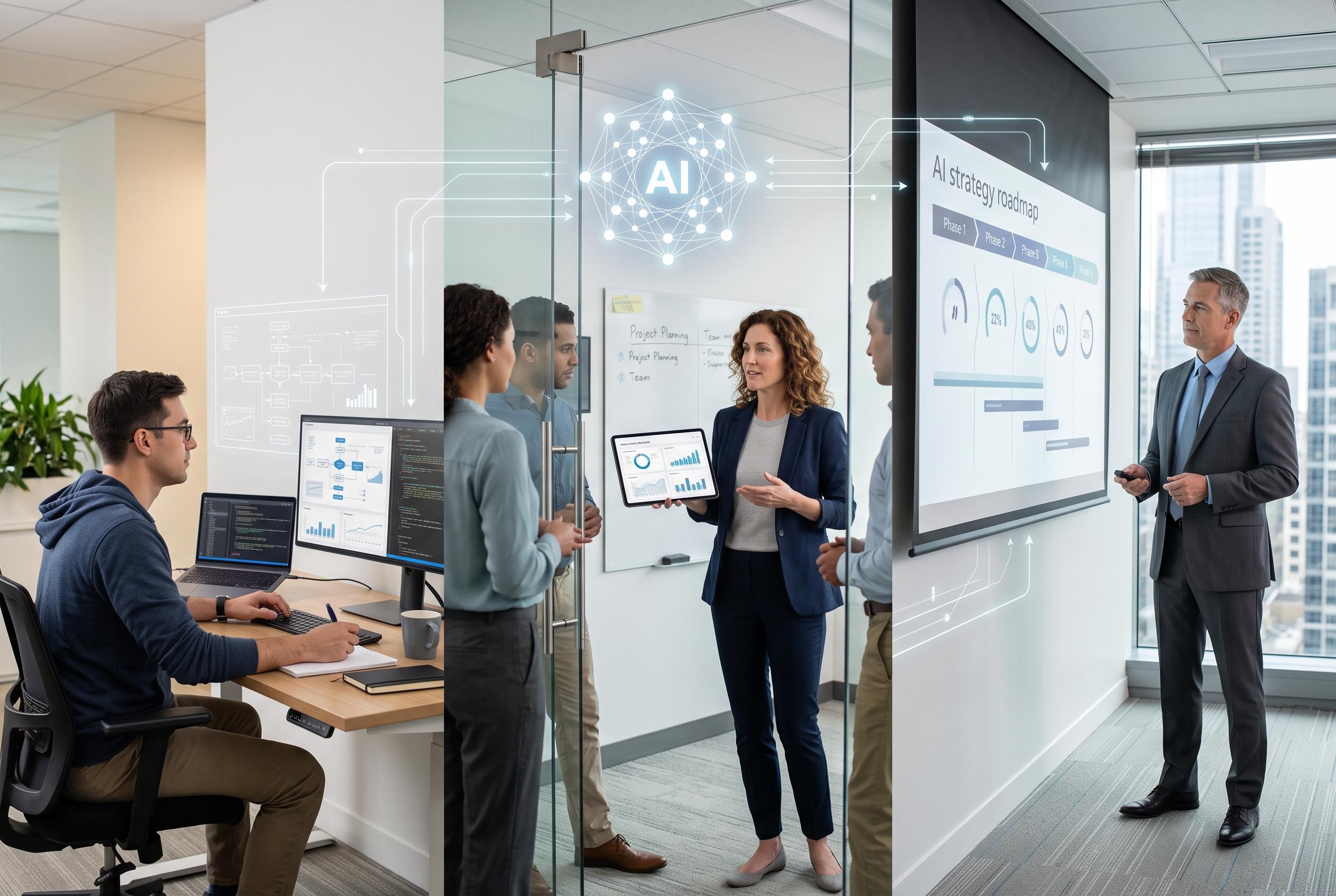

As AI training diversifies to meet the needs of technical, business, and executive professionals, the focus shifts from whether to learn AI to how deeply to integrate it into their roles, with programmes tailored for specific functions and expertise levels.
Artificial intelligence training now sits on a spectrum that reflects the different ways people use the technology at work. Some courses are aimed at software developers, data scientists and cloud engineers who want to build production-ready systems. Others are designed for managers and business specialists who need to apply AI in planning, analysis and workflow automation without writing code. A third group is pitched at executives who need enough technical fluency to make decisions, assess risk and work effectively with specialist teams.
Among the more technical options, Johns Hopkins University’s Certificate Programme in Agentic AI is positioned for developers, AI and machine learning practitioners, DevOps staff, solution architects and technology leaders. According to the programme details, it covers prompt engineering, retrieval-augmented generation, multi-agent systems, reinforcement learning and AI governance, with faculty-led masterclasses, weekly mentoring and practical enterprise projects. Intermediate Python is recommended, and the toolset includes LangChain, LangGraph, Azure OpenAI, Amazon Bedrock and OpenAI APIs.
MIT Professional Education’s Applied AI and Data Science Programme takes a broader, more applied route. The school says the 14-week online course is designed to prepare AI-driven decision-makers through prompt engineering, agentic AI, ethical AI, supervised and unsupervised learning, time-series analysis, neural networks, recommendation engines, regression and computer vision. It is delivered with Great Learning and can be taken on its own or as part of MIT’s wider professional certificate pathway in machine learning and artificial intelligence.
For professionals who want to use AI in business roles rather than engineering ones, MIT also offers a no-code and agentic AI course built for people without programming experience. The programme focuses on supervised and unsupervised learning, neural networks, recommendation engines, computer vision and agentic AI, while using no-code tools to build practical solutions. Separately, MIT’s Applied AI Bundle: Generative and Agentic AI is framed as an executive-level option that emphasises opportunity mapping, governance, compliance, organisational readiness and the integration of AI into digital systems.
The list also includes courses aimed at specific functions. Johns Hopkins’ AI and Agentic AI in Finance is intended for finance professionals working in analysis, risk, compliance, credit and portfolio monitoring. It covers forecasting, investment research, KYC and AML, credit underwriting and governance in regulated settings, using tools such as Claude, ChatGPT Codex, RAG and MCP. Great Learning’s AI-Native Professional course is aimed at HR, marketing, finance and operations teams that want to automate repetitive work and build no-code AI agents using tools including ChatGPT, Claude, Gemini, NotebookLM, Perplexity, Activepieces, Gamma, Google Workspace and Lovable.
Taken together, the courses show how AI training is becoming more role-specific. The main choice is no longer whether to learn AI, but how deeply to learn it. Technical professionals may need the skills to design and deploy systems. Business users may need enough knowledge to automate tasks and judge outputs. Executives may need frameworks for governance, value creation and organisational adoption. The best fit depends less on prestige than on the practical demands of the job.
Disclaimer: This content is intended for informational purposes only. Readers are advised to exercise their own judgement, conduct due diligence, or consult a qualified expert before acting on any information provided.