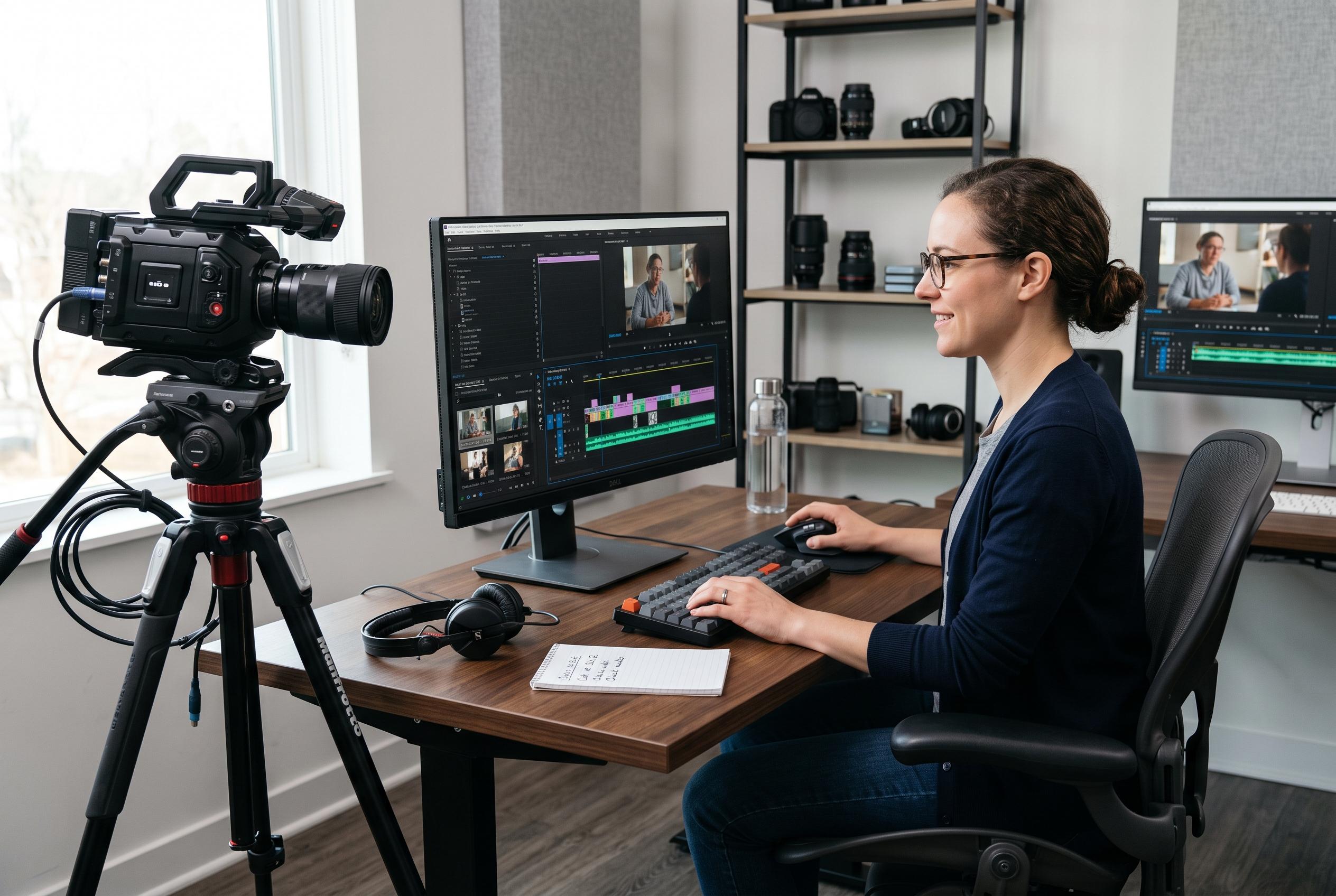

Artificial intelligence is reshaping video creation workflows by taking over routine tasks, enabling creators to focus more on storytelling and quality, with advancements spanning pre-production, live broadcasts, and post-editing.
AI is not replacing video creators so much as changing where their time goes. The most useful systems now sit behind the scenes, taking on transcription, captioning, rough assembly, footage sorting, audio cleanup and early-stage ideation, while humans still handle the decisions that shape meaning, tone and pacing. That division is already visible across the industry, from editorial workflows to live broadcast graphics and generative video tools. According to Wyzowl’s 2026 survey, use of AI in video marketing is rising quickly, with 63% of video marketers now using it for creation or editing, up from 51% a year earlier.
The clearest gains are in pre-production and routine administration. AI tools can draft outlines, suggest hooks, organise research, build shot lists and generate interview questions in seconds. They are also being used to manage the less glamorous parts of the production chain, such as syncing interviews, sorting raw footage and preparing first-pass captions. The point is not to replace planning, but to remove delay. As the original article notes, AI works best on tasks that are repetitive, data-heavy and easy to standardise.
That logic is now shaping more advanced production systems. Creative Bloq reported that Autodesk is pushing a hybrid model in Flow Studio, combining AI rendering with familiar 3D filmmaking controls so creators can block scenes, direct camera movement and reuse performances rather than relying only on prompts. In live production, TVTechnology reported that Vizrt’s Viz Arena 6 uses AI calibration and an intelligent keyer to speed up augmented reality sports graphics, with the company saying preparation can be up to 10 times faster. Both examples point to the same trend: AI is becoming a production aid that preserves directorial control rather than erasing it.
Generative video is moving in the same direction. Android Central reported that Google’s Veo 3 and Veo 3 Fast are now generally available on Vertex AI, with support for rapid generation, 1080p output, speech, background sound, lip-sync and language localisation. Google has also signalled an image-to-video feature that would turn still images into short clips. These systems are useful for testing concepts, product demos and training material, but they still require a human eye for brand fit, accuracy and final narrative shape.
Post-production is where many teams see the fastest return. AI editors are increasingly used for jump cuts, subtitle generation, noise removal, background removal and scene rearrangement, trimming hours from tasks that once took most of a day. Kapwing has also highlighted tools such as automatic silence removal, audio levelling and faster playback review, which help editors move through rough cuts more quickly. Yet the final edit still depends on judgement: when to hold a pause, how to build emotion and which moments deserve emphasis cannot be delegated to software alone.
For teams choosing tools, the practical rule is simple: start with the biggest bottleneck, then pick software that can be reviewed, edited and overridden. A small workflow built around transcription, rough cutting or clipping will usually be more valuable than a long list of overlapping apps. That is the central argument of the original article, and the broader industry evidence supports it. AI is making video production faster, but the strongest results still come when creators use it to clear the routine work and keep control of the story.
Disclaimer: This content is intended for informational purposes only. Readers are advised to exercise their own judgement, conduct due diligence, or consult a qualified expert before acting on any information provided.