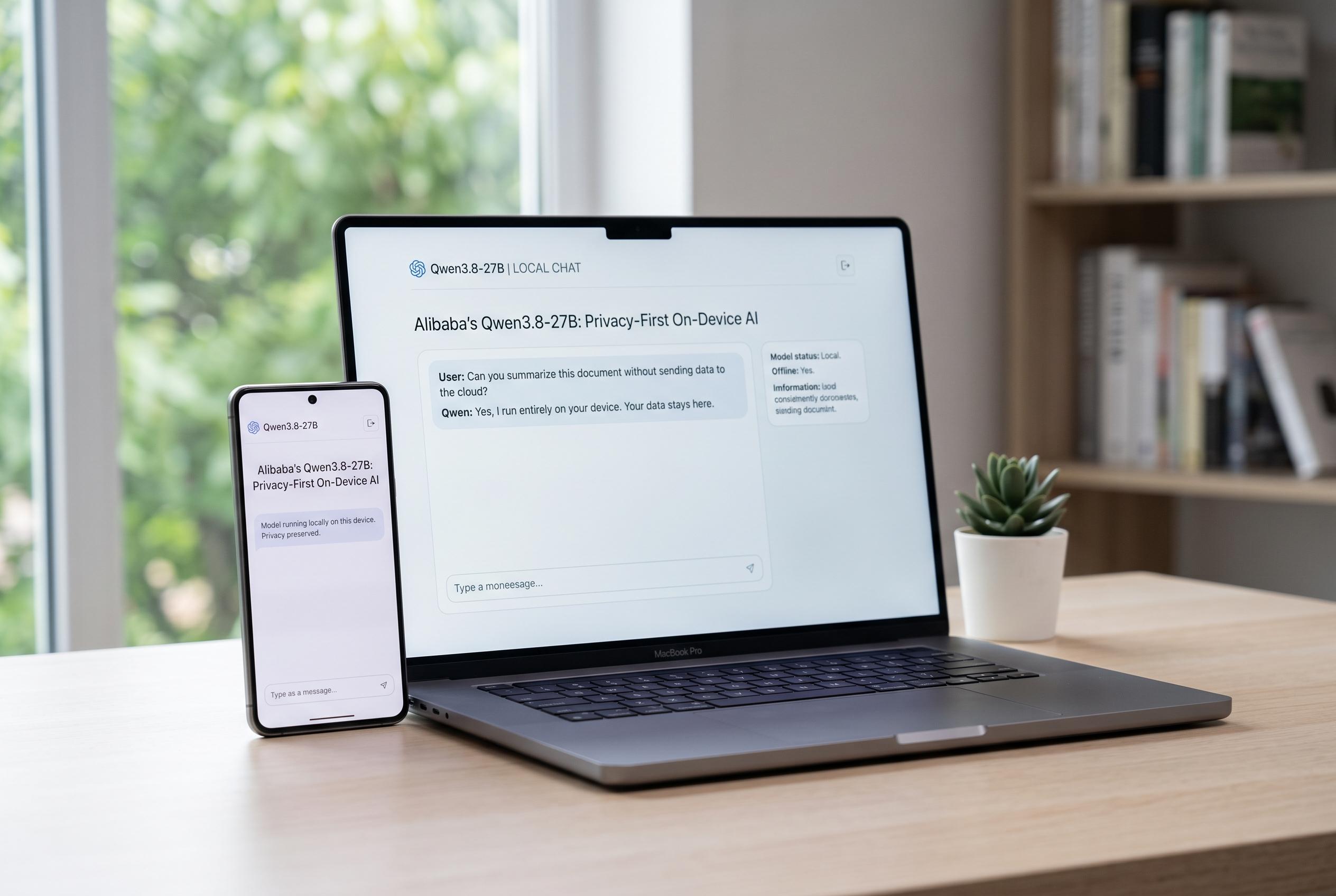

Alibaba has unveiled Qwen3.8-27B, a consumer-friendly AI model that supports local deployment, marking a shift towards more private and accessible AI systems for everyday devices.
Alibaba has expanded its Qwen family with a new model designed to run on consumer devices, including laptops, as the industry pushes further towards on-device artificial intelligence rather than relying entirely on remote data centres. The move reflects a broader effort to make AI faster, more private and more usable when internet access is limited. Reuters’ account of the launch said the new model is intended for everyday hardware, while Alibaba also made the weights for its larger Qwen3.8-Max model available to developers.
The model is called Qwen3.8-27B, according to the report cited by SANA, and Alibaba says it can handle coding, professional tasks, research and longer-running jobs. The company claims it can match the performance of a model roughly ten times its size in its own tests, although those results have not been independently verified in the material provided. The emphasis on a 27-billion-parameter model matters because it suggests a design compromise between capability and the memory and compute limits of consumer machines.
The launch also sits within a rapid sequence of Qwen releases. MarkTechPost reported in July that Alibaba previewed Qwen3.8-Max-Preview as a 2.4 trillion-parameter multimodal system at the World AI Conference in Shanghai. Later reports said Alibaba formally launched Qwen3.8 on 3 August, alongside QwenWork, its enterprise agent product. Taken together, the releases point to a strategy that combines very large cloud models with smaller systems that can be deployed more flexibly.
Alibaba’s decision to release model weights for Qwen3.8-Max is also significant for developers, because it allows local downloading and integration into third-party applications rather than limiting access to cloud APIs. Other reports say the larger model uses a mixture-of-experts design with 95 billion active parameters, which helps explain how such a large system can remain relatively efficient at inference. In practical terms, the shift strengthens self-hosting options and makes it easier for firms to keep more data processing under their own control.
Disclaimer: This content is intended for informational purposes only. Readers are advised to exercise their own judgement, conduct due diligence, or consult a qualified expert before acting on any information provided.