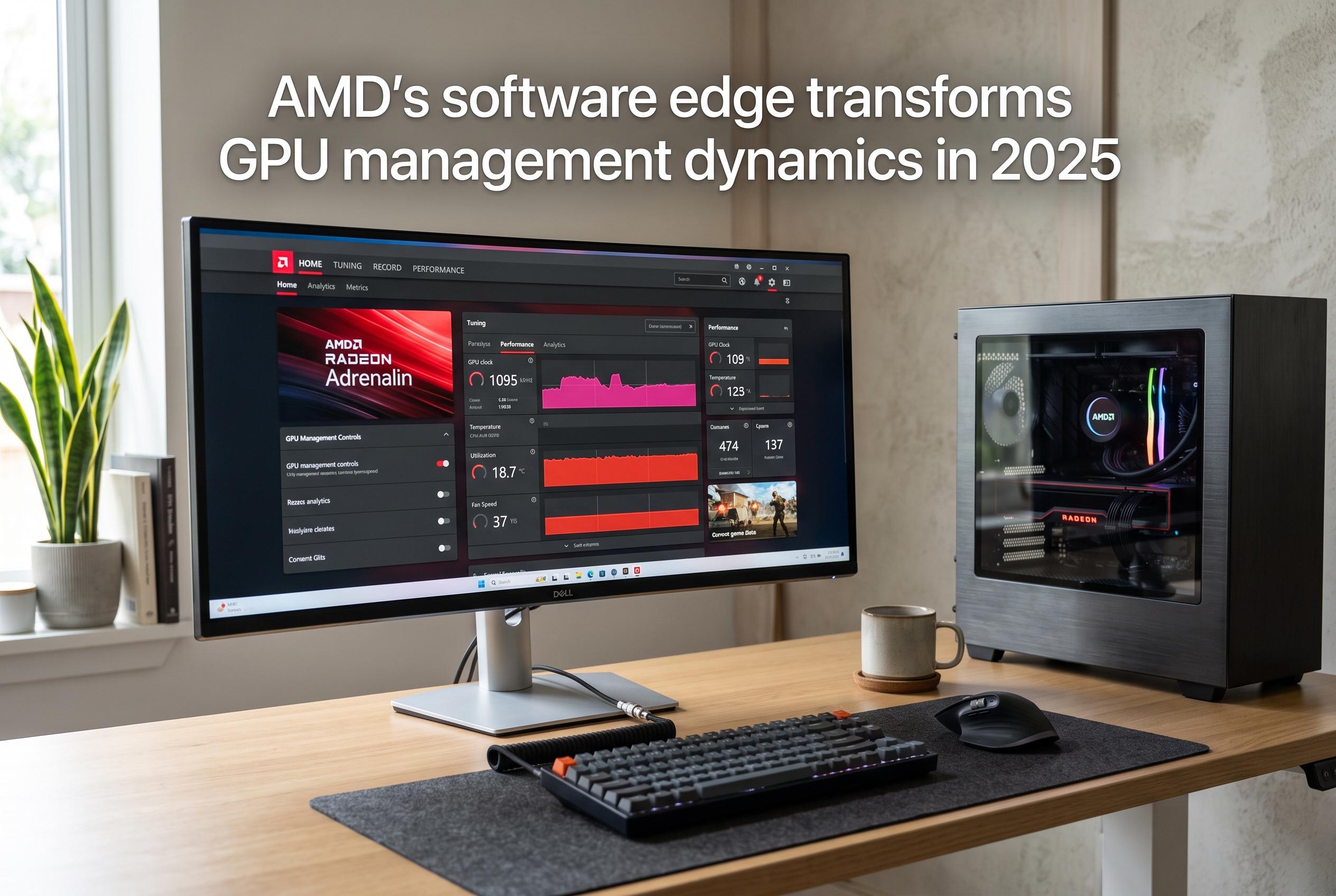

Transitioning from Nvidia to AMD in early 2025 reveals a significant shift: AMD’s integrated Adrenalin Edition software offers a more streamlined and user-friendly experience, positioning it as a game-changer in GPU management despite Nvidia’s technical advantages.
After nearly a decade on Nvidia graphics cards, one thing stood out to me far more than raw performance when I moved to an AMD Radeon RX 9070 XT in early 2025: the software. The card itself was strong in games, but AMD Software: Adrenalin Edition felt like a proper modern control centre, while Nvidia’s old software stack still looked and behaved like a patchwork of tools. How-To Geek reported that the shift was most noticeable in day-to-day use, not benchmark results.
For years, Nvidia users had to rely on the ageing Control Panel for core settings, with GeForce Experience and later the Nvidia app filling in some gaps. That changed only gradually. Tom’s Hardware reported that Nvidia retired the classic Control Panel in 2026 and began moving more functions into the Nvidia app, including advanced display and 3D options. Even so, AMD’s package has long offered a more integrated approach. The company says Adrenalin Edition includes performance tuning, clock control and fan-speed adjustment in one place, rather than forcing users to combine multiple utilities.
That difference matters most when tuning a GPU. AMD’s software lets users undervolt, overclock and create fan curves directly from the main interface, with per-game profiles that make it easier to tailor settings to individual titles. By contrast, Nvidia users have typically needed third-party tools for similar work. Technical guides and video walkthroughs focused on Adrenalin consistently show how the software places these controls within easy reach, which helps explain why many Radeon owners describe it as simpler to manage.
Even so, AMD still lags Nvidia in some graphics features. Multi-frame generation remains a Nvidia and Intel advantage, and Nvidia’s RTX HDR still has no direct AMD equivalent. But for users who value a clean interface, built-in tuning tools and a single application for most GPU tasks, AMD’s software stack now looks unusually complete. That is why, despite Nvidia’s stronger feature catalogue in some areas, the switch can still feel like a software upgrade first and a hardware swap second.
Disclaimer: This content is intended for informational purposes only. Readers are advised to exercise their own judgement, conduct due diligence, or consult a qualified expert before acting on any information provided.