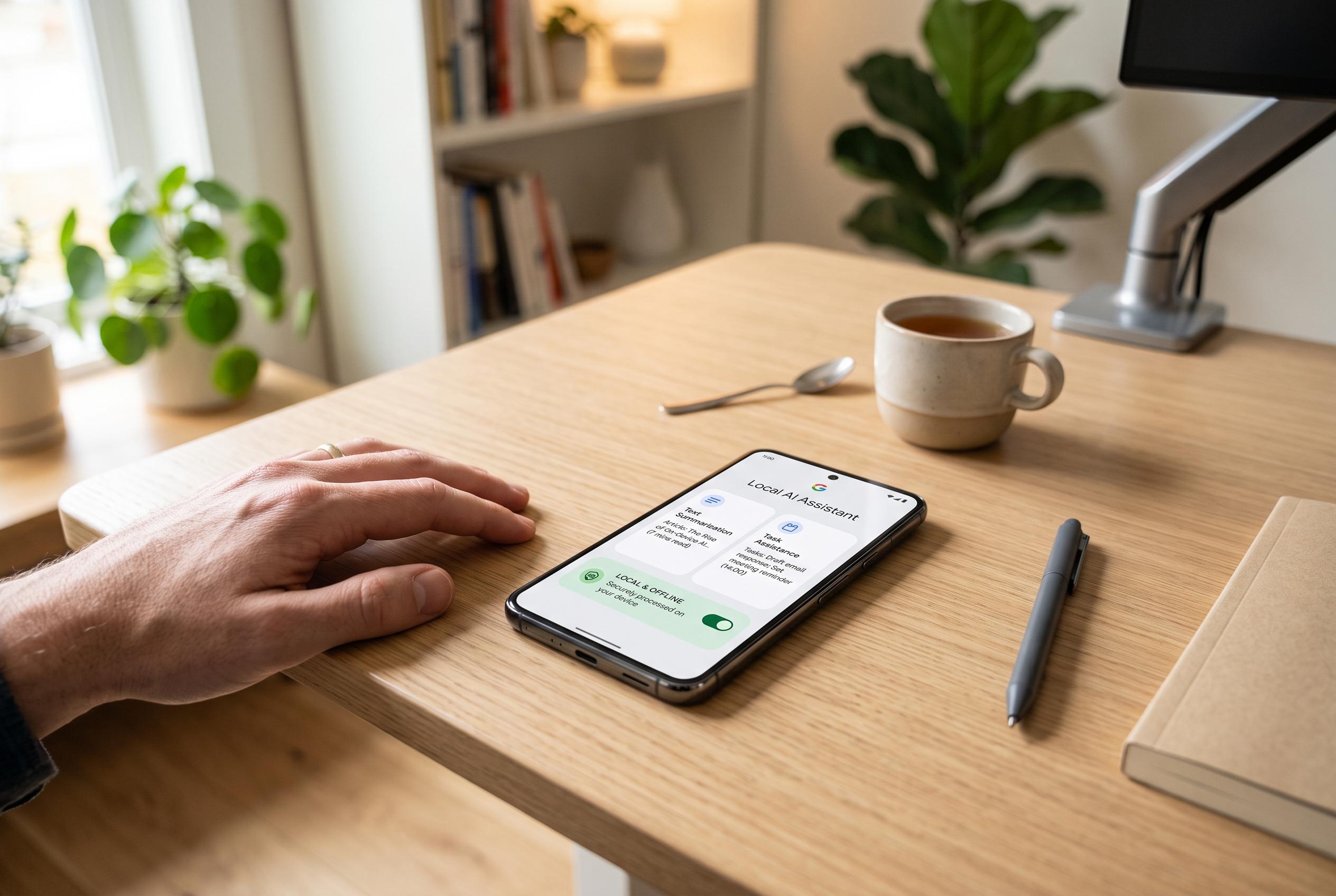

Experimentation with on-device AI models shows potential for privacy-focused, offline text summarisation and task assistance, though hardware limits still restrict accuracy and reliability.
Running a local large language model on an Android phone can remove the need for a cloud subscription in many everyday tasks, but it is not a full substitute for a remote AI service. The Android Police experiment used PocketPal, a Google Play app that can load open-source models from Hugging Face on-device, and found that setup took only a few minutes. Similar Android apps such as SLAC, Mobile LLM Server, LMSA and LM Playground are built around the same idea: keeping inference local so the model runs on the phone rather than on a vendor’s servers.
The appeal is straightforward. A local model can work without an internet connection, which makes it useful when travelling, on poor mobile signal or in situations where cloud access is inconvenient. It also keeps prompts and outputs on the device, which is a meaningful privacy advantage for users who do not want their data sent off-phone. In the Android Police test, the model was useful for tasks such as summarising text, structuring information into tables and turning long reviews into clearer buying guidance.
That said, the hardware and model constraints remain significant. Running capable models locally usually depends on modern Android phones with strong neural processing units, enough RAM and a compact, quantised model format such as GGUF. Industry guidance around Android local AI has increasingly pointed to flagship-class hardware, with 8GB of RAM or more often cited as the practical baseline for 7-billion-parameter models in 4-bit form. Qualcomm’s Snapdragon 8 Gen 2 generation and newer devices have become common targets for this kind of experimentation.
The weaknesses were just as visible. The Android Police tester found that the model often gave incorrect answers on historical or factual questions, including one about Indian Premier League winners, and it was not reliable enough to trust on topics where accuracy mattered. The model also tended to produce overlong responses, making it less disciplined than many cloud services. That limits its usefulness when a user needs a concise answer or wants to fact-check information quickly.
Even so, the experiment suggests that local AI may already be good enough for a narrower but still valuable category of work: drafting messages, summarising pasted text, reformatting notes and helping users think through decisions offline. For people who mainly use AI as a writing aid or productivity tool, a phone-based model may reduce the need to pay for a cloud subscription. For broader research, live information and higher accuracy, a cloud assistant still has the advantage.
Disclaimer: This content is intended for informational purposes only. Readers are advised to exercise their own judgement, conduct due diligence, or consult a qualified expert before acting on any information provided.