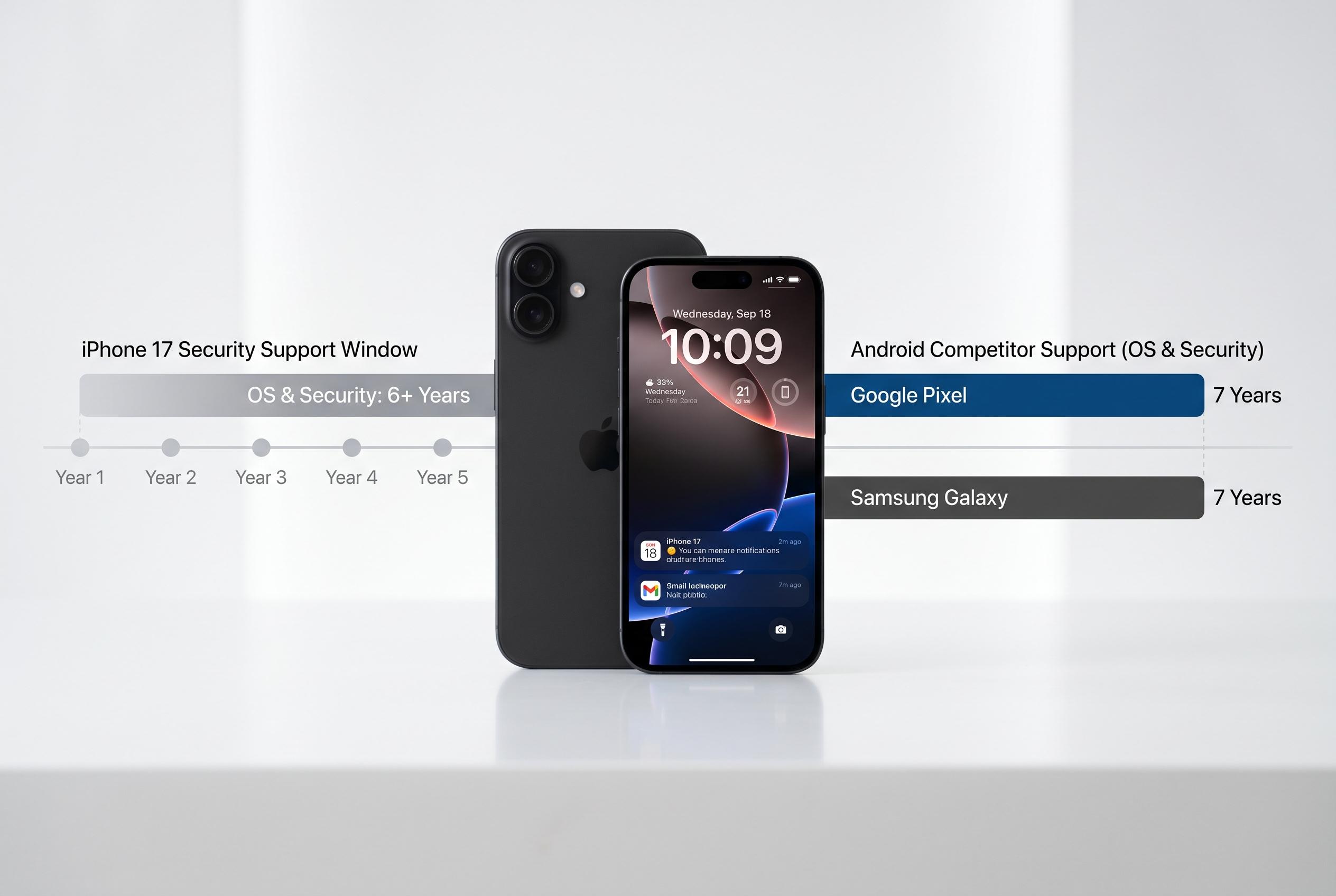

Apple’s documentation indicates at least five years of support for the iPhone 17, but rival Android manufacturers such as Google and Samsung are offering longer support windows, boosting device longevity for longer-term users.
Apple’s latest iPhone documentation for European Union markets indicates at least five years of software and security updates for the iPhone 17, but that figure sits below the practical support window many users have come to expect from recent handsets. In Apple’s case, longevity is usually inferred from past behaviour rather than advertised as a formal promise, and long-term iPhone owners generally assume roughly five to six years of usable support. That expectation is reinforced by the continued update path for older models such as the iPhone 11, which is still set to receive iOS 27.
The comparison with Google’s Pixel line is more direct. According to Android Central, the Pixel 10 is due seven years of software support, covering operating system upgrades, monthly security patches and Pixel-specific feature releases. Google’s support policy has become one of the strongest in the Android market, alongside rivals such as Samsung and Honor, and it is designed to make the handset more viable for buyers who keep phones for longer periods.
But long support alone does not guarantee an equally strong experience near the end of a device’s life. The BGR analysis notes that the base iPhone 17’s A19 chip scores well ahead of the Pixel 10’s Tensor G5 in Geekbench 6 tests, with the performance gap also visible when the Pixel is compared with the nearly five-year-old iPhone 13 Pro. That suggests an older iPhone may remain faster in everyday use than a same-generation Pixel after several years, even if both are still receiving software updates. The same article also notes that not every new feature will run on older hardware, which limits the practical value of long update commitments.
Google’s own support channels show how that longevity is meant to work in practice. Pixel devices receive staged software releases that can include new features, security fixes and operating system upgrades, and users can check for updates manually through the Settings menu if a rollout has not yet reached their device. Recent carrier notices have also shown Google continuing to issue bug-fix updates for the Pixel 10, underlining that support is not just about headline promises but about sustained maintenance over time. Even so, the strongest conclusion for most buyers may be a pragmatic one: according to BGR, a three- to four-year upgrade cycle may offer the best balance between performance, battery health and repair costs.
Disclaimer: This content is intended for informational purposes only. Readers are advised to exercise their own judgement, conduct due diligence, or consult a qualified expert before acting on any information provided.