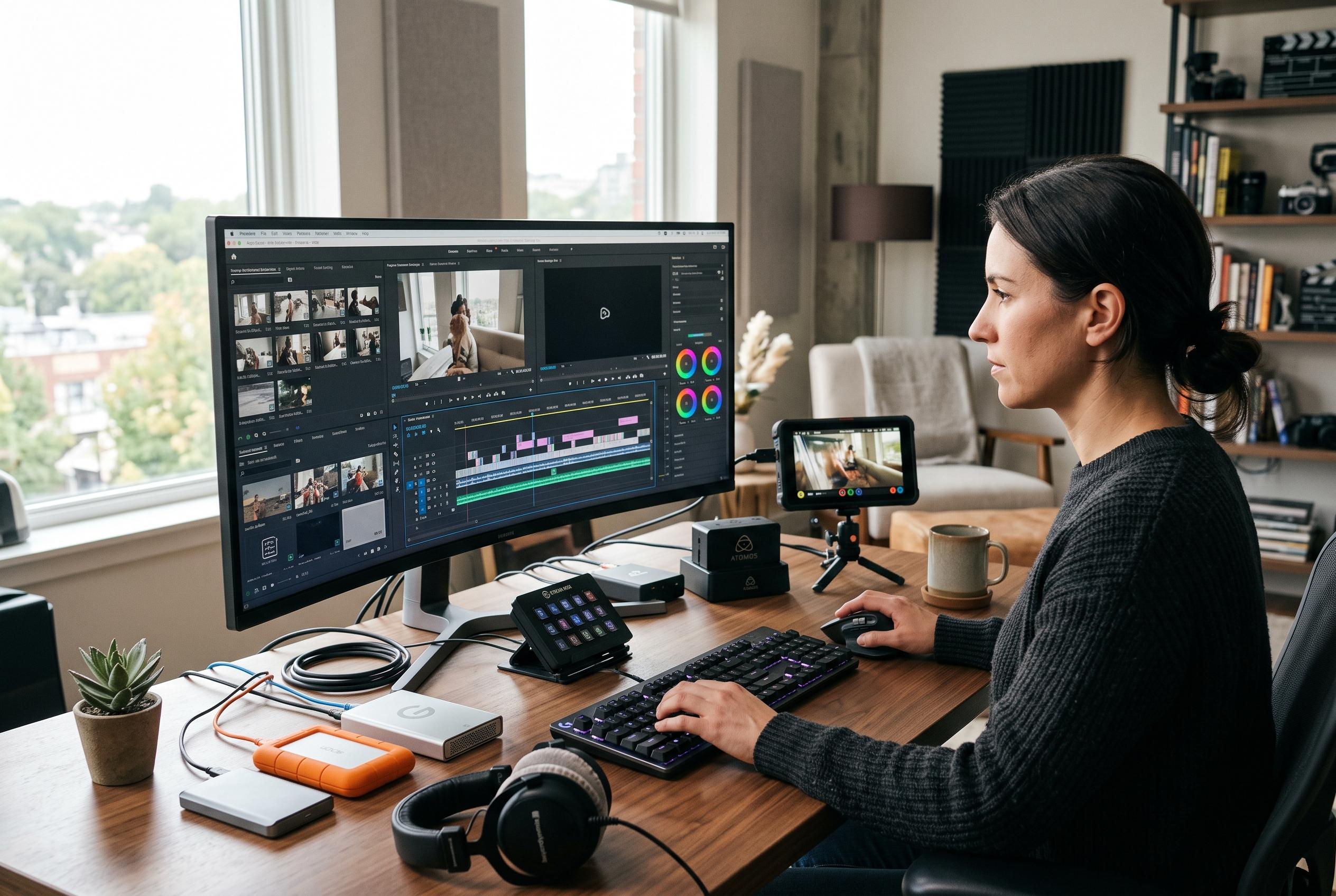

Atomos reveals Ground Control as a shipping desktop app, transforming cloud production into a local-like workspace and expanding its production ecosystem with new hardware and collaboration tools at NAB 2026.
Atomos has turned a NAB 2026 preview into a shipping desktop workflow product, moving Ground Control from the public beta timeline described in April coverage to a released application that is now being positioned as a direct bridge between ATOMOSphere and a Mac desktop. The shift matters because it changes the software from a promise about cloud production into something closer to day-to-day infrastructure: a mounted workspace that behaves like local storage rather than a browser tab, while Atomos also adds new collaboration features intended to keep review and file organisation inside the same system.
When the company first outlined the software at the NAB Show in Las Vegas on 19 April 2026, the emphasis was on two linked additions to ATOMOSphere: a browser-based editor for paid subscribers and Ground Control as the desktop companion. Small Caps, PRONEWS and MarketScreener all reported at the time that editors would be able to start cutting as soon as footage was uploaded, without waiting for full file downloads, while Ground Control would surface cloud projects as accessible drives for browsing, organising and previewing media through streaming and local caching rather than conventional transfer-and-store workflows.
That pairing is the more important technical point than the launch of any single feature. PRONEWS said the editor was designed for immediate work on cut-downs, dailies and review assemblies, with teams able to share updates in real time from any location with an internet connection. The same report said Ground Control removes the need to open a browser or manually fetch files before work begins. In practical terms, Atomos is trying to collapse three separate stages of a modern remote workflow, ingest, access and first-pass editing, into a single cloud-first environment, while newer collaboration tools such as shared bins and editable review destinations push that model further towards managed approval rather than simple file storage.
The software push also makes more sense when set against Atomos’s wider repositioning. RedShark described the NAB 2026 line-up as the company’s most ambitious to date, while Videoguys, republishing Church Production, said Atomos was moving beyond its historical identity as a monitor-recorder specialist towards a full production ecosystem provider. That interpretation is supported by the company’s purchase of Flanders Scientific, which Small Caps and MarketScreener both framed as a major expansion into professional reference monitoring. In RedShark’s report, chief executive Peter Barber summed up the ambition this way: “Now we have solutions all the way from five-inch on-camera monitors all the way up to 65-inch reference displays within the ecosystem.”
Hardware announced around the same time shows how Atomos wants that ecosystem to look. Small Caps said the Sumo PRO-19 is a 19-inch 4K HDR monitor-recorder-switcher aimed at directors, cinematographers, digital imaging technicians and video-assist crews, with support for ProRes, ProRes RAW, Avid DNx recording, RAW workflows up to 8K, plus Wi-Fi, Ethernet, AirGlu timecode, built-in NDI HX3 and direct upload to ATOMOSphere, Frame.io and Dropbox. ProVideo added that the Shogun AV-19 targets broadcast and live production, supporting four live streams, four ISO recordings and programme recording, while the A-Eye Controller Pro can manage up to 254 PTZ cameras across NDI, VISCA, VISCA IP and Pelco protocols. Videoguys said those PTZ tools are being aimed at houses of worship, education and live events as well as more traditional studio users.
There is, however, some disagreement in third-party reporting over pricing. Small Caps and the market announcement reproduced by MarketScreener both put the Sumo PRO-19 at $4,399 with shipping scheduled for early June 2026. RedShark, by contrast, listed the unit at $2,899 and said the Shogun AV would come in at $2,099. Those conflicting figures do not alter the broader direction of travel, but they do show how quickly Atomos’s NAB package was assembled and distributed across different outlets, with not every detail lining up cleanly between reports.
On the cloud side, the commercial model is more consistent. RedShark, PRONEWS and MarketScreener all said ATOMOSphere accounts begin with 20GB of free storage, with paid tiers unlocking more capacity and editing functions. PRONEWS and MarketScreener both added that annual plans of 1TB or more include a 15% discount in the Atomos online shop, an unusually direct attempt to tie recurring cloud revenue to the company’s hardware business. That is not just a storage upsell. It is an effort to keep users inside one commercial and technical stack, from camera-connected upload through review and rough edit to the purchase of recorders, monitors and accessories.
Taken together, the release of Ground Control and the earlier arrival of ATOMOSphere Editor suggest that Atomos is betting its next phase of growth on workflow control rather than on standalone devices alone. The combination of camera-to-cloud ingest, desktop-mounted cloud media, browser-based editing, PTZ control, live-production hardware and reference monitoring gives the company a more coherent proposition than a simple accessories refresh. If that proposition works, Atomos will no longer be judged only by the strength of its on-camera recorders, but by whether it can persuade production teams that cloud media should feel, and behave, like local media from first capture to final delivery.
Disclaimer: This content is intended for informational purposes only. Readers are advised to exercise their own judgement, conduct due diligence, or consult a qualified expert before acting on any information provided.