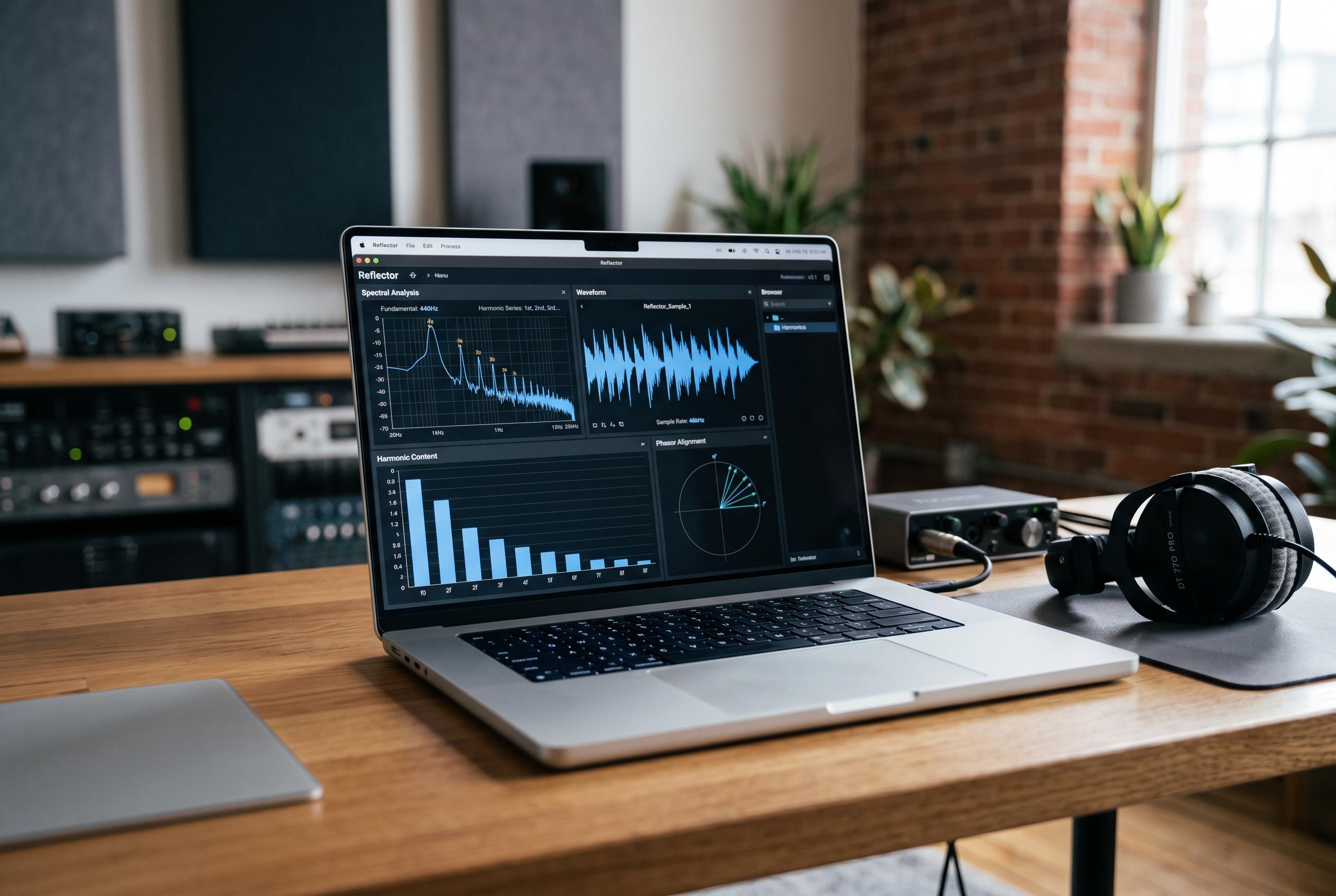

Austin Rockman releases Reflector, a novel open-source macOS tool that uses synthetic audio training to help musicians explore and match harmonic content within their sample collections, offering new creative possibilities without relying on copyrighted material.
Austin Rockman has released Reflector, an open-source macOS workstation designed to help musicians explore sample libraries through harmony rather than simple filenames or folders. The app indexes a user’s own collection and looks for material that both resembles a query and complements it musically, with two separate modes for similarity and compatibility. Rockman says the tool was trained entirely on synthetic audio and keeps everything local, with no copyrighted material used in the learning pipeline.
The project is aimed at tonal and textured sounds such as pads, keys, strings, synths, guitars, vocals and field recordings with a clear tonal centre. It does not analyse rhythm, but Rockman says that even loop-based material may still produce useful results when searched for harmonic relationships. Reflector also follows an arrangement as it grows, updating suggestions as new parts are added, and can transpose candidates that fit after pitch-shifting. Sessions can be built on a multi-track timeline with duplication, automatic crossfades and by-ear transposition, then exported as WAV files or stems for a DAW.
The software arrives alongside a growing class of tools focused on reshaping or discovering harmonic content inside sampled audio. Products such as Superchord, UVI Workstation, Color Play and Harmonic DNA Reconstruction CORE EQ show how developers are increasingly packaging resonance, spectral imprinting, browser-based library management and harmonic reconstruction into creative workflows. In that context, Reflector stands out less as a conventional sampler and more as an ideation tool, meant to surface combinations a composer might not otherwise consider.
Disclaimer: This content is intended for informational purposes only. Readers are advised to exercise their own judgement, conduct due diligence, or consult a qualified expert before acting on any information provided.