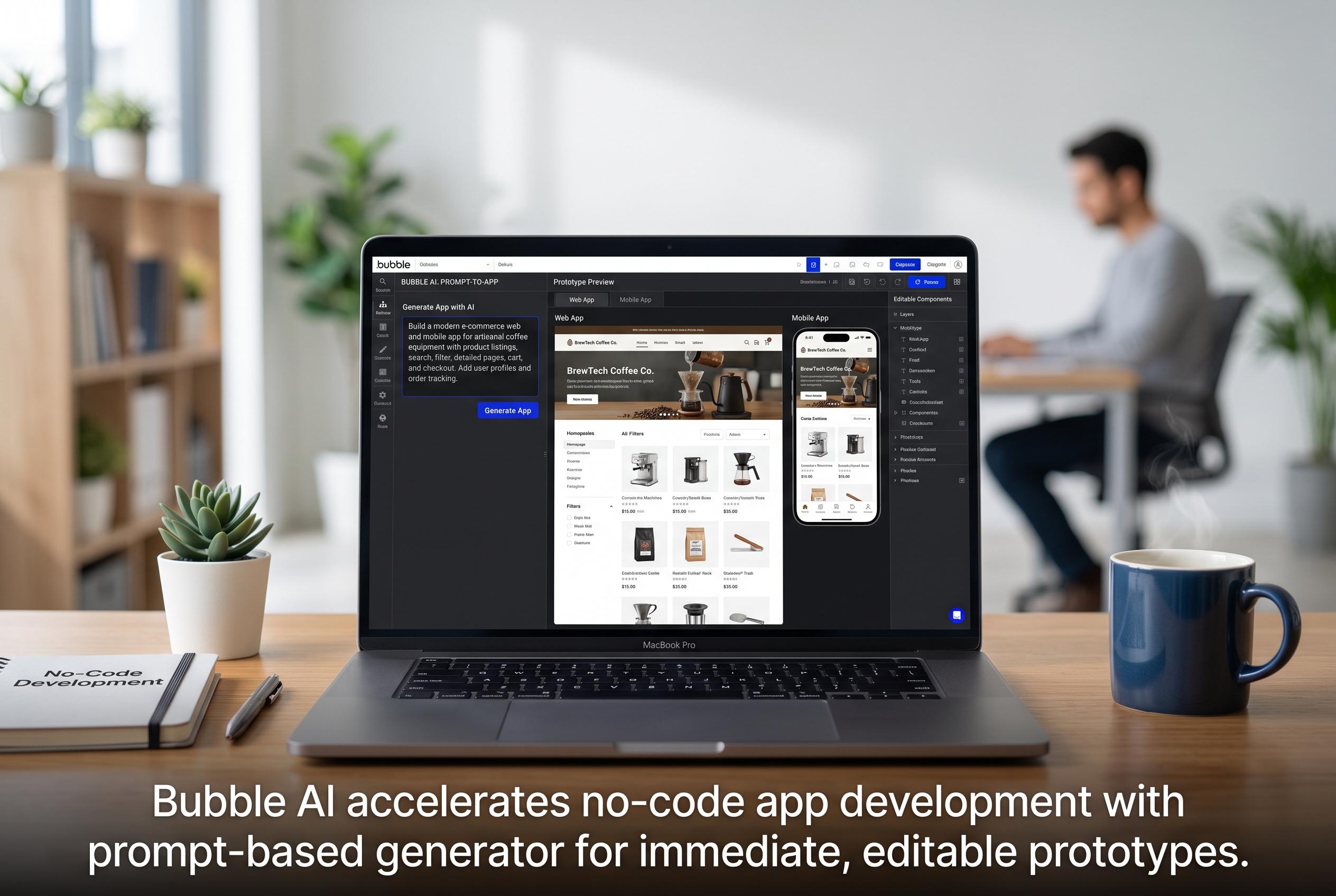

Bubble unveils a prompt-driven AI tool that swiftly creates functional web and mobile apps within its visual platform, offering a faster route from idea to prototype while maintaining full control for users.
Bubble AI is Bubble’s prompt-based app generator, designed to turn a plain-English description into a working application inside its visual editor. Rather than exporting code for a developer to tidy up, it creates something you can inspect, edit and extend directly. Bubble says the aim is to give users a fast first version without removing control from the build process.
The system generates the foundations of a web or mobile app in one pass, including pages, interface elements, workflows and a database. According to Bubble’s product materials, the output is intended to be immediately usable for exploration and testing, with sample records included so the app does not begin as an empty shell. The company also says the tool can create privacy rules alongside the data model, although those settings still need review before launch.
Bubble positions the AI generator as part of a broader no-code platform that has used visual programming since 2012. Its manual explains that Bubble lets users build full-stack web and mobile applications without writing code, using drag-and-drop editing for layout, data and logic. The AI feature is therefore less a separate product than an acceleration layer for the same visual environment.
A key distinction, Bubble argues, is that its AI does not leave users with a codebase to read or maintain. In Bubble’s comparison material, the platform contrasts this approach with tools such as Lovable, Bolt and Replit, which generate code that may still require debugging, prompting or developer intervention. Bubble says its model lets users move between AI-assisted generation and manual editing at any point, which is meant to reduce the gap between early prototyping and production work.
The platform’s native mobile capability is still described as beta. Bubble says the AI generator can create native iOS and Android interfaces, including mobile navigation patterns and app-store publishing support, while the AI Agent can now build and edit mobile workflows and data as well. That may appeal to teams looking to test mobile ideas quickly, but beta status suggests users should expect a degree of change and should validate behaviour carefully before release.
Bubble also frames the product as suitable for a range of use cases, from SaaS products and marketplaces to internal tools and dashboards. It can connect to external services such as Stripe for payments, and Bubble says the same backend can support both web and mobile versions of an app. The practical message is clear: Bubble AI is aimed at users who want an editable app structure quickly, not a black-box prototype that must later be rebuilt elsewhere.
Disclaimer: This content is intended for informational purposes only. Readers are advised to exercise their own judgement, conduct due diligence, or consult a qualified expert before acting on any information provided.