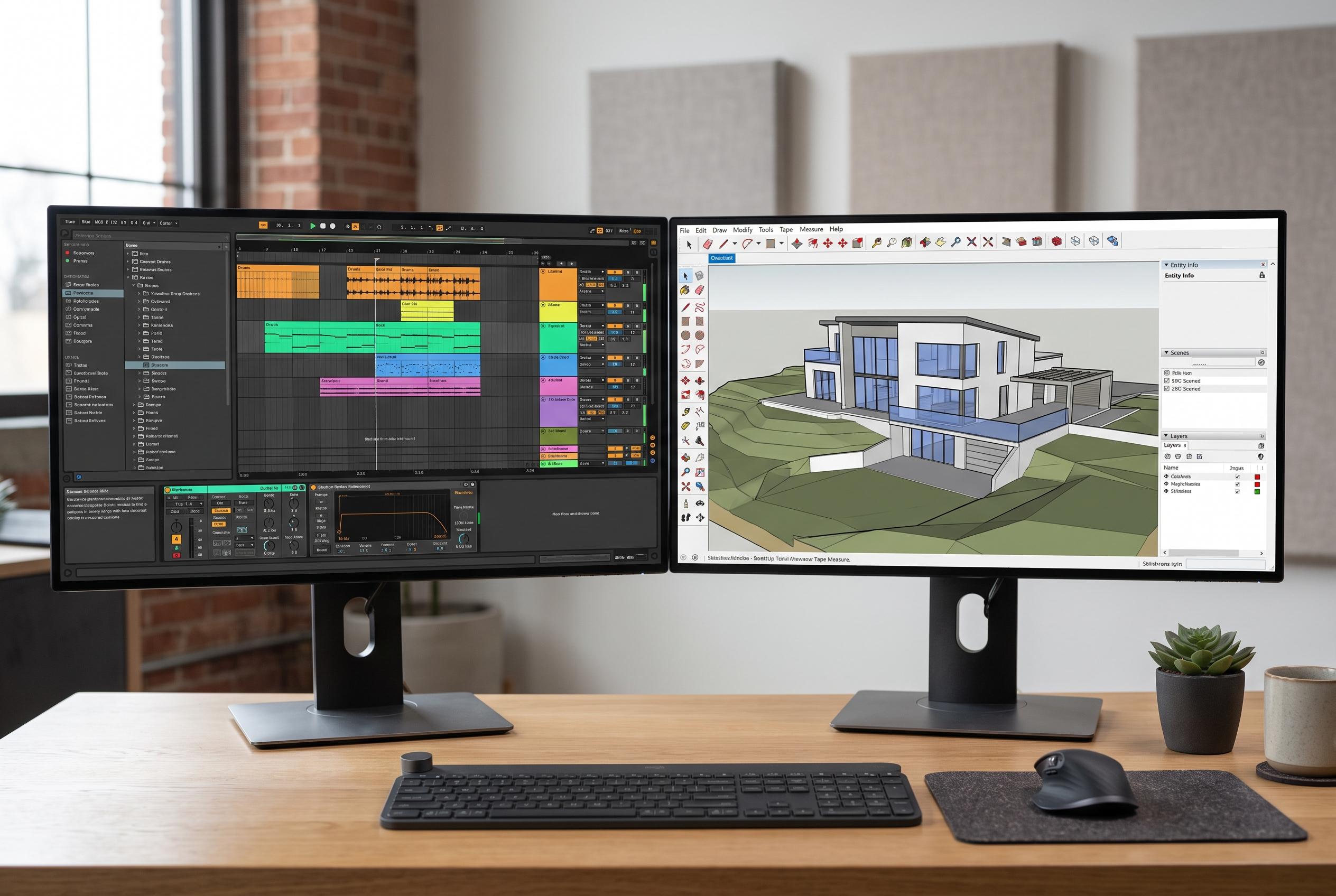

Ableton Live and SketchUp Pro exemplify how flexible, user-friendly tools facilitate rapid experimentation and collaboration across music and design, transforming ideas into tangible results with minimal friction.
Creative work depends on more than talent. It also depends on software that keeps ideas moving with as little friction as possible. In music production, Ableton Live is built to support recording, arranging, sound design, mixing and live experimentation in one environment. In 3D design, SketchUp Pro gives architects, interior designers, engineers and other specialists a way to build, compare and present spatial concepts efficiently. Both are aimed at shortening the distance between an initial idea and a workable result.
The attraction of Ableton Live lies in its flexibility. According to Ableton, users can begin with a melody, programme drums, record instruments, manipulate samples or develop an arrangement gradually. That matters because creative work rarely follows a neat sequence. A producer may want to test several directions before settling on a track structure, and Live is designed to accommodate that kind of iterative process.
Its dual workflow is central to that approach. Session View encourages experimentation with clips and combinations, while Arrangement View supports a more linear build towards a finished piece. For musicians who work across composition and performance, that means the software can serve as both a sketchbook and a production desk. The result is a system that can reduce technical interruption while still leaving room for revision and discovery.
SketchUp Pro plays a similar role in a different field. According to SketchUp’s product information, it is aimed at professional 3D modelling workflows and supports rapid concept generation, design comparison, visualisation, sharing and the import and export of 3D models and 2D documentation. For designers, that makes it useful not only for presentation, but also for testing ideas before physical work begins.
That pre-build stage can be important in architecture and interiors, where proportion, layout and sightlines often determine whether a concept works. A model can reveal issues that are harder to spot in a sketch or written brief. It can also make it easier to explain a proposal to clients or contractors, since a three-dimensional view is often clearer than a technical description alone.
Both programmes also highlight a broader truth about creative productivity: efficient tools should support iteration, not suppress it. Ableton Live allows musicians to shape material from different starting points. SketchUp Pro allows designers to develop a space from a rough concept into a detailed model. In both cases, the software helps turn abstract thinking into something visible, audible or otherwise testable.
That shared logic extends to collaboration. A well-managed Ableton project can act as a central workspace for recordings, edits and production decisions, while a SketchUp model can give multiple stakeholders a common reference point for discussion. In practical terms, that reduces misunderstanding and helps teams focus on the same version of the idea.
For users trying to work more efficiently, the lesson is straightforward. Start small, organise files carefully, keep versions, and learn through actual projects rather than trying to master every feature at once. The strongest creative systems are rarely the most complicated ones. They are the ones that let ideas develop without unnecessary delay.
Disclaimer: This content is intended for informational purposes only. Readers are advised to exercise their own judgement, conduct due diligence, or consult a qualified expert before acting on any information provided.