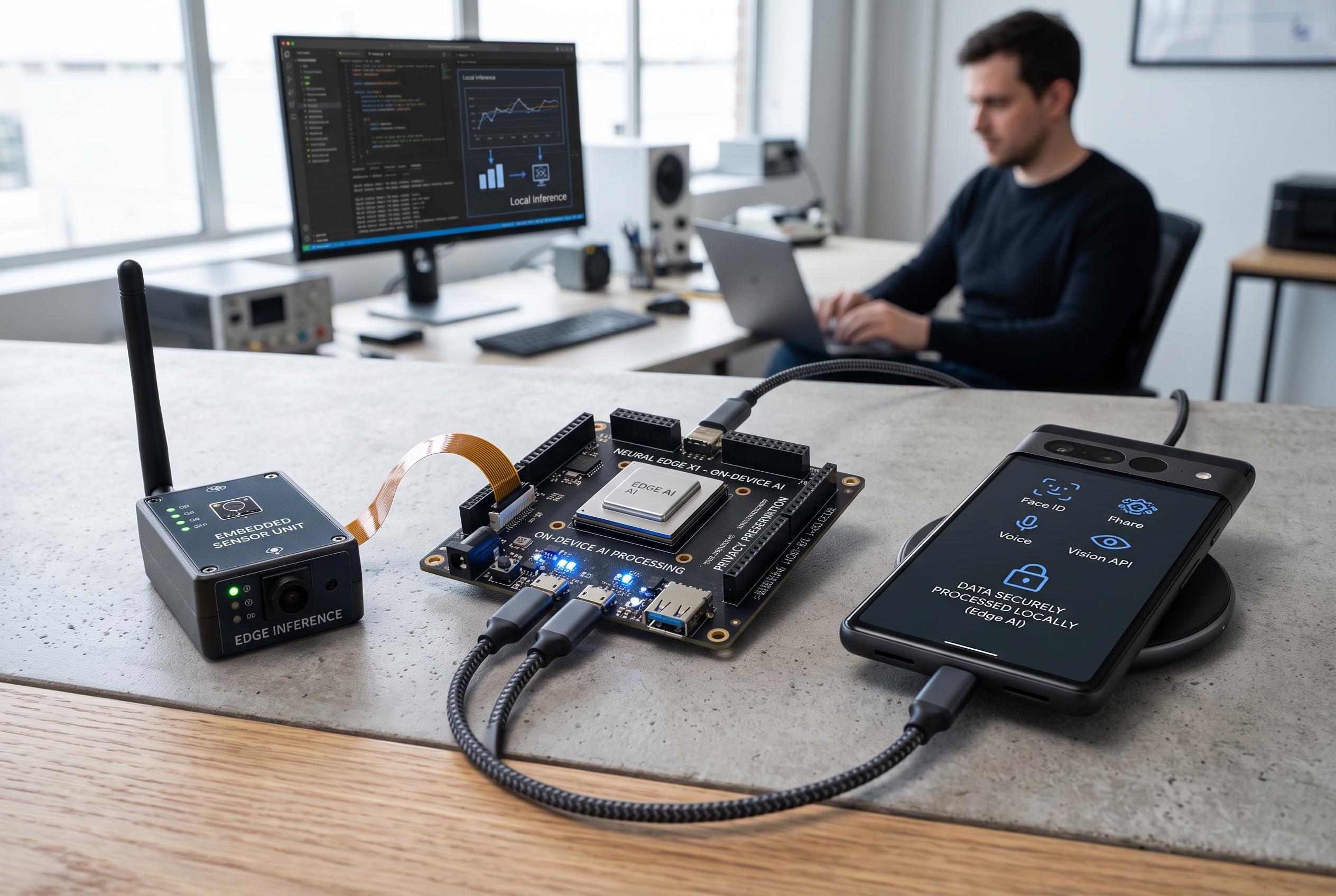

Advances in model compression and latency reduction are propelling a quiet revolution in AI, making powerful, privacy-preserving on-device models increasingly practical for mobile and embedded systems, signalling a major shift from cloud dependency.
The next major phase of AI is less likely to be defined by ever-larger cloud systems than by compact models that run directly on devices. In a Dev.to post, the author argues that the real shift is a quieter one: capable models small enough to work on a phone, even with no network connection. That view aligns with wider industry reporting that edge AI is moving from experiment to deployment because privacy, responsiveness and cost all improve when inference happens locally.
The technical case rests on model compression. Techniques such as quantisation, pruning and distillation can reduce the memory and compute demands of a model enough to make on-device use practical. Guides from hakia.com and tekpiq.com say these methods can cut model size dramatically while preserving acceptable accuracy for many everyday tasks, including message classification, note summarisation and document question-answering. For mobile and embedded systems, that shift matters because the smallest useful model is often more valuable than the largest possible one.
Latency is another decisive factor. Industry explainers from hakia.com and the Institute of Project Management say edge inference can complete in tens of milliseconds, while cloud round-trips typically take far longer and depend on network quality. Tekpiq notes that cloud calls also introduce per-request cost, whereas on-device inference removes that variable once the model is installed. For applications that must respond immediately, such as factory-floor systems, voice features and real-time mobile tools, that difference changes what can be built at all.
Privacy is the other major argument. When data remains on the device, it does not need to be sent to a remote server for processing. The Institute of Project Management describes this as privacy by design, and orbitive.tech makes the same point in the context of mobile systems that must be both responsive and privacy-preserving. That is particularly important for health data, private messages and internal documents, where sending content to the cloud may be unacceptable even if it is technically convenient.
The likely endpoint is not a single model replacing all others, but a hybrid system in which a small local model handles routine work and a larger cloud model is used only when the task requires it. DevelopersVoice describes this as a spectrum of cloud, edge and on-device computing, while StackOverflowTips says hybrid fallback is a practical way to cover difficult queries without abandoning the advantages of local inference. The broader market appears to be moving in that direction, with hakia.com projecting strong growth in edge AI as deployment matures and hardware improves.
Disclaimer: This content is intended for informational purposes only. Readers are advised to exercise their own judgement, conduct due diligence, or consult a qualified expert before acting on any information provided.