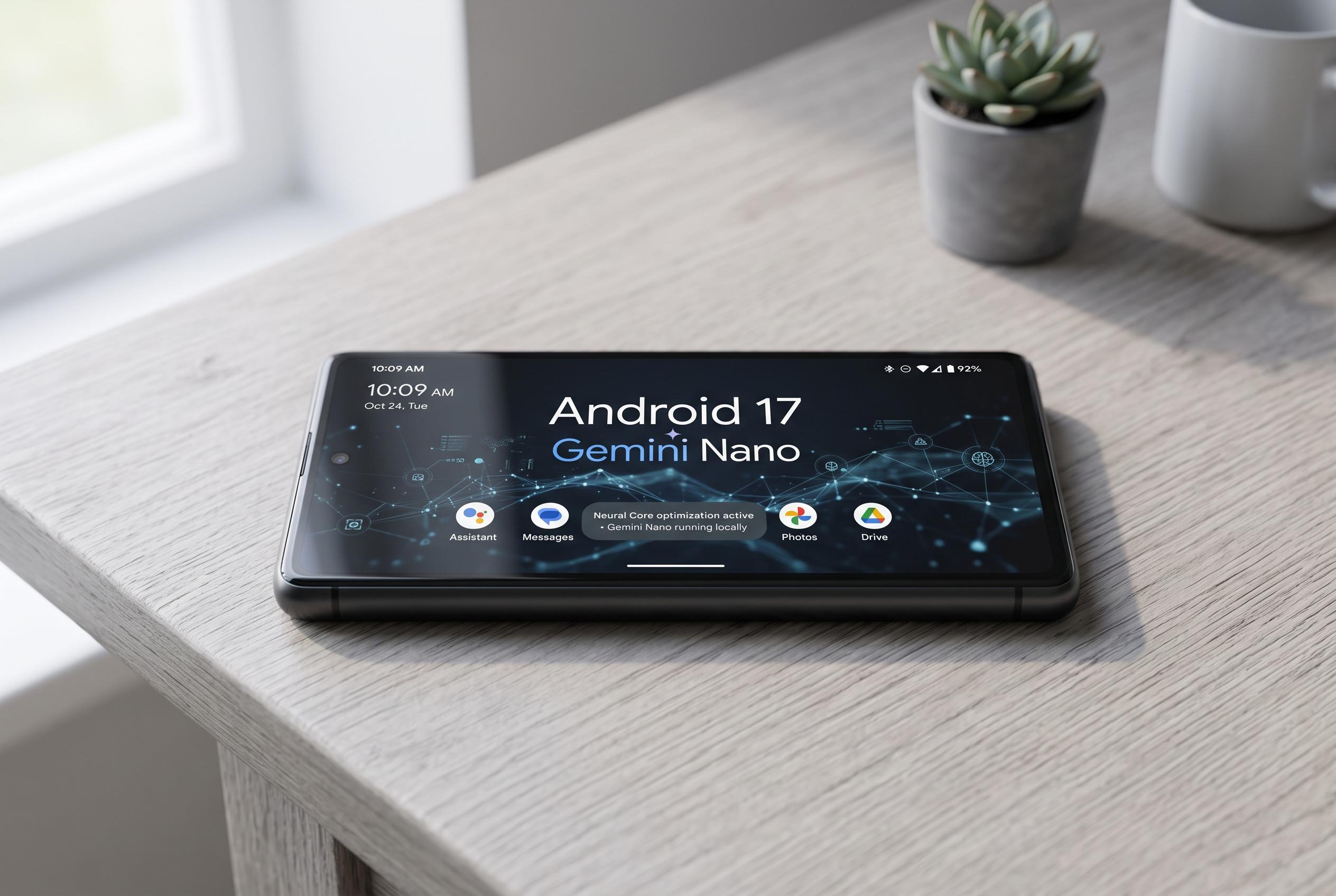

Google’s latest developments in on-device AI, including Android 17 and Gemini Nano, are set to transform Android apps by enabling smarter, privacy-focused, and more resilient functionalities in the next few years.
On-device artificial intelligence is becoming one of the most significant shifts in Android development, and 2026 may be the point at which it starts to feel unavoidable. Google’s latest work around Android 17, Gemini Nano and new AI tooling points to a platform that is moving beyond chat-style features and towards software that can respond more directly to user intent.
The core change is architectural. Traditional AI apps send data to remote servers, wait for a model to process it and then return a result. That approach can be powerful, but it depends on connectivity, adds latency and can increase operating costs. By contrast, local inference lets selected tasks run on the handset itself. Google is already enabling this through Gemini Nano and tools such as ML Kit’s Prompt API, which gives developers a way to build features that stay closer to the device.
The practical advantages are clear. Local processing can improve privacy because sensitive notes, messages, photos and documents do not always need to leave the phone. It also makes AI features more resilient in poor coverage, on flights or when mobile data is unreliable. For developers, it can reduce dependence on costly cloud requests, especially when an app reaches a large user base. Several 2026 app round-ups from Android-focused publications make the same point: the appeal is not just technical, but economic.
The most likely model is hybrid rather than fully local or fully cloud-based. Smaller, faster tasks such as note summaries, content classification, short rewrites or simple commands can happen on the device. Larger jobs, broader context or real-time information can still be sent to the cloud. That turns AI design into a routing problem, where developers decide which workload belongs where instead of asking only which model to use.
Google’s broader Android direction reinforces that shift. Reporting in February and May showed Gemini features moving towards multi-step task automation and more agentic behaviour across apps, while Google AI Studio was described as being able to generate native Kotlin Android apps from prompts. At the same time, Android is being shaped for a wider range of devices, from foldables and tablets to wearables and laptop-style hardware. That makes adaptive design and AI design increasingly connected.
The strongest apps are unlikely to advertise themselves as AI products at all. A travel app that surfaces the right itinerary detail at the right time, a photo app with better semantic search or a finance app that sorts transactions automatically may all feel more useful precisely because the intelligence is invisible. That is the direction many developers are now preparing for: software that behaves intelligently, respects privacy and works across device types without forcing users into a separate chatbot interface.
Disclaimer: This content is intended for informational purposes only. Readers are advised to exercise their own judgement, conduct due diligence, or consult a qualified expert before acting on any information provided.