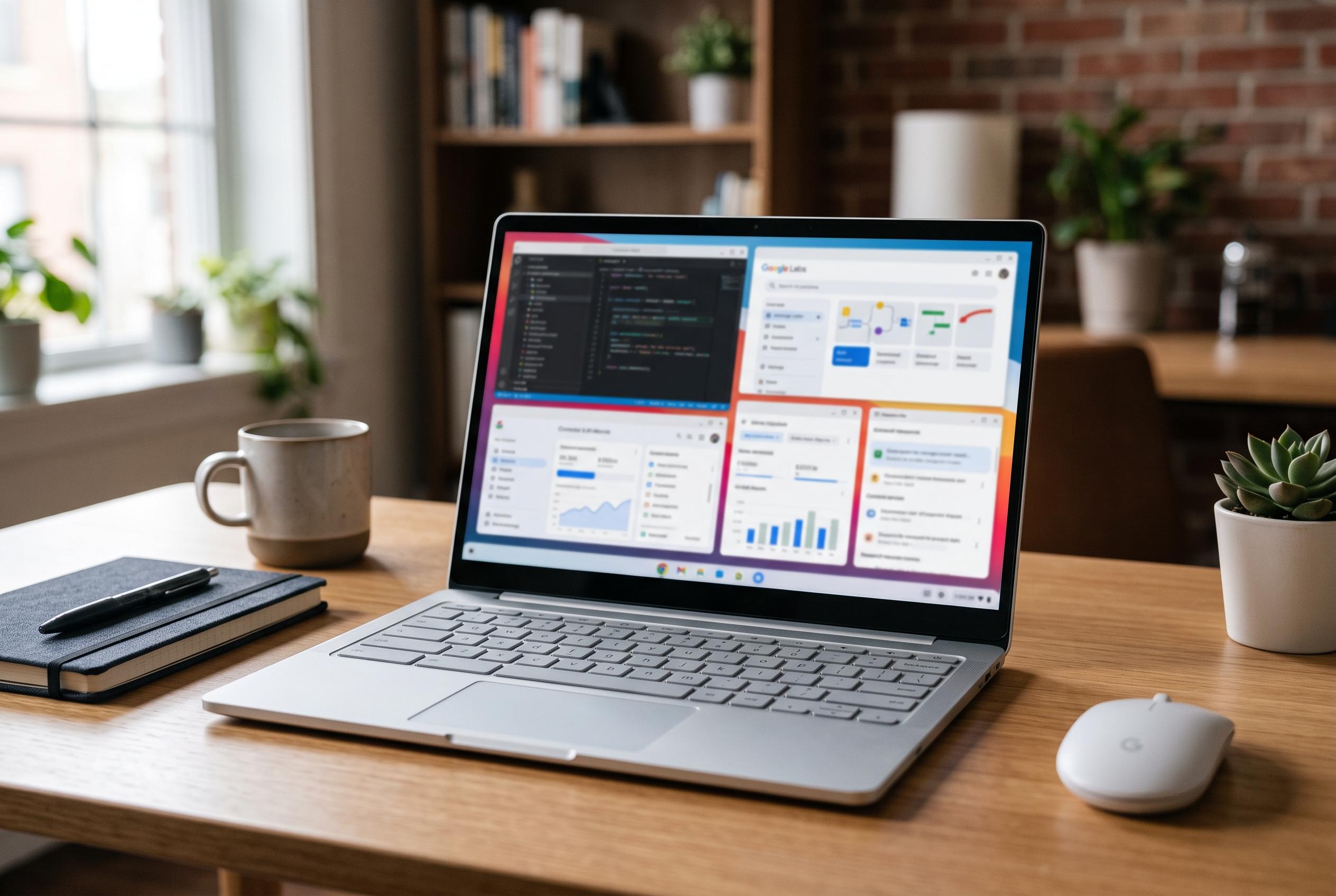

Google’s Labs page is evolving from a showcase of experiments to a hub for practical AI tools spanning creation, learning, and development, signalling a shift towards more usable innovations.
Google’s Labs page has become a useful showcase for the company’s more experimental AI work, rather than a graveyard for half-finished ideas. The hub, according to Google, is intended to let people try new tools early, send feedback to the teams building them and see where the company’s products may be heading next.
What stands out is that several of the current experiments look less like curiosities and more like practical tools. Google Labs now groups its projects into categories such as Create, Develop, Explore, Learn and Play, reflecting how broad the company’s testing ground has become. The range includes creative, educational and developer-focused experiments, showing that Labs is not aimed at one narrow audience.
One of the most striking examples is Gemini Notebook, which has roots in NotebookLM, first launched in 2023 as part of Google’s Project Tailwind. Google renamed it Gemini Notebook in July 2026 and linked it more closely with the wider Gemini ecosystem. The result is a research tool that can work from a user’s own sources, with notebooks able to sync between Gemini and Gemini Notebook so that chats and research material can move more easily between the two.
For users who want to build rather than simply query, Opal is a more accessible route into app creation. Google says the tool can turn a plain-language description into a workflow, while an agent layer can choose tools and models, ask follow-up questions and retain useful details across sessions. That makes it easier to move from an idea to something usable without first learning to code.
Stitch takes a similar approach for design. It allows users to describe an app in natural language, start from an image or sketch, then generate high-fidelity interfaces that can be refined into interactive prototypes. In practical terms, that lowers the barrier to testing layout and flow before any development work begins.
Mixboard pushes the same logic into visual brainstorming. Rather than forcing ideas into a rigid format, it gives users a canvas for images, text and AI-generated variations, with natural-language editing built in. For people who think better in pictures than in prose, that flexibility may be the point.
The learning tools are more ambitious than the label suggests. Learn Your Way can turn textbook content into interactive lessons, quizzes, narrated slides, audio lessons and mind maps, while adapting material to a learner’s level and interests. Illuminate takes a different path by converting research papers into short audio conversations between two AI-generated voices, which may be a quicker way to absorb dense material.
Taken together, the experiments suggest that Google Labs is no longer just a preview window for unfinished products. It is increasingly a place where Google tests how people might create, learn and build with AI before those ideas either disappear or graduate into something larger. For now, that makes the page worth watching, not for novelty alone, but for clues about the company’s next usable tools.
Disclaimer: This content is intended for informational purposes only. Readers are advised to exercise their own judgement, conduct due diligence, or consult a qualified expert before acting on any information provided.