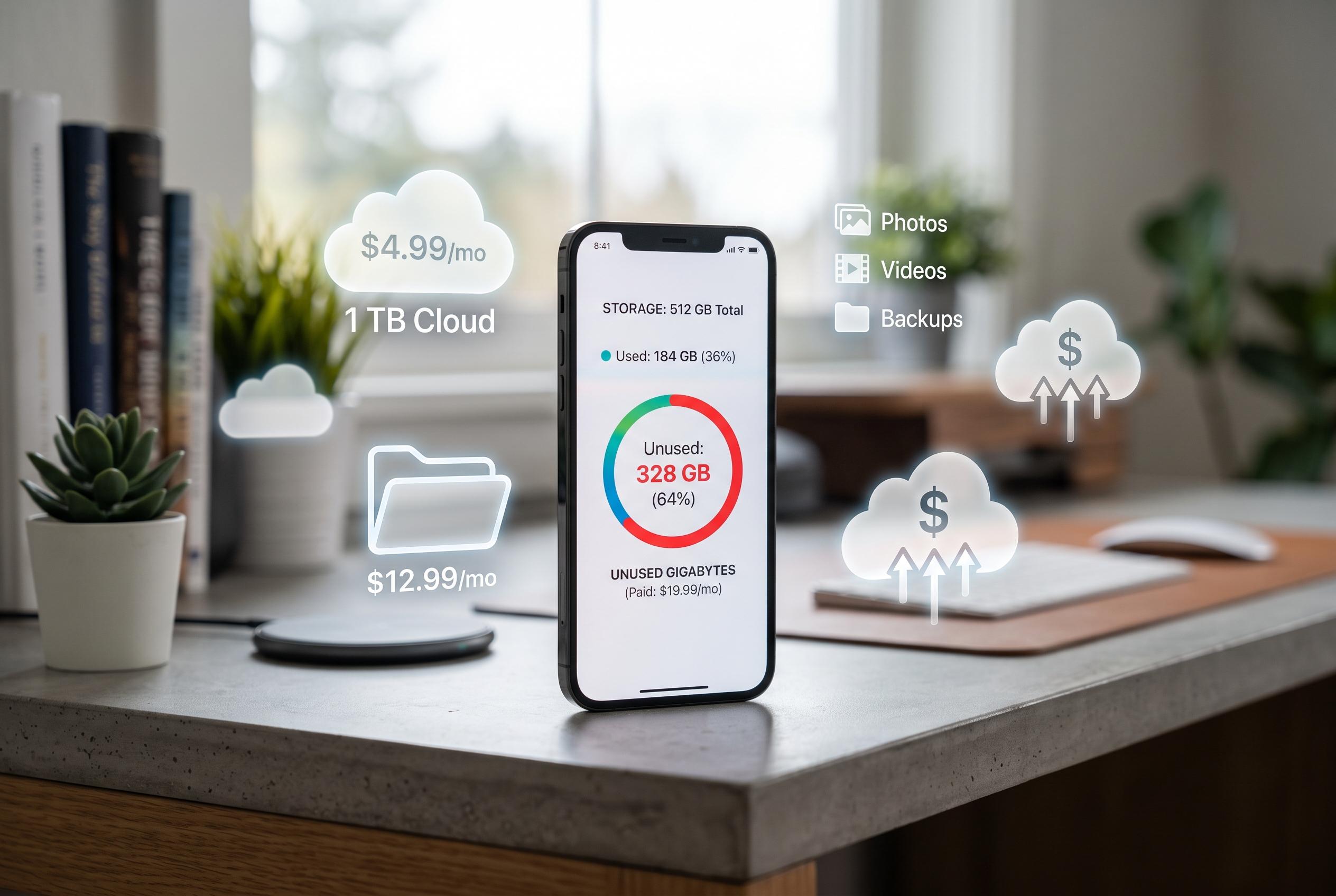

Manufacturers continue to encourage consumers to buy more storage than they need, profiting twice: from device sales and cloud subscriptions. Experts recommend smarter management of device space to avoid unnecessary expenses, amid declining storage costs and shrinking microSD options.
Smartphone buyers are still being encouraged to pay for capacity they may never use. ZDNET’s Adrian Kingsley-Hughes argues that manufacturers make money twice: first on the handset itself, then again when users are pushed into paid cloud storage as their photos, videos and apps fill the device. With storage now soldered in on most phones and microSD expansion largely gone, the upgrade decision is often driven more by anxiety than by evidence.
The better way to judge a storage tier, Kingsley-Hughes says, is not by capacity alone but by cost per gigabyte. Using Apple’s iPhone 17 Pro Max as an example, he shows how the headline jump from 256GB to 512GB, and then to 1TB and 2TB, looks less generous when converted into marginal cost. On that basis, the extra storage can appear cheaper than the sticker price suggests, but it is still easy to overbuy if the device will never come close to being full.
That matters because a gigabyte disappears quickly. In the article, Kingsley-Hughes notes that photo capacity varies sharply by file type and camera setting, while video can consume space in minutes rather than hours. Large messaging apps and social platforms also occupy far more room than many users realise. The result is that a phone that seemed oversized at purchase can become cramped long before the owner has made full use of it.
There is also a broader market context. Computerworld has previously noted how storage costs have fallen dramatically over time, making cheap digital capacity one of the enablers of modern computing. Yet consumer-facing pricing still bears little resemblance to the underlying cost of flash memory, according to a 2026 storage-pricing study cited in the related material, which says the wholesale price of NAND can be only a small fraction of what buyers pay for a handset upgrade. That gap explains why storage tiers remain so profitable for manufacturers.
The practical answer is to manage space more actively rather than defaulting to the largest model. Kingsley-Hughes recommends offloading unused apps, cleaning up duplicate or low-quality photos, limiting automatic media downloads in chat apps and streaming content instead of keeping local copies where possible. Apple and Google both offer tools that keep smaller versions of photos on the device while storing the originals in the cloud, but those settings can also encourage users to pay for more online storage. External storage remains an option through USB-C, though it is less convenient than cloud services and may require encryption for sensitive files.
Disclaimer: This content is intended for informational purposes only. Readers are advised to exercise their own judgement, conduct due diligence, or consult a qualified expert before acting on any information provided.