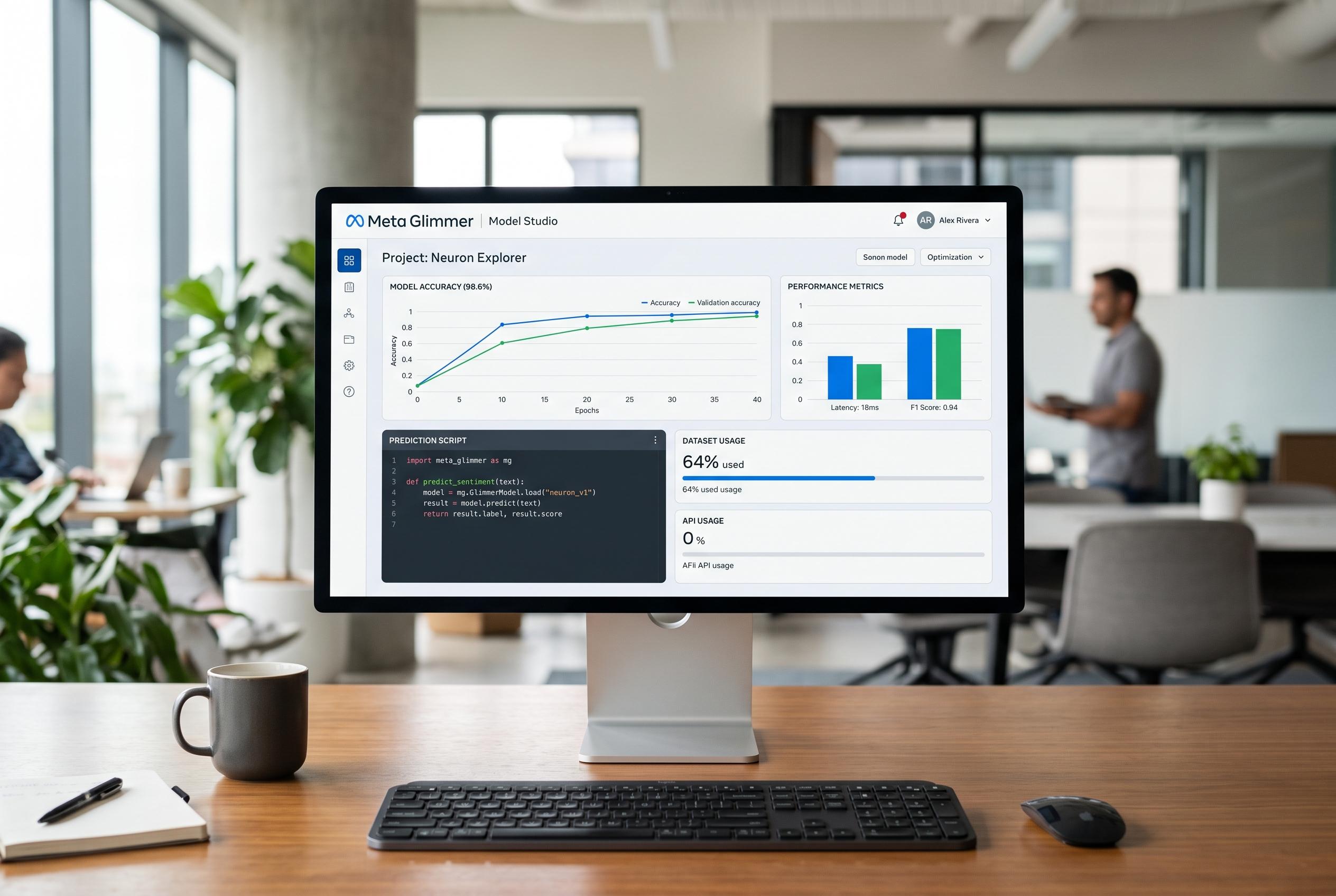

Meta releases Muse Glimmer, a 30-billion-parameter open-weight AI model designed for local and offline use, signalling a strategic pivot in AI deployment and competitive positioning against rivals like OpenAI and Chinese competitors.
Meta has not, for now, released the heavyweight model some observers expected. Instead, the company has put out Muse Glimmer, a 30-billion-parameter open-weight system that it says can run on a laptop with a single consumer GPU and stay within a 24GB or 32GB memory envelope. The model is available on Hugging Face under the Apache 2.0 licence and is pitched for agentic workflows, coding, tool use and multimodal input. Mark Zuckerberg described the move as a direct challenge to Chinese AI rivals, while also indicating that the more advanced Muse Spark 1.2 is still to come.
The release marks a clear change in direction from Meta’s earlier approach. When Muse Spark first appeared in April, access was limited to selected partners through an API, according to Ars Technica. This week’s Glimmer launch pushes model weights directly to developers, a shift that matters because it lowers the barrier to local deployment and reduces dependence on centralised cloud services. In practical terms, that can cut inference costs, support offline use and keep sensitive data inside an enterprise’s own systems.
The commercial logic is just as important as the technical one. Meta’s core business is not selling model subscriptions, but monetising scale across Facebook, Instagram, WhatsApp and Messenger, plus devices such as its AI glasses. That gives the company a different strategy from OpenAI and Anthropic: if the model layer becomes cheaper and easier to replace, competition moves towards distribution, personalisation, hardware and consumer reach, areas where Meta already has a strong position. OpenAI, by contrast, has made its own open-weight reasoning models available under Apache 2.0, showing that permissive licensing is becoming a more contested part of the market rather than Meta’s sole preserve.
The key test now is Muse Spark 1.2. Meta has not confirmed when it will arrive, what licence it will use or whether it will be fully downloadable rather than API-bound. Those details will determine whether the company is merely broadening developer access or making a deeper play against the closed-model business of rivals. If Spark 1.2 is genuinely permissive and competitive at the frontier, it would put fresh pressure on pricing and procurement for routine AI workloads. If not, Glimmer may prove to be less a full assault than a carefully staged opening move. Meta’s own safety work around Spark suggests the company is already treating the model as production-grade, but the market impact will depend on how open the next release really is.
Disclaimer: This content is intended for informational purposes only. Readers are advised to exercise their own judgement, conduct due diligence, or consult a qualified expert before acting on any information provided.