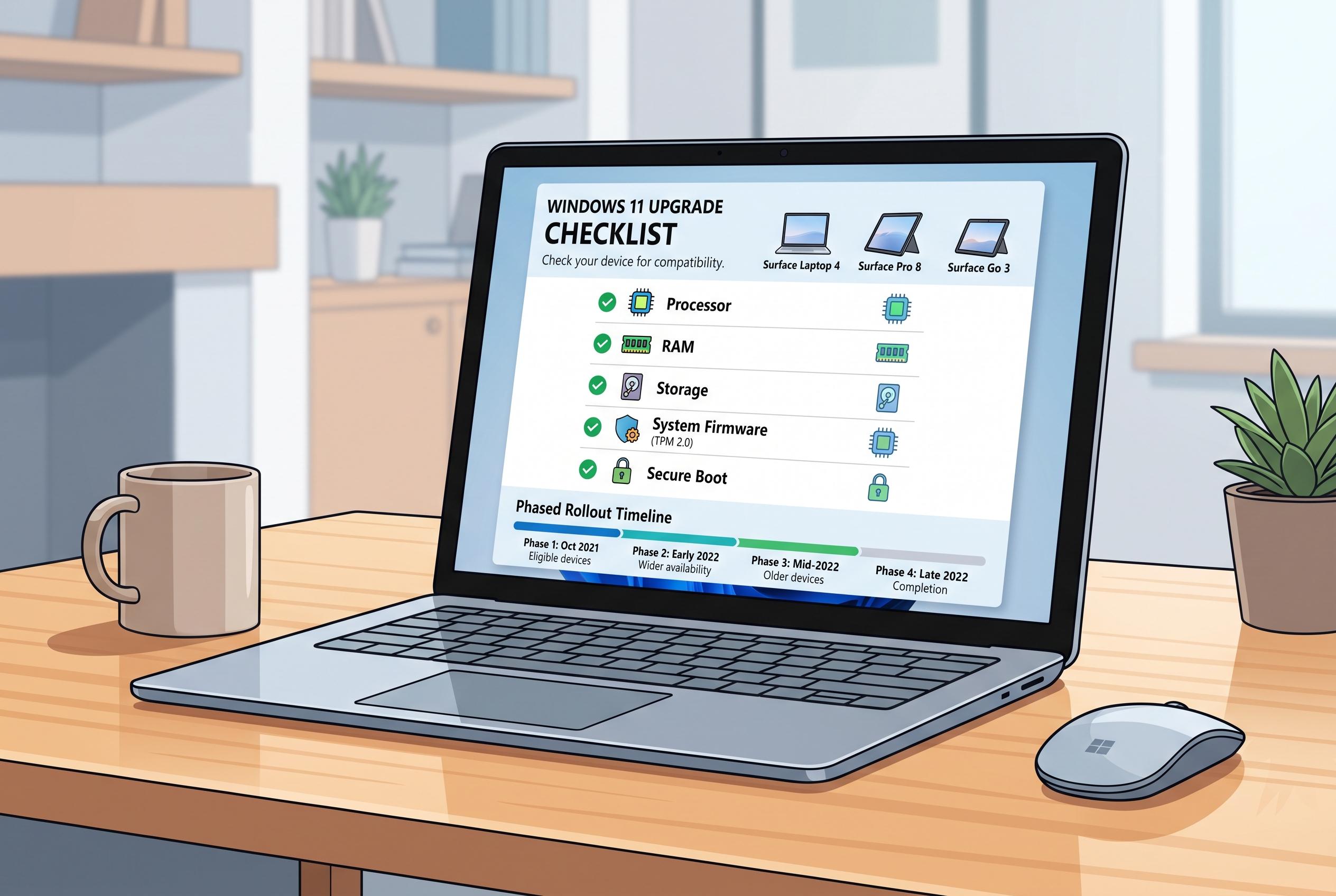

As support for Windows 10 ends in October 2025, Microsoft provides detailed criteria for Surface device upgrades, highlighting model-specific eligibility, phased update deployment, and implications for enterprise and consumer users.
Microsoft’s official Windows 11 position for Surface owners is clearer now that Windows 10 support has ended on 14 October 2025. According to Microsoft Support, the upgradeable Surface line includes Surface Pro 6, Surface Pro 7, Surface Pro 7+, Surface Pro X, Surface Laptop 2 through 4, Surface Laptop Go, Surface Go 2, Surface Book 3, qualifying Surface Book 2 configurations and Surface Studio 2. Older models, including Surface Pro 5 and earlier, the first-generation Surface Go, the first-generation Surface Laptop, the first-generation Surface Book, Surface 3 and the first-generation Surface Studio, are not officially eligible. Microsoft says PC Health Check remains the final test for an individual device.
That distinction matters because Surface compatibility is not determined by model name alone. Microsoft’s requirements still depend on the exact processor, firmware state, TPM 2.0, Secure Boot capability, memory, storage and graphics support. Surface Book 2 is the clearest example: only the 8th Gen Intel Core i5-8350U and i7-8650U variants qualify, while the 7th Gen Intel Core i5-7300U version does not. Microsoft’s guidance therefore treats the model family as a starting point, not the final answer.
Microsoft’s Surface supported-operating-systems matrix adds another layer of context for people deciding whether to keep an older device in service. The company lists current Windows 11 support for newer Surface generations, including Surface Pro 11th Edition and Surface Pro 12th Edition, while also setting version-specific support windows for models such as Surface Pro 9 and Surface Pro 10 with 5G for Business. That matrix is more useful for deployment planning than a simple yes-or-no consumer list, because it shows how support varies by model, build and business configuration.
Even a compatible Surface may not receive Windows 11, version 25H2, straight away. Microsoft says the update is being rolled out in phases and that eligible devices on Windows 11, version 24H2, will receive it according to hardware readiness and user experience. The company also notes that newer driver and firmware releases are tied to the device’s servicing period, which means an older but still compatible Surface can be supported differently from a newer one.
For buyers and upgraders, Microsoft’s edition guidance is also relevant. The company says the newest consumer Surface devices ship with Windows 11 Home, while the newest commercial models ship with Windows 11 Pro. That affects features such as BitLocker, Remote Desktop and domain join, so the right decision is not only about eligibility but also about workload, management needs and the remaining value of the hardware. On an older Surface, the cost of batteries, accessories and downtime may easily outweigh the benefit of staying with an officially supported but ageing machine.
Disclaimer: This content is intended for informational purposes only. Readers are advised to exercise their own judgement, conduct due diligence, or consult a qualified expert before acting on any information provided.