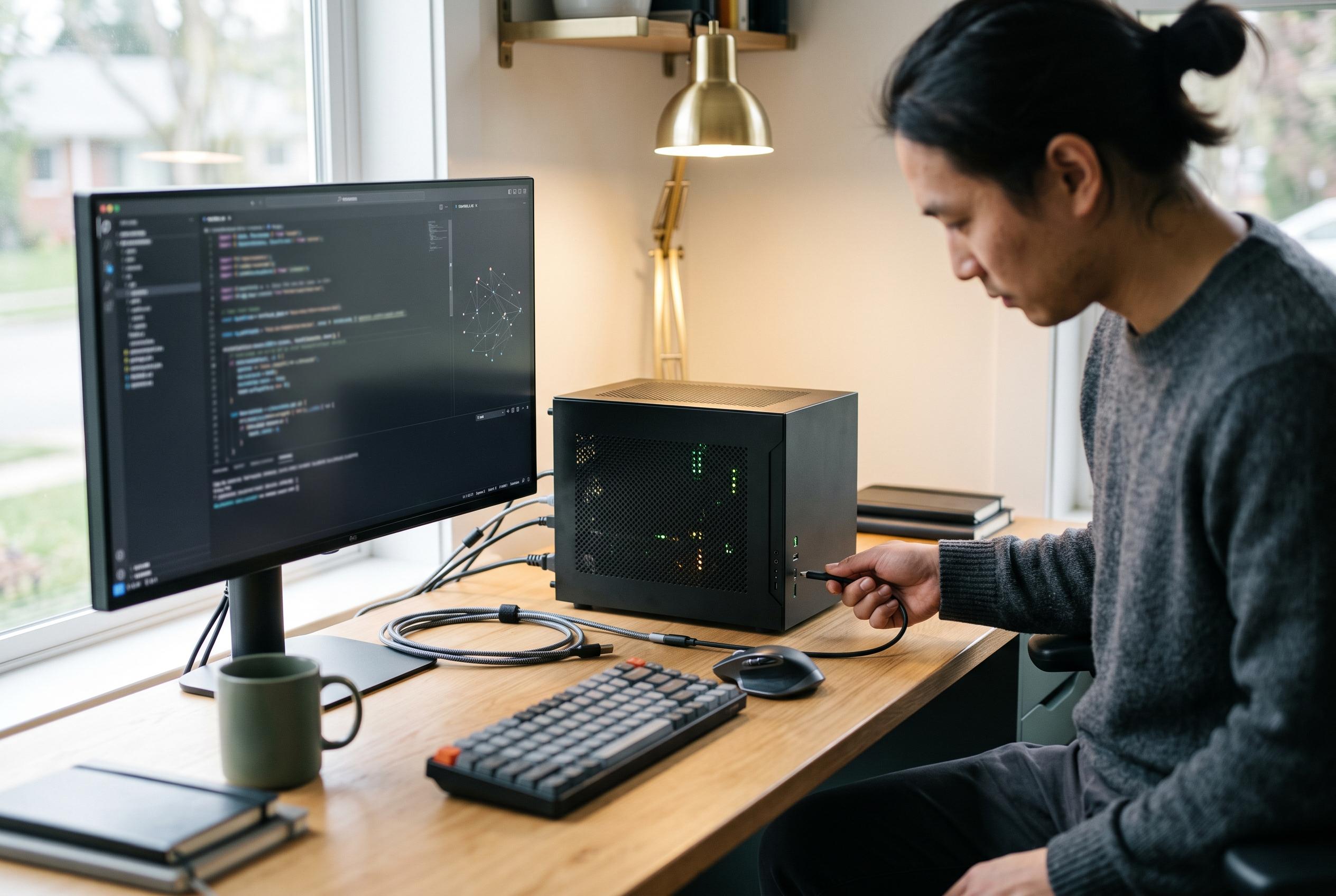

NVIDIA introduces a more affordable 64GB version of its DGX Spark AI machine, enhancing local model development capabilities for AI practitioners and edge applications, with expansion options for larger models and simplified setup features.
NVIDIA is making its DGX Spark local AI machine slightly easier to enter, but not cheap. The company has unveiled a 64GB version of the compact system, priced from US$4,999 and due to go on sale on 23 October through Acer, Asus, Dell, Gigabyte, HP and MSI. It is intended for developers who want to work on models locally rather than push data to a cloud service, and NVIDIA is careful to frame it as a serious development platform rather than a general-purpose desktop replacement. According to the company, the new configuration keeps the same GB10 Grace Blackwell Superchip, DGX OS and AI software stack as the 128GB model, but cuts memory to bring the entry price down.
NVIDIA says a single 64GB unit can run models of up to 100 billion parameters entirely on the device. That places the machine in a niche aimed at AI agents, inference, fine-tuning, data science and edge development, where keeping data on-site is often a practical requirement. The company is also removing the Founders Edition route for this version, leaving the OEM partners as the only channel. For buyers who need more headroom, the 64GB model is designed to scale by pairing two systems together rather than moving to a different product category.
Two DGX Spark units can be linked directly with a QSFP cable, which NVIDIA says pools memory to 128GB and allows models with as many as 200 billion parameters. The company says that arrangement doubles memory bandwidth and can deliver up to 1.7 times the performance of a single machine. To reduce the setup burden, NVIDIA is bundling Sync Cluster Assistant, which detects the connected systems and configures the network automatically. A further simplification is due at the end of October, when Sync Model Launcher is expected to make it easier to download and run models such as Qwen3.8-27B on one system or a two-node cluster, then expose the model to a laptop and launch coding tools in a web browser.
The broader significance is that NVIDIA is pushing beyond GPUs into a more complete developer stack. Its DGX Spark line is a dedicated local AI environment built around Linux and DGX software, while the planned RTX Spark PCs will bring related hardware into Windows 11 laptops and mini-PCs from makers including Acer, Asus, Dell, HP, Lenovo, Microsoft and MSI. Those machines are being positioned not only for AI workloads but also for content creation and gaming, with support for DLSS, Reflex and ray tracing. In practical terms, the strategy could make local model development more approachable for more users, while also binding them more closely to NVIDIA’s CUDA ecosystem and integrated software tools.
Disclaimer: This content is intended for informational purposes only. Readers are advised to exercise their own judgement, conduct due diligence, or consult a qualified expert before acting on any information provided.