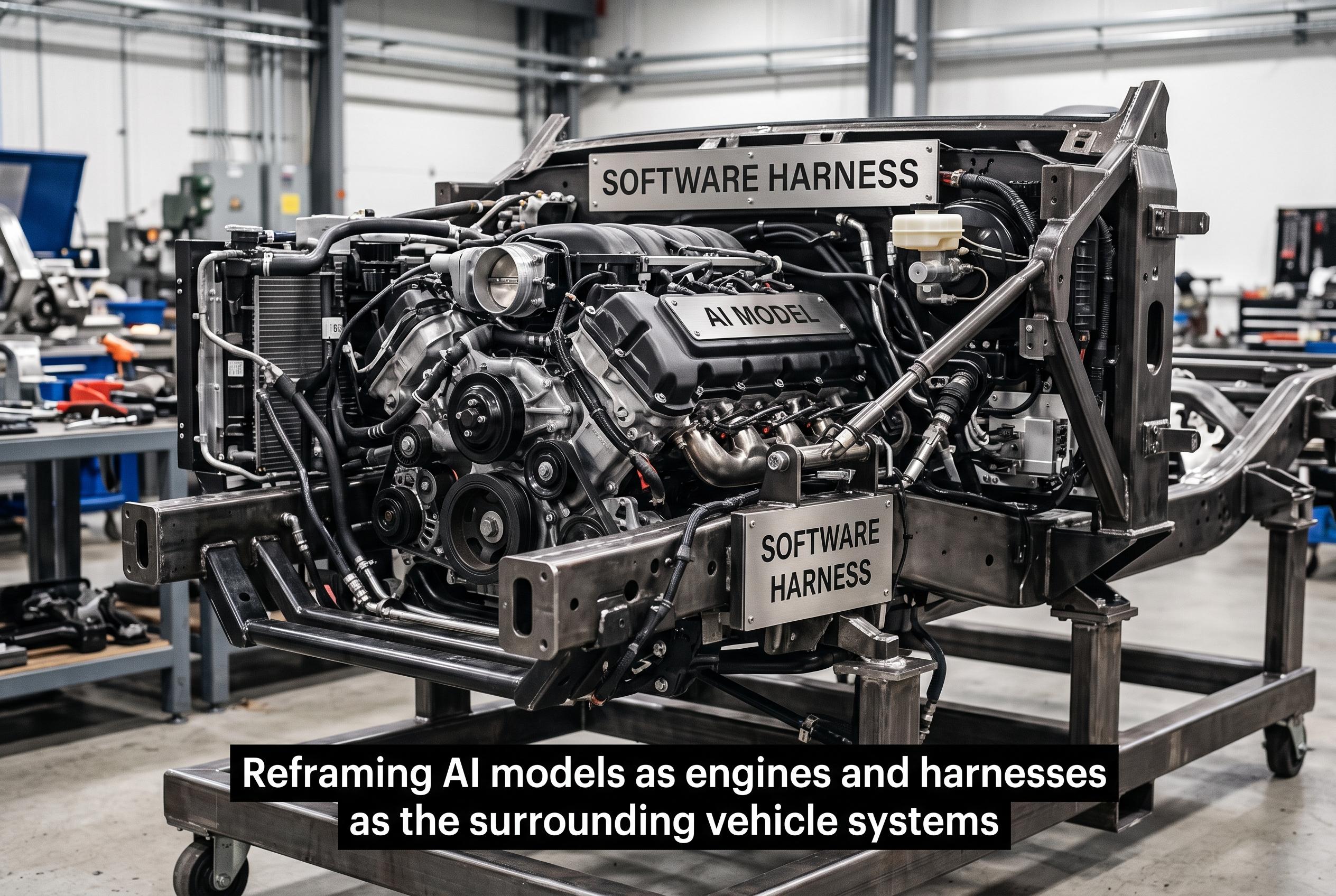

A new perspective emphasizes that the true power of AI lies not just in the models themselves, but in the surrounding software framework, the harness, that enables models to function effectively as assistants and agents.
An AI model is often treated as the main event, but the more important layer is the system around it. Vageesh Goswami, writing on Medium, argues that the model is best understood as the engine, while the harness is the rest of the vehicle that lets the engine actually do useful work. In that framing, the model generates outputs, but the harness supplies the structure that turns those outputs into action.
The distinction matters because a language model on its own is limited. It can predict text, but it cannot inspect a codebase, run a command, call an external service or keep track of what happened in the previous step unless something else manages that process. AI Hero describes the harness as the software layer that turns a language model into an agent, with responsibilities that include tool use, system prompts, context-window management, permissions and hooks. In practice, that means the harness determines how the model is placed in a working environment.
That is why the common car analogy is useful. The model is the engine: powerful, but inert without controls and a route. The prompt acts like the steering wheel, while tool calling functions like the pedals, allowing the system to interact with the outside world. The execution loop keeps the process moving from one step to the next, and memory or state management acts like a dashboard, preserving what has already happened so the model does not restart from nothing on every turn. Safety controls also matter, because a harness without limits can continue acting when it should stop.
The same idea appears across other explanations of agent design. Ijonis says the harness is the software that converts a language model into a productive agent and argues that much of the variation in results comes from system design rather than model choice alone. SixDegree makes the same case, describing the harness as the surrounding software that turns raw inference into an agent through tool dispatch, memory, sub-agent orchestration and permissioning. LLM Reference similarly defines it as the runtime scaffolding that combines the model, tools and context into an agentic loop.
That is also why products built on similar models can behave so differently. AI Hero notes that Claude.ai and Claude Code may rely on the same underlying model, but their harnesses produce different outcomes because the surrounding software is not the same. LLM Reference points to tools such as Claude Code, Cursor, Cline, Aider, Windsurf and Devin as examples of systems where the user experiences the product, not the base model. In each case, the harness is what determines whether the system merely chats or actually completes work.
For builders, the implication is practical. Choosing a stronger model helps, but it is only part of the problem. A well-designed harness can make a modest model useful, while a poor one can make a strong model frustratingly limited. That is why attention in AI development is shifting from model scaling alone to system scaling: better orchestration, better memory handling, better permissions and better loops. Goswami says he plans to examine those details further, including how harnesses work internally, how different companies design them and what trade-offs emerge around cost, latency and errors.
Disclaimer: This content is intended for informational purposes only. Readers are advised to exercise their own judgement, conduct due diligence, or consult a qualified expert before acting on any information provided.