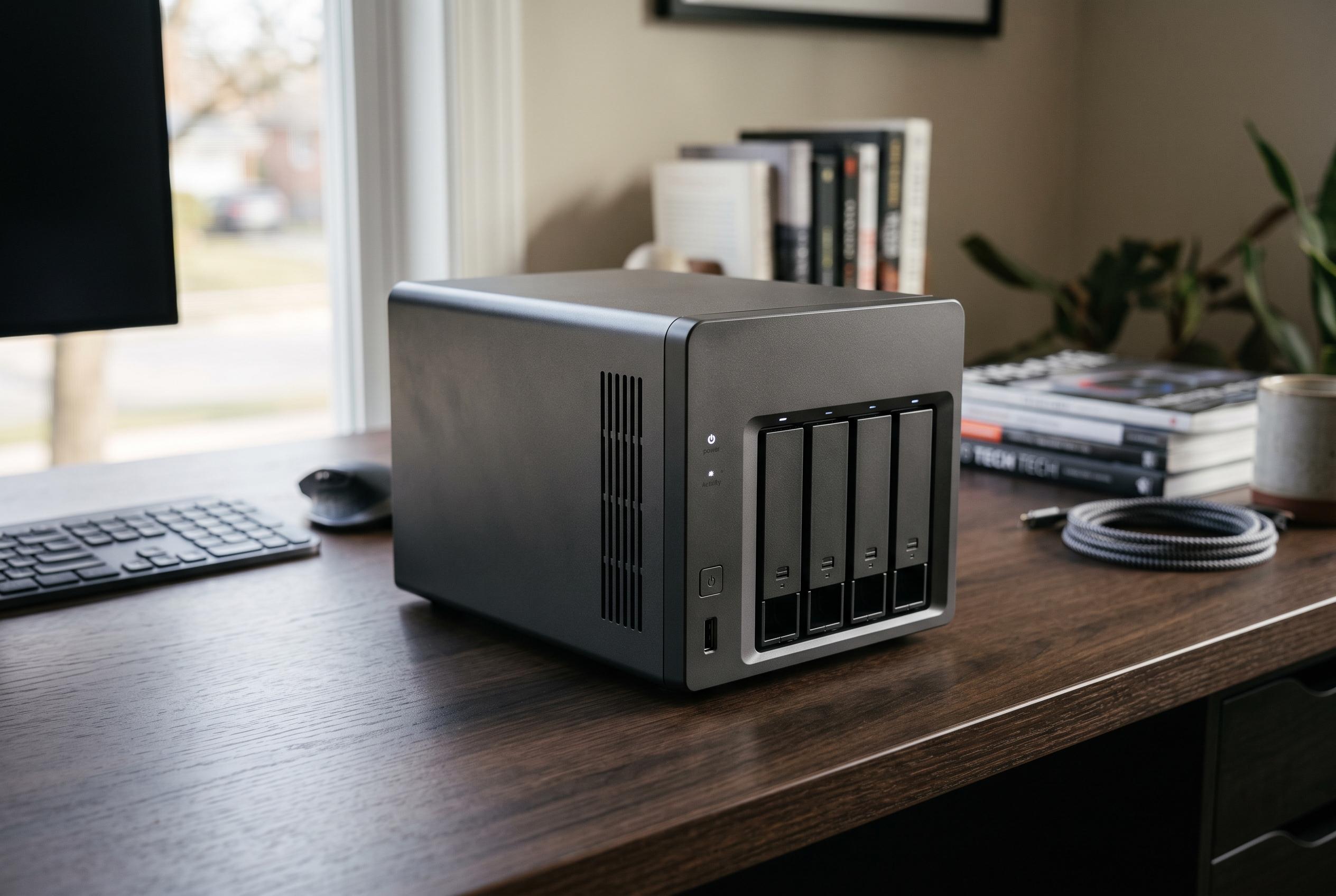

Growing adoption of 2.5GbE NAS enclosures is transforming storage options for home users and small teams, offering faster data transfer speeds and greater flexibility across various form factors for enhanced media, backups, and collaboration.
2.5GbE NAS enclosures have become the practical middle path for home users and small teams that have outgrown gigabit networking but do not yet need the cost and complexity of 10GbE. As Modern Meeting Standard notes, the appeal is simple: faster transfers, better responsiveness for shared files, and enough headroom for media libraries, backups and lightweight collaboration.
The market now spans compact two-bay boxes, larger four- and six-bay desktop units, and even rackmount systems for space-constrained businesses. ITPro’s review of the QNAP TS-432XeU shows how 2.5GbE-class networking is being adopted across form factors, with short-depth chassis, quiet operation and backup-focused software now common priorities. That broader trend matters because buyers are no longer choosing only on speed; they are also weighing software, expandability and installation fit.
For most households, the most sensible choices remain the simpler desktop models. Synology’s DiskStation DS225+ has won praise from Android Central for combining 2.5 Gigabit Ethernet with Synology’s mature DSM software, while TerraMaster’s F2-425 and Asustor’s Drivestor 2 Gen 2 reflect the same basic idea: modest hardware, faster-than-gigabit networking and enough flexibility for photos, backups and streaming. For users who want a stronger entry point, QNAP’s TS-216G and the QNAP bundle centred on the TS-473A-8G extend that formula with either dual 2.5GbE or an easy route to a faster network.
The more capable options are aimed at users who need room to grow. The QNAP TS-664-8G-US adds six bays, dual 2.5GbE and M.2 NVMe support, while TerraMaster’s F6-424 pairs dual 2.5GbE with DDR5 memory and NVMe slots for cache or extra storage. For larger deployments, the QNAP TS-1655 offers a 12-bay tower design with dual 2.5 Gigabit Ethernet, making it better suited to expanding archives than compact home systems. In practice, these models are less about headline speed than about keeping performance stable as workloads increase.
There is also a clear split between units built for simplicity and those intended for mixed workloads. The ORICO HS200, for example, combines HDD bays, NVMe slots and dual 2.5GbE in a hybrid design that can handle storage, media serving and container-based apps. That kind of flexibility will appeal to enthusiasts, but it will be unnecessary for many families. By contrast, the TERRAMASTER F2-425 keeps things quiet and straightforward, with a 19dB(A) noise rating that makes it a better fit for living spaces.
The main buying question is no longer whether 2.5GbE is fast enough; it is which enclosure best matches the size and complexity of the job. Two-bay models are the easiest starting point for personal storage. Four-bay systems offer better RAID choice and more room for growth. Six-bay and larger units make sense when shared libraries, multiple users or future expansion are part of the plan. As benchmarking round-ups from Mama Linux, Android Central and The Gear Audit all suggest, the best enclosure is the one that balances software, networking and capacity without overspending on hardware the user will not fully use.
Disclaimer: This content is intended for informational purposes only. Readers are advised to exercise their own judgement, conduct due diligence, or consult a qualified expert before acting on any information provided.