
Fifteen months after its launch, the Switch 2 accessory market reveals a shift towards practicality, with consumers prioritising faster storage, improved controllers, and ergonomic handheld accessories, signalling a maturing industry.
Fifteen months after the Nintendo Switch 2 reached shops in June 2025, the accessory market has settled into a clearer pattern than the early launch rush suggested. Across updated buying guides from specialist gaming sites and mainstream tech publications, the products most often treated as worth buying first are not novelty extras but faster storage, a better controller and a durable case. Third-party docks and low-resolution cameras remain the categories that attract the most caution.
That matters because the installed base became large very quickly. Popular Mechanics said Nintendo sold more than 6 million Switch 2 consoles across June and July 2025, including more than 2 million in the United States between June and August. Forbes argued that, after spending about $500 on the console itself, owners had good reason to become far more selective about accessories and to look harder at cheaper licensed alternatives. Stuff and Popular Mechanics both noted that many original Switch peripherals still work with the new machine, although the carry-over is incomplete: Stuff said older controllers cannot wake the console, and older memory cards do not meet the new storage requirement.
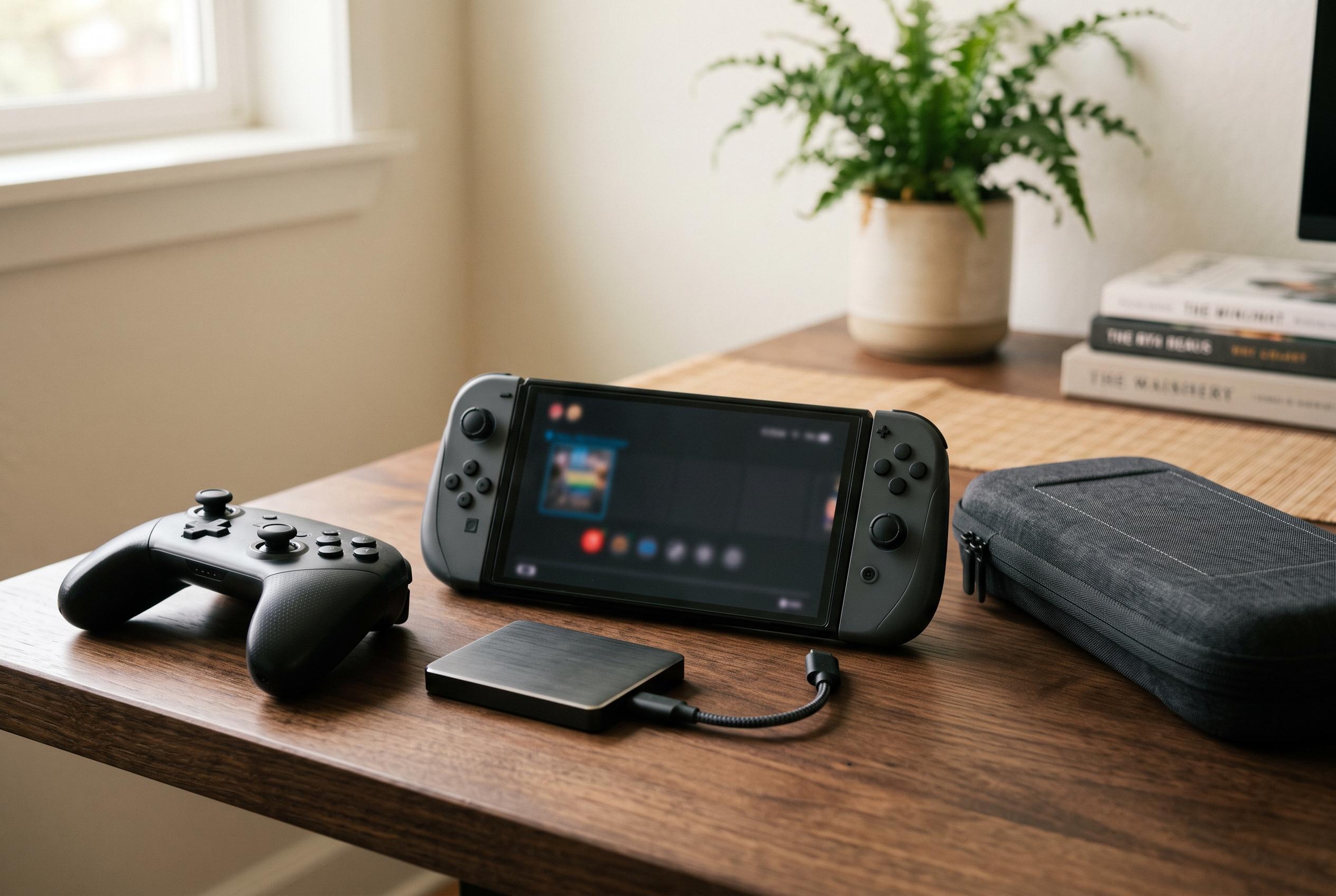
On controllers, there is broad agreement that Nintendo’s Pro Controller remains the reference point for docked play. Stuff said the revised pad improves on the original with a C button for GameChat, a headphone jack and two programmable rear buttons called GL and GR. Kotaku made the same rear buttons the centre of its case for the controller, arguing that the remapping options are the clearest justification for its $85 launch price. Even so, the third-party market has matured faster than it did around launch. Stuff places 8BitDo’s Ultimate 2 and Pro 3 close behind Nintendo’s own controller, while Forbes frames officially licensed third-party pads as a sensible way to save money rather than a compromise to avoid. Reviewers still flag limits at the cheaper end, however. GamesRadar says PowerA’s Advantage wired controller is a decent budget multiplayer option, but one whose lower build quality is evident.
Travel cases are where the range has widened most noticeably. Pocket Tactics now ranks the JSAUX Carry Case among the better hard-shell options, citing room for 15 cartridges in a 320 x 148 x 58mm case weighing 528g, while also warning that it is large and not moulded perfectly around the console. GamesRadar favours Belkin’s Charging Case Pro as the strongest all-round option because it combines a hard shell with pass-through charging, storage for up to 12 games and a hidden AirTag pocket. Yet that same review also says the newer Pro model’s $99.99 / £99.99 price makes the older version easier to recommend for buyers watching costs. For people who want to carry the whole setup rather than just the handheld, Kotaku pointed to Nintendo’s All-In-One case, which has room for the dock, a Pro Controller, six game cards and cables.
If there is one upgrade that several guides treat as close to essential, it is storage. Popular Mechanics described a microSD card as “borderline mandatory” for many owners, and Stuff said older microSD cards are simply “not good enough” for Switch 2 because the system requires the faster microSD Express format. Stuff added that Nintendo’s licensed cards at least remove some confusion over labelling. Pocket Tactics goes further on market limitations, saying licensed cards currently top out at 256GB and listing Samsung’s 256GB microSD Express card at $59.99. For portable play, power banks are the next priority. Pocket Tactics recommends the CUKTECH 20, a 25,000mAh unit with up to 140W output and a recharge time of up to two hours, while Stuff’s own tested shortlist also keeps high-output battery packs in focus for players who want to keep gaming while charging.
Camera advice is more divided than controller advice. Kotaku called Nintendo’s official camera the best early choice for GameChat, pointing to its 1080p image, compact design and privacy shutter, and Stuff added that its stand works behind the dock as well as in handheld or tabletop use. But later guides are less forgiving of novelty designs. GamesRadar says Hori’s Piranha Plant camera, despite being officially licensed and visually appealing, is held back by 480p video and is better replaced by any compatible 1080p USB-C camera. Pocket Tactics makes much the same point, noting that some USB-C cameras work with the console anyway, which reduces the value of paying for branding alone. For audio, Pocket Tactics highlights SteelSeries’ Arctis GameBuds partly because they can serve more than one platform, with up to 10 hours of battery life per charge and 40 hours from the charging case.
Where reviewers remain most conservative is docking. The broader consensus reflected in Stuff’s updated roundup is that many accessories from the previous generation can carry over, but docking remains a more sensitive purchase than cases or controllers, especially when features and power requirements differ by model. The emphasis in 2026 has instead shifted towards products that improve handheld comfort. GamesRadar recommends JSAUX’s Ergonomic Charging Grip at $21.99 / £15.99 as a cheaper alternative to Nintendo’s own $49.99 charging grip, while Pocket Tactics singles out Dbrand’s Killswitch for protection and ergonomics, with the important caveat that it is not dockable and instead comes with a dock adapter that doubles as a stand.
The result is a more mature consensus than the accessory market had at launch. Players who mainly use a television are being steered towards a proper controller first; commuters need a case, faster storage and a serious power bank; and anyone planning to use GameChat is better off paying for a decent camera than the cutest one. There is still room for niche extras: Kotaku said Nintendo’s Joy-Con 2 Wheel remains the safest pick for Mario Kart World because the magnetic connection is stable, and Stuff argued that a GameCube controller is effectively the right way to play GameCube titles such as F-Zero GX because of its analogue shoulder buttons. But the broader message is restrained. As Popular Mechanics put it, buying for the Switch 2 is “a marathon, not a sprint”.
Disclaimer: This content is intended for informational purposes only. Readers are advised to exercise their own judgement, conduct due diligence, or consult a qualified expert before acting on any information provided.