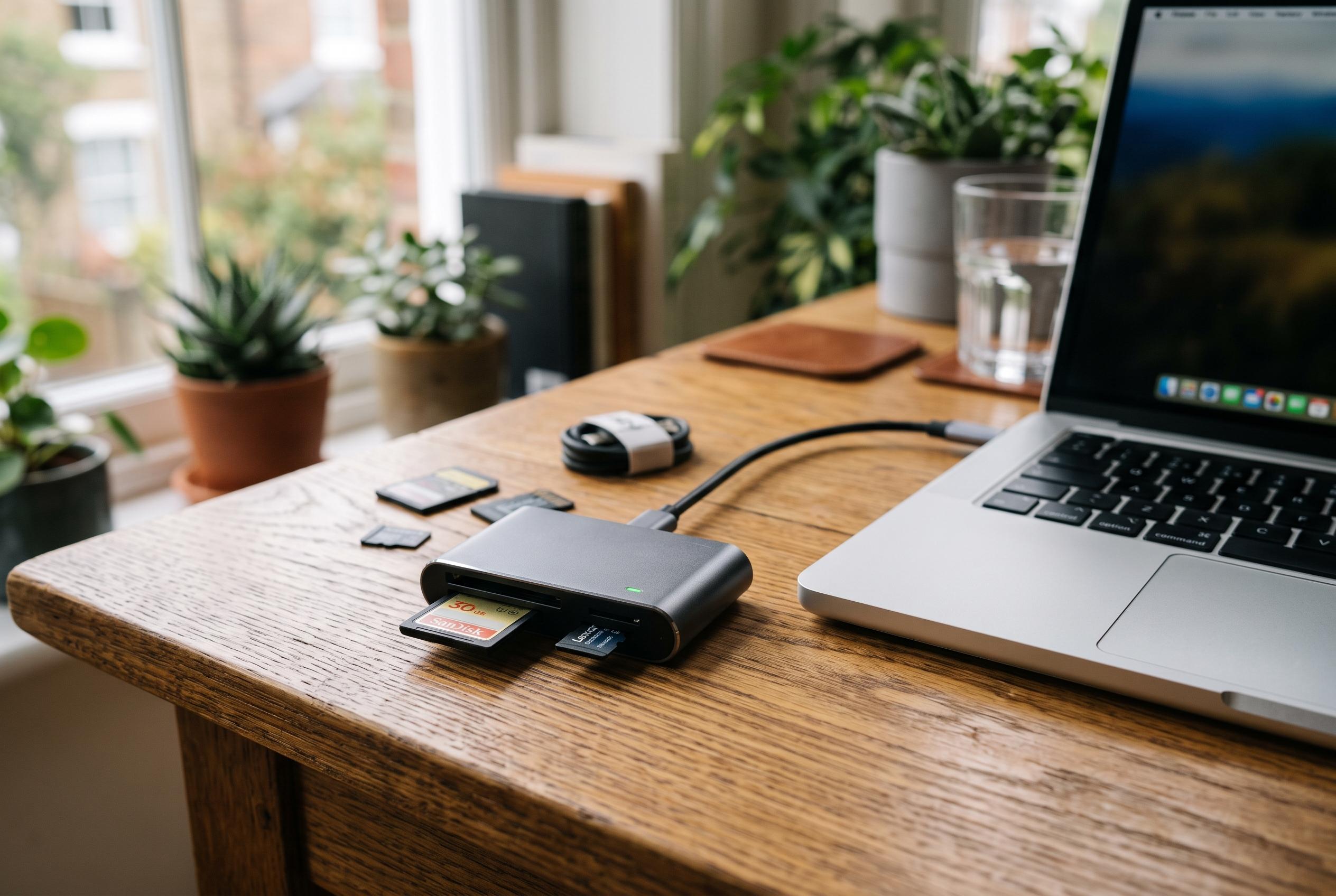

Acer’s low-cost SD and microSD reader offers broad device compatibility and convenience for casual and mobile users, but its limited transfer speeds and media support make it less suitable for professional high-speed workflows.
For a low-cost accessory, Acer’s dual-slot SD and microSD reader looks more convincing as a travel tool than as a professional ingest device. On 6 September 2026, Acer’s own global store listed the dual-connector version at $12.99, but the more important number is not the advertised 5Gbps interface speed. PCWorld and Acer’s own support notes both make clear that the memory-card side is limited to UHS-I rates of up to 104MB/s, and Software995’s testing put real-world transfers on standard cards at roughly 95MB/s to 100MB/s.
That still leaves a useful product for people who move between old and new hardware. PCWorld described a double-sided design with USB-C at one end and USB-A at the other, while Acer says it works across Windows, macOS, Android, Chrome OS and Linux. The company lists official measurements of 2.8in by 0.7in by 0.4in and a weight of 35g, alongside protective caps and an attached cord intended to stop the reader disappearing into a camera bag or laptop sleeve.
In practice, the strongest case for the device is convenience rather than outright speed. CarXplorer, after a 45-day test period, said the reader was immediately recognised on macOS, Windows 11 and Android 14 without extra software. Software995 reported similarly broad support, saying it plugged directly into an iPhone 15 Pro Max, an iPad Pro, a Pixel 8 Pro and a Samsung Galaxy S24, and transferred 200GB of mixed photos and video over multiple sessions without thermal throttling. When both card slots are active, however, performance per card drops because the bandwidth is shared.
Those limits become decisive if your workflow goes beyond everyday UHS-I media. CarXplorer says the reader does not support UHS-II, which rules it out for buyers who have invested in faster cards for high-bitrate video work. Acer is equally explicit that the accessory is for SD and microSD media only, not for direct camera connections, and excludes other formats including CFexpress, XQD, MS and Memory Stick. PCWorld added another omission that matters on thin laptops: there is no passthrough charging, so a machine with a single USB-C port may have to choose between power and card access.
For the audience Acer is actually chasing, the use cases are less glamorous but entirely credible. PCWorld pointed to DSLRs, security cameras, dash cams and drones, while Acer’s own sales material adds wildlife monitors and GoPro footage. On Best Buy, verified purchaser CHARLESW wrote: “This works great with my phone when i am out in the field, and need to view images I have taken. Easy to use and setup.” Another buyer said it had become a useful addition to a backpack for year-round trail-camera use with iPhones.
Retail feedback is positive overall, but it is not spotless. Best Buy’s listing for model ACER-UC207-Blue-BBY showed a 4.3-star average from 12 reviews on 6 September 2026, with 83% saying they would recommend it to a friend. Acer’s own global store showed a much larger tally of 314 reviews and a 4.7 rating the same day, although that is seller-hosted feedback rather than independent retail data. Negative reports do exist: one Best Buy customer said the reader appeared as a drive but would not display files, while another said the smaller card slot would not read properly.
One complication for shoppers is that Acer’s naming has become muddled across listings and deal coverage. Kotaku’s July 2026 write-up described a “3-in-1” Acer reader with a USB 3.0 port that could also take USB-A accessories such as wireless mouse or keyboard receivers. By contrast, PCWorld’s coverage of the cheaper dual-sided model, and Acer’s current store page for it, present a simpler SD and microSD reader with USB-C and USB-A connectors on the body. In other words, buyers comparing reviews need to check the exact product page and photographs, because not every similarly named Acer reader appears to have the same port layout.
Taken together, the reporting points to a narrow but sensible recommendation. If you mainly use UHS-I SD or microSD cards and want a pocket reader that can move cleanly between phone, tablet and laptop, the Acer looks worthwhile. If you need UHS-II throughput, support for specialist media, direct camera tethering or the certainty of a more fully featured hub, it belongs in the wrong category. CarXplorer placed it between flimsy budget readers and pricier professional UHS-II models, and Software995 reached much the same conclusion after finding that it matched the typical ceiling for standard cards: competent, portable and best suited to mobile workflows rather than top-end production.
Disclaimer: This content is intended for informational purposes only. Readers are advised to exercise their own judgement, conduct due diligence, or consult a qualified expert before acting on any information provided.