
Apple’s latest support guidance highlights potential risks associated with third-party bands, cheaps chargers, bulky cases, and magnetic accessories, urging consumers to stick with certified products to avoid health, reliability, and device damage issues.
Apple’s own support guidance now draws a sharper line on Apple Watch add-ons than many buyers may expect. In a help page published on 12 March 2026, the company said third-party bands may fit badly, interfere with Wrist Detect, cause skin sensitivities or other health concerns, and even damage the watch. (support.apple.com) Apple separately advises users to charge the watch with Apple-made or MFi-certified chargers carrying the Made for Apple Watch badge, warning that counterfeit or uncertified chargers can bring slow charging, repeated chimes and reduced battery lifespan. (support.apple.com) For a device sold as both gadget and jewellery, that is a stricter rulebook than many shoppers assume.
That helps explain why the most common bad purchase is still the cheapest spare charging puck. Writing in BGR on 26 August 2026, José Adorno noted that a replacement Apple Watch charging cable costs $29, a price that pushes some owners towards no-name substitutes. (bgr.com) BGR said poor-quality chargers can run hotter than they should and can also lose alignment, leaving a watch apparently charging when the magnetic connection has already dropped. (bgr.com) Apple’s own safety guidance says the watch, charging cable and power adapter do warm up in use and should remain in a well-ventilated area while charging. (support.apple.com) On a watch that may be charged nightly, those small compromises accumulate quickly.
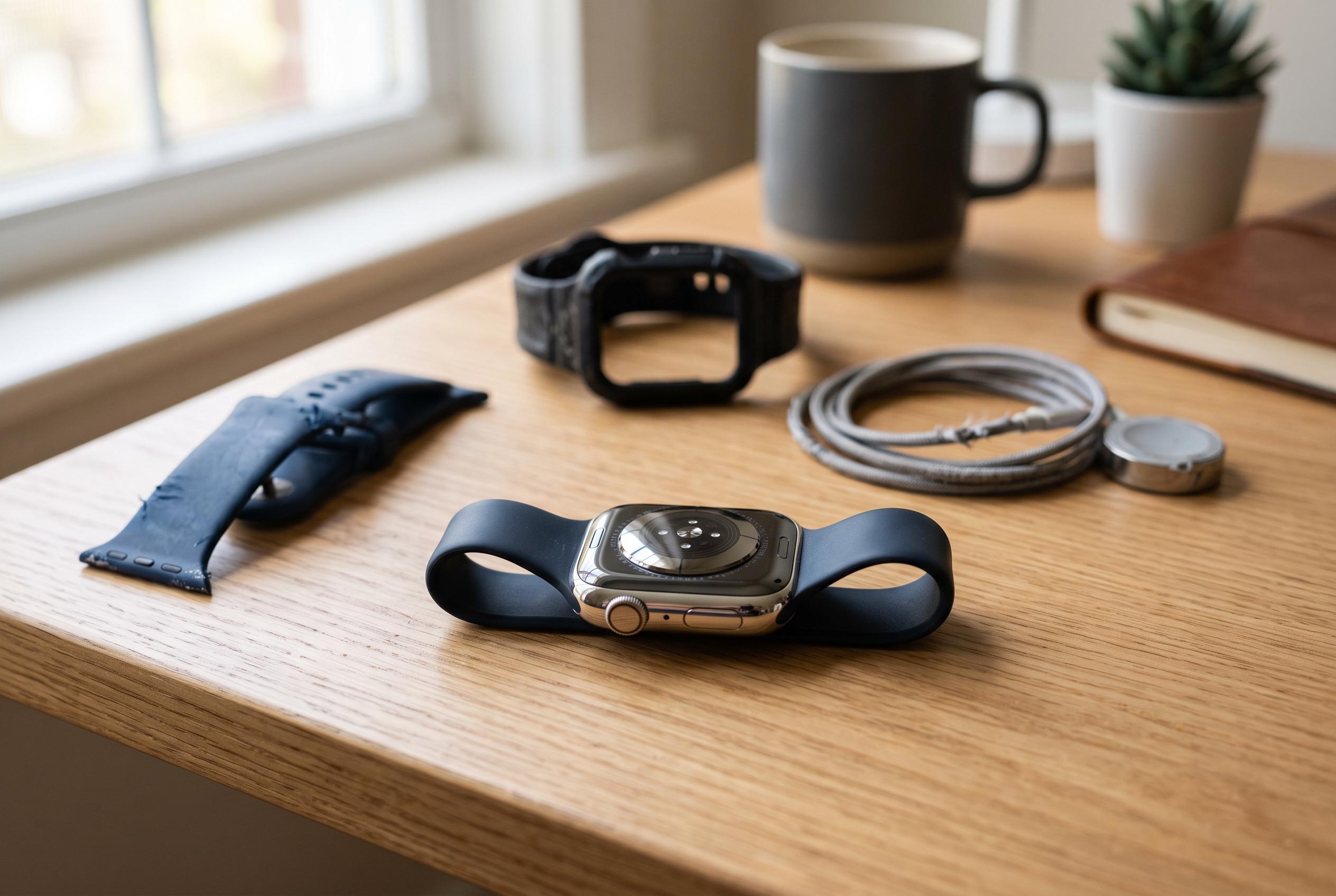
Protective shells are another example of smartphone buying habits travelling badly to the wrist. BGR and Yahoo Tech both say thick cases often crowd the Digital Crown and side button, making scrolling stiffer and trapping grit around the crown. (bgr.com) Yahoo’s syndicated version adds a more practical distinction: if a case is genuinely needed, a precisely cut design from a reputable maker such as Spigen, with an open section around the crown, is less likely to collect debris. (tech.yahoo.com) BGR also noted that Apple does not sell a protective shell for the watch, and neither do official partners such as Hermès or Nike. (bgr.com) What protects the case on paper can make the watch worse to use in practice.
Bands require more nuance than blanket warnings about unofficial accessories. Apple says the correct fit should be “not too tight, not too loose” and advises users to keep the watch, the band and the skin dry, especially after exercise or exposure to sweat, soap, sunscreen and lotions. (support.apple.com) The same support page says “Many third parties make accessory bands for Apple Watch” and warns that some may fit poorly, interfere with features or trigger skin reactions. (support.apple.com) That official caution sits alongside a more contested materials debate. Macworld reported in January 2025 on a US class-action lawsuit that cited a University of Notre Dame study finding PFAS in 15 of 22 watch bands tested, including bands linked in the suit to Apple’s Sport Band, Ocean Band and Nike Sport Band; Apple responded that Apple Watch bands are “safe for users to wear” and said it also uses independent laboratories to test materials. (macworld.com) So the materials question is not settled by price alone, but nor is it a reason to ignore fit and ventilation.
The attraction of cheaper straps is obvious once the official catalogue is priced out. After Apple’s September 2024 band refresh for the Apple Watch Series 10 and Ultra 2, AppleInsider reported six new band additions and more than 30 new colour changes across existing styles. (appleinsider.com) The same report said bands remain interchangeable within the 38mm to 41mm and 44mm to 49mm size families, while prices started at $49 for the Sport Band and Nike Sport Band, rose to $99 for several other styles, and stretched as high as $999 for the Hermès Grand H. (appleinsider.com) AppleInsider also warned that many no-name third-party bands use substandard materials and can fall apart or irritate the skin. (appleinsider.com) Cheap substitutes are easier to understand when the official range costs that much.
Screen protection presents a similar trade-off. BGR argued that thick tempered glass on an Apple Watch can affect the ambient light sensor beneath the display, upsetting automatic brightness, Always-On Display behaviour and battery use, while also dulling touch response. (bgr.com) That is a more serious compromise on a watch than on a phone because so many functions depend on sensors working close to the surface of the device. BGR’s conclusion was that, where protection is unavoidable, an ultra-thin layer is safer than a chunky pane sold on maximalist marketing claims. (bgr.com) The Apple Watch face is less forgiving of extra layers than a phone screen.
Magnets are the one accessory issue that clearly extends beyond convenience. Apple says in its Compass guidance that magnetic material in some of its own older bands, including Leather Link, Leather Loop, Milanese Loop and earlier Sport Loop versions, can interfere with compass accuracy, although Sport Bands and Sport Loop bands introduced from September 2019 onwards are not affected. (support.apple.com) That lends support to BGR’s warning about aftermarket charging stands with stronger magnets than necessary, particularly for users relying on headings, route history or Precision Finding. (bgr.com) Harvard Health adds a more serious medical context: it warned that people with pacemakers or implantable cardioverter-defibrillators should be cautious around wearables that use magnetic chargers, and it cited a case in which a 55-year-old woman’s ICD was deactivated while she slept wearing an Apple Watch. (health.harvard.edu) Apple’s broader medical-device guidance says sources of magnetic or wireless charging interference should generally be kept at least 6 inches away from an implanted device, or 12 inches when a wireless charger is in use. (support.apple.com) Magnet strength, in other words, is not just a convenience issue.
Taken together, the evidence points to a simple rule: buy for a wearable computer, not for a miniature phone. Apple Watch depends on magnetic charging, skin contact and sensor accuracy, so the safest pattern is narrower than the accessory market suggests: use Apple’s own charger or a Made for Apple Watch product, choose a breathable and correctly fitting band from a trusted supplier, and treat bulky cases, thick protectors and over-magnetised stands as suspect by default. (support.apple.com) The savings on the accessory aisle are often modest, but the chances of sacrificing comfort, battery life or reliable readings are not.
Disclaimer: This content is intended for informational purposes only. Readers are advised to exercise their own judgement, conduct due diligence, or consult a qualified expert before acting on any information provided.