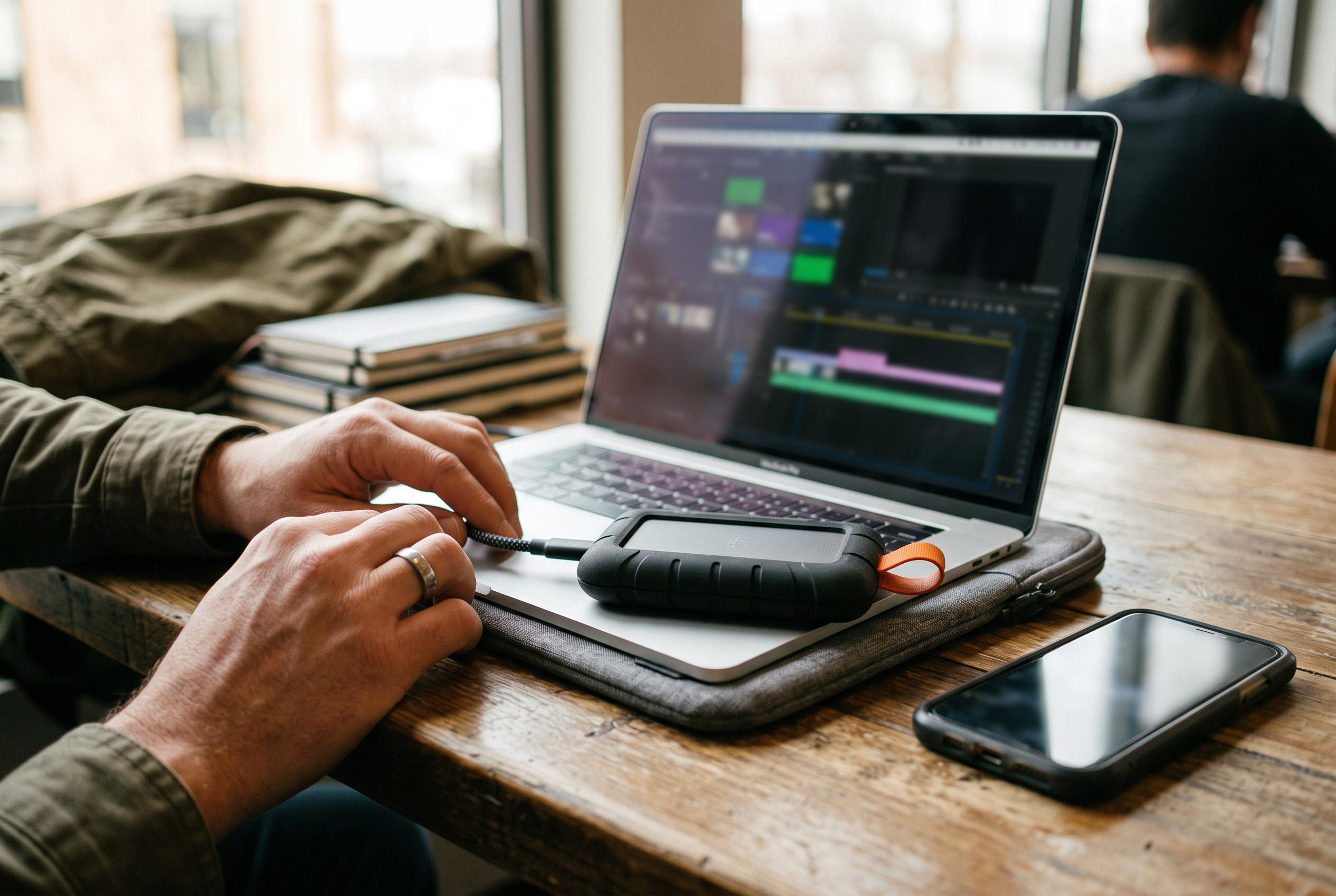

Choosing the right external SSD for 4K video editing while travelling involves considering real-world performance, durability, and compatibility, with new rugged models offering improved all-round capabilities for mobile editors.
Choosing an external SSD for editing 4K video on the road is less about headline speed figures and more about how those figures hold up in real use. A drive may look fast on paper, yet its performance can fall sharply if the laptop lacks the right port, if the cable is substandard, or if the workload is long enough to exhaust cache. For travelling editors, the practical question is whether a drive can sustain smooth playback, quick imports, and reliable offloading without becoming a bottleneck.
The SanDisk Extreme PRO Portable SSD V2 remains the most balanced option for that kind of work. Shotkit regards it as the strongest all-round pick because it combines up to 2,000MB/s transfer rates, a metal body that doubles as a heatsink, IP65 dust and water resistance, and a useful carabiner loop for attaching it to a bag. Tom’s Hardware, PCWorld, Cameralabs and TechRadar all describe it as a rugged, high-performing portable drive with hardware encryption and broad appeal for professional users, while noting that its full 20Gbps performance depends on a compatible host. On Macs, which do not support USB 3.2 Gen 2×2, the drive falls back to roughly 1,000MB/s, which is still ample for much 4K work.
For users who value compatibility above peak speed, the Samsung T7 Shield is the safer choice. Shotkit points to its IP65 sealing, drop resistance and textured rubber shell, along with a 10Gbps interface that behaves predictably on both Macs and PCs. In practice, that means fewer surprises and a simpler buying decision, even if the drive cannot match the top-end throughput of newer 20Gbps or Thunderbolt models. Its thermal management also helps it stay steady during longer transfers, which matters when copying large camera cards after a shoot.
Samsung’s T9 is aimed at Windows laptops with a 20Gbps USB 3.2 Gen 2×2 port, and it is the more performance-led alternative to the T7 family. Shotkit notes read speeds of up to 2,000MB/s and sustained writes of around 1,000MB/s once the cache fills, which makes it better suited to heavier timelines and larger offloads. The trade-off is that it lacks an official IP rating, so it is less convincing in wet or dusty environments. As with other Gen 2×2 drives, its speed advantage diminishes on a Mac.
For editors who want the smallest possible drive without giving up serious speed, the Corsair EX400U Survivor stands out. Shotkit describes it as thumb-drive sized yet capable of up to 4,000MB/s read and 3,600MB/s write over USB4 and Thunderbolt, making it one of the few models on the list that can fully exploit modern Mac and high-end Windows ports. Its IP55-rated shell adds a basic level of dust and splash resistance, and the lanyard hole makes it easier to secure in transit. It is not a truly rugged drive, but it occupies an appealing middle ground between compactness and performance.
The SanDisk Professional PRO-G40 is the most hardened option in the group. Shotkit says it combines IP68 sealing, crush resistance and drop protection with Thunderbolt 3 performance of up to 3,000MB/s read and 2,500MB/s write. That makes it the best match for difficult field conditions, particularly where the drive may be used as both a transport device and a working scratch disk. The main compromises are heat during long sessions and the need to reformat it for Windows use, since it ships in a Mac-friendly configuration.
At the top end of SanDisk’s current portable range is the Extreme PRO SSD V3, which Shotkit positions as the lightest rugged drive in the roundup. It is rated at up to 4,000MB/s read and 3,800MB/s write, with claimed sustained writes of about 3,100MB/s and IP65 protection. The catch is familiar: the USB 3.2 Gen 2×2 interface limits it to 10Gbps on Macs, so users do not see the full benefit unless they are on a compatible Windows system. Even so, the combination of low weight, strong sealing and high throughput makes it attractive for editors who move often and want one drive to cover most scenarios.
Underlying all of these choices is a simple rule: buy for the port you actually have, not the speed printed on the box. Shotkit recommends a minimum of 1TB for 4K work, with 2TB a more realistic baseline and 4TB preferable for longer trips or higher-bitrate footage. It also stresses that advertised speeds are usually peak figures, not sustained ones, which is why metal enclosures, thermal control and reputable brands matter. In practice, a good portable SSD for travelling 4K editing should offer enough bandwidth to keep timelines responsive, enough capacity to avoid constant shuffling, and enough durability to survive the trip as well as the edit.
Disclaimer: This content is intended for informational purposes only. Readers are advised to exercise their own judgement, conduct due diligence, or consult a qualified expert before acting on any information provided.