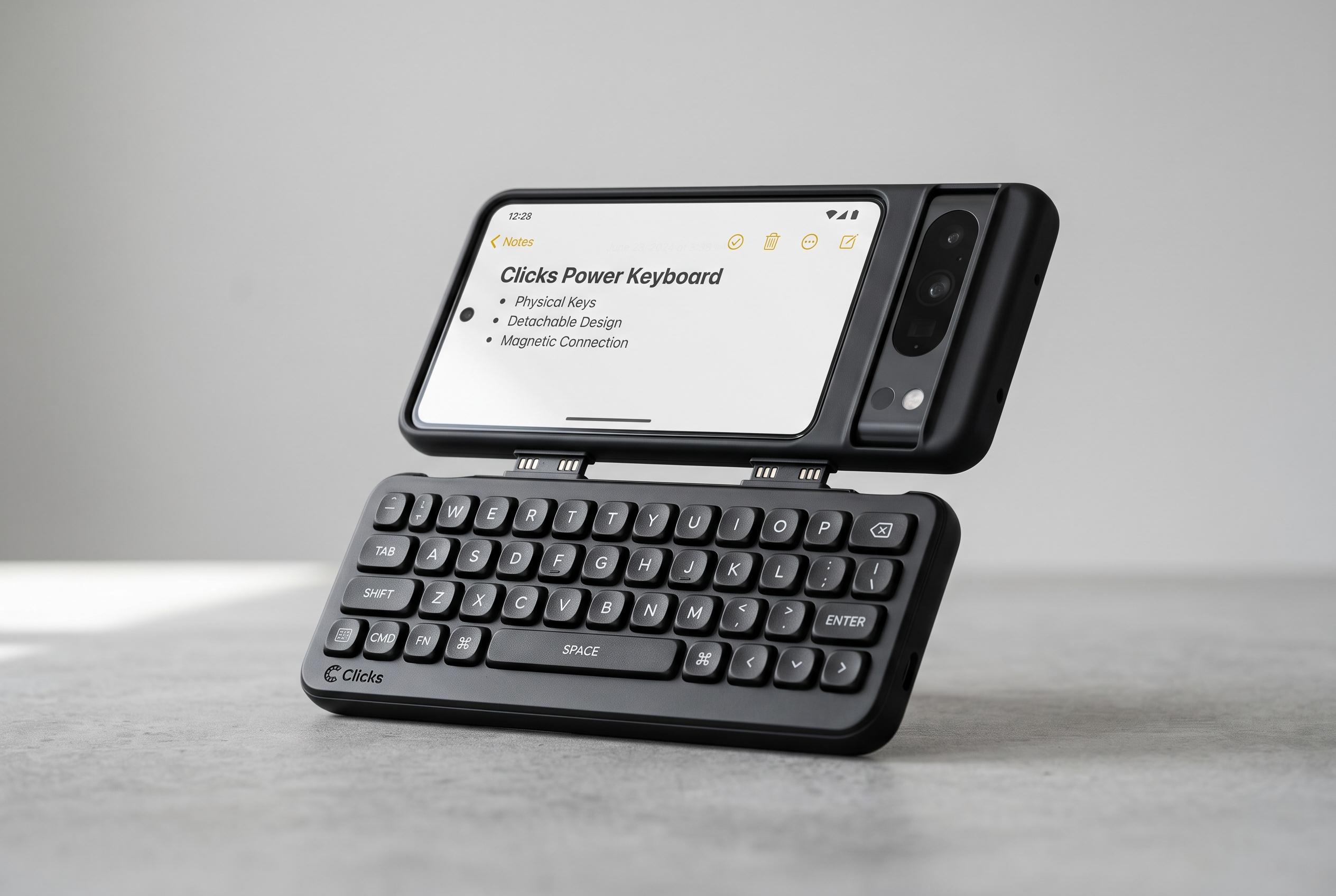

Clicks introduces the Power Keyboard, a magnetic, detachable physical QWERTY keyboard designed to enhance productivity and tactile typing on smartphones and other Bluetooth devices, challenging the trend of touchscreen-only devices.
Clicks has built a business around a form factor most of the smartphone industry left behind years ago: the physical QWERTY keyboard. According to Fast Company, the company’s co-founders are veteran technology journalists Michael “MrMobile” Fisher and Kevin “CrackBerry Kevin” Michaluk, both of whom have long argued that tactile typing still has value on a phone. Their latest accessory, the Power Keyboard, takes that idea further than the earlier case-based products by turning the keyboard into a separate magnetic device rather than part of a fixed shell.
The new model is designed to attach to iPhones with MagSafe and Android phones that support Qi2, and it can also be used with other Bluetooth-capable devices, including tablets, streaming boxes, smart televisions and mixed-reality headsets. Fast Company says it has a built-in 2,300mAh battery, allowing it to function as a power bank as well as an input device. TechSpot also noted that Clicks is positioning the accessory as a productivity tool for users who want a more physical, Blackberry-style typing experience without committing to a permanent case.
In practice, the appeal lies in the details. The Power Keyboard uses a slide-out mechanism, backlit keys and a dedicated number row, which sets it apart from older BlackBerry layouts and from Clicks’ earlier cases. Fast Company said the accessory also exposes more of the screen, which can make tasks such as spreadsheet editing or long-form typing more practical. Tech Advisor, in its hands-on coverage, said the keyboard uses Bluetooth and magnetic attachment, while TechRadar reported that it can also provide 5W wireless charging when connected.
The trade-off is size. Fast Company said the phone-and-keyboard combination is much thicker and heavier than a standard handset, and it is less pocket-friendly than a normal phone. Even so, the detachable design makes it easier to use only when needed, which may suit people who want hardware keys for email, messaging or short bursts of work rather than all-day use. The broader point is that Clicks is not merely selling nostalgia; it is testing whether a minority of users still value a more deliberate, mechanical way of interacting with their phones.
Disclaimer: This content is intended for informational purposes only. Readers are advised to exercise their own judgement, conduct due diligence, or consult a qualified expert before acting on any information provided.