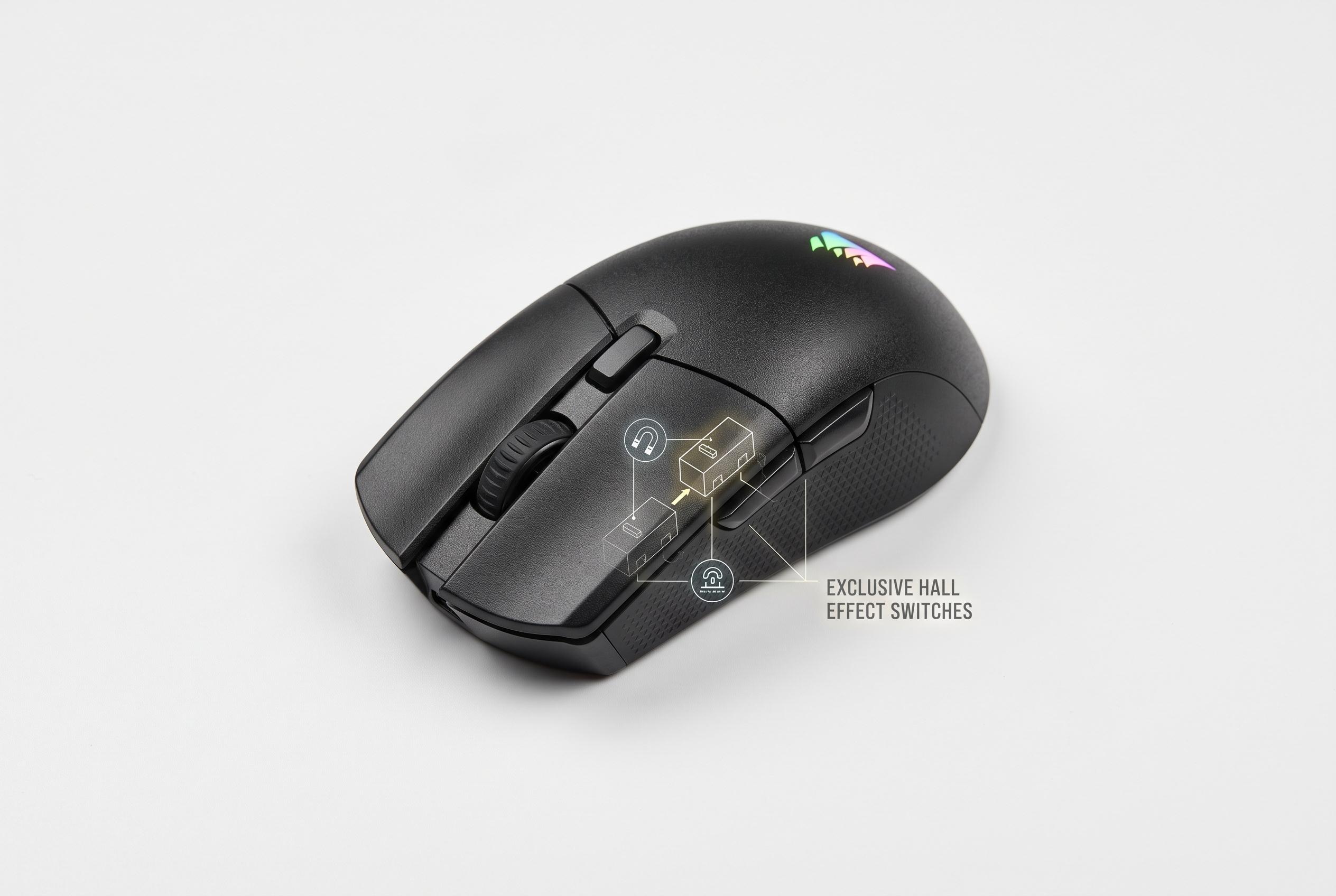

Corsair’s new Clipper Pro Mini 60 offers exceptional responsiveness for gamers with its innovative Hall Effect switch system and incredibly low input latency, but its proprietary hardware design may limit user servicing options.
Corsair’s Clipper Pro Mini 60 is a compact gaming keyboard built for speed rather than versatility. In Igor’sLab’s testing, the 60% board stood out for its exceptionally low wired input latency and its Hall Effect switch system, which uses magnetic sensing rather than traditional physical contacts. Corsair says the board is aimed at competitive play, with customisable actuation and a set of rapid-response features designed to shorten the path from key press to on-screen action. According to Corsair, the keyboard is priced at $99.99 and includes IP57 protection against dust and short-term water exposure.
The headline figure from the test is the measured 5.9 ms end-to-end latency at an 8,000 Hz polling rate over USB-C. Igor’sLab also recorded an average of 7.2 ms at 1,000 Hz, suggesting the higher polling rate brings a modest but measurable improvement in responsiveness. The test notes a slightly tighter spread at 8,000 Hz as well, which points to more consistent behaviour under the same conditions. Corsair’s own product material highlights the same 5.9 ms figure and the wired 8,000 Hz connection, reinforcing the keyboard’s focus on low-latency input.
The Clipper Pro Mini 60 also offers per-key actuation adjustment from 0.2 mm to 3.8 mm, a core advantage of Hall Effect keyboards. Corsair lists support for Rapid Trigger, Multi-Action, Smart Tap, Tap Lock and FlashTap SOCD, functions that are intended to make repeated movement and direction changes faster in games. The keyboard stores up to five profiles in 8 MB of onboard memory, and Corsair says configuration can be handled through its web-based hub rather than a local software install.
Igor’sLab was more guarded about the hardware structure itself. The review describes a fairly straightforward internal build with a plate-mounted layout, a Hall Effect PCB and a single damping layer, all housed in a plastic shell rather than aluminium. The keycaps are double-shot PBT, which is generally durable, but the report says the bigger concern is Corsair’s proprietary MGX Hyperdrive Core switch format. The switches were not removable with standard tools during the test, and the review did not complete a full teardown, so their exact mounting method was not confirmed. That leaves the Clipper Pro Mini 60 looking strong on performance, while less appealing for users who value easy servicing or broad switch compatibility.
Overall, the Clipper Pro Mini 60 appears to be a focused competitive keyboard with a clear trade-off: excellent latency and a feature set aimed at fast play, but a limited connection choice and a more closed hardware design. Corsair positions it as a compact alternative to larger gaming boards, and the company’s comparison material frames it as a Hall Effect step up from the mechanical K65 RGB Mini in areas such as custom actuation and movement tools. Based on Igor’sLab’s measurements, that positioning is broadly justified on responsiveness, even if the internal design is less ambitious than the performance figures suggest.
Disclaimer: This content is intended for informational purposes only. Readers are advised to exercise their own judgement, conduct due diligence, or consult a qualified expert before acting on any information provided.