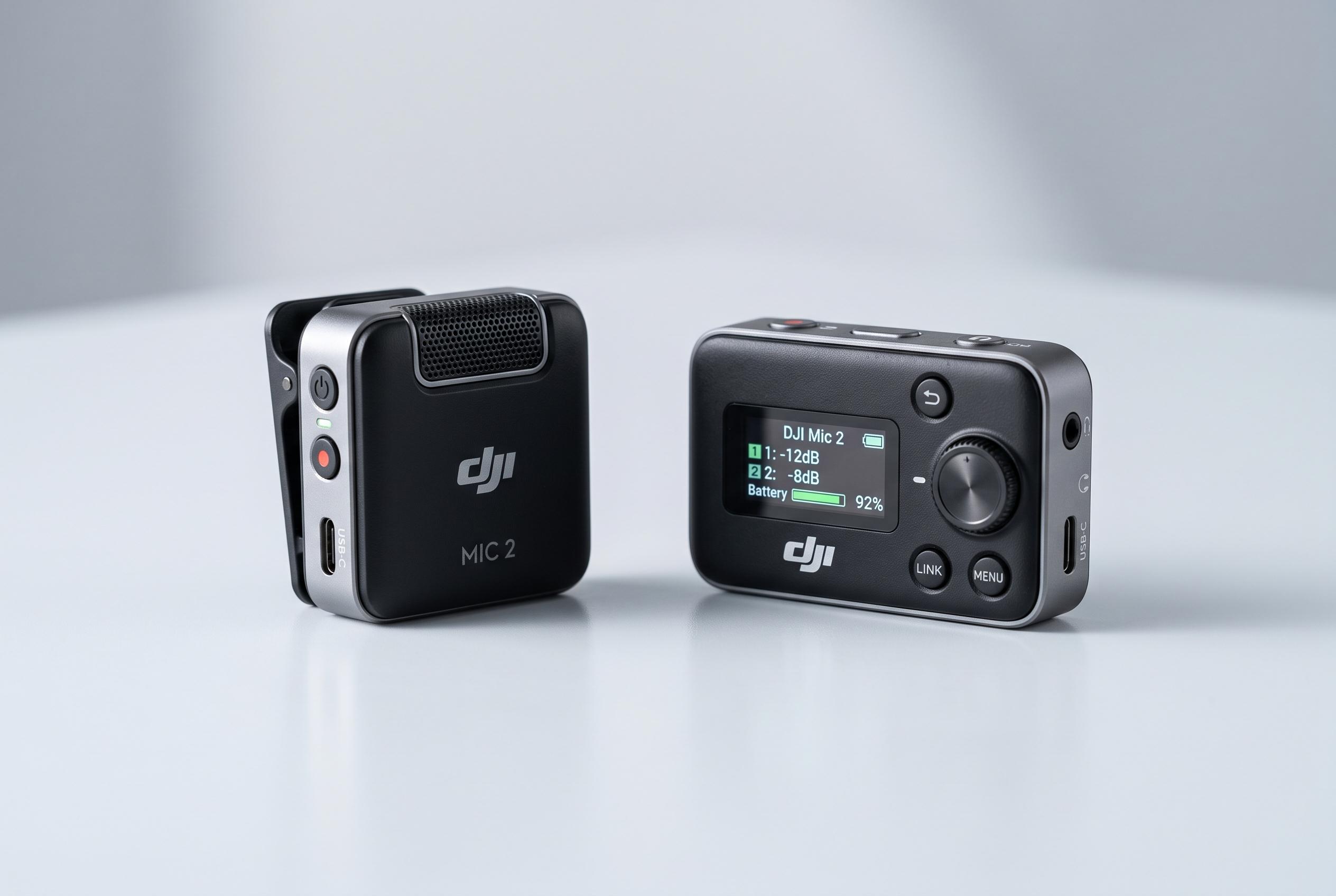

DJI’s latest Mic Mini 2S addresses creators’ need for reliable, discreet audio capture by adding internal recording and scalability while maintaining a compact design, challenging traditional large wireless mics.
DJI’s latest compact wireless microphone tries to solve a familiar creator problem: how to capture reliable audio without carrying gear that feels larger than the camera. The Mic Mini 2S keeps the tiny, discreet design of the earlier Mic Mini, but adds the features that matter most when recordings cannot be repeated. According to reviews and launch coverage, the new model is aimed at phone-first creators who now need something closer to a professional backup system than a basic social media accessory.
The hardware remains impressively small. Each transmitter weighs about 12g and can be clipped or attached magnetically, while the receiver is similarly compact. The system is also available with decorative magnetic face covers, giving creators a way to make the microphone less visually stark on camera. What DJI has still not added is a 3.5mm lavalier input, so users who want a fully hidden microphone will need a different setup.
The biggest change is internal recording. DJI has added on-board storage of about 14.5GB to 16GB, depending on the source, enough for roughly 28 hours of audio recording in standard mode. The transmitter also supports 32-bit float recording, a format that captures a wider range of loud and quiet sounds and reduces the risk of unusable clipping. That matters because wireless links can fail briefly in busy environments, and an internal backup can preserve an interview or event recording that would otherwise be lost.
Audio controls have also been broadened. The Mic Mini 2S offers three tone presets, Regular, Rich and Bright, alongside AI noise reduction with Basic and Strong modes. In practice, that gives users more control over how much background sound remains in the recording. Strong noise suppression can clean up traffic, wind or mechanical noise, although more aggressive processing can make speech sound less natural. For many creators, the quieter Basic setting will likely be the better default.
DJI has also made the system more scalable. One receiver can now handle up to four transmitters, with support for multi-channel recording on compatible gear. That opens the door to two-person interviews, panel discussions and small production setups without moving to a much larger wireless kit. The system retains a claimed transmission range of up to 400 metres in ideal conditions, though that figure is more about connection headroom than practical shooting distance.
Battery life remains solid for a compact product. The transmitters last about 11 hours and the receiver about 10 hours, with the charging case extending total use substantially. Several reports also note faster file transfer through the case and compatibility with DJI’s wider ecosystem, including Osmo devices. Pricing and availability vary by market, but the Mic Mini 2S is positioned above the cheaper Mic Mini as the more capable option for creators who want portability without giving up too many safeguards.
Disclaimer: This content is intended for informational purposes only. Readers are advised to exercise their own judgement, conduct due diligence, or consult a qualified expert before acting on any information provided.