
Epomaker’s NEX Pro challenges established brands with a lightweight, high-spec wireless gaming mouse featuring a distinctive RGB charging dock, aimed at competitive gamers seeking speed and precision.
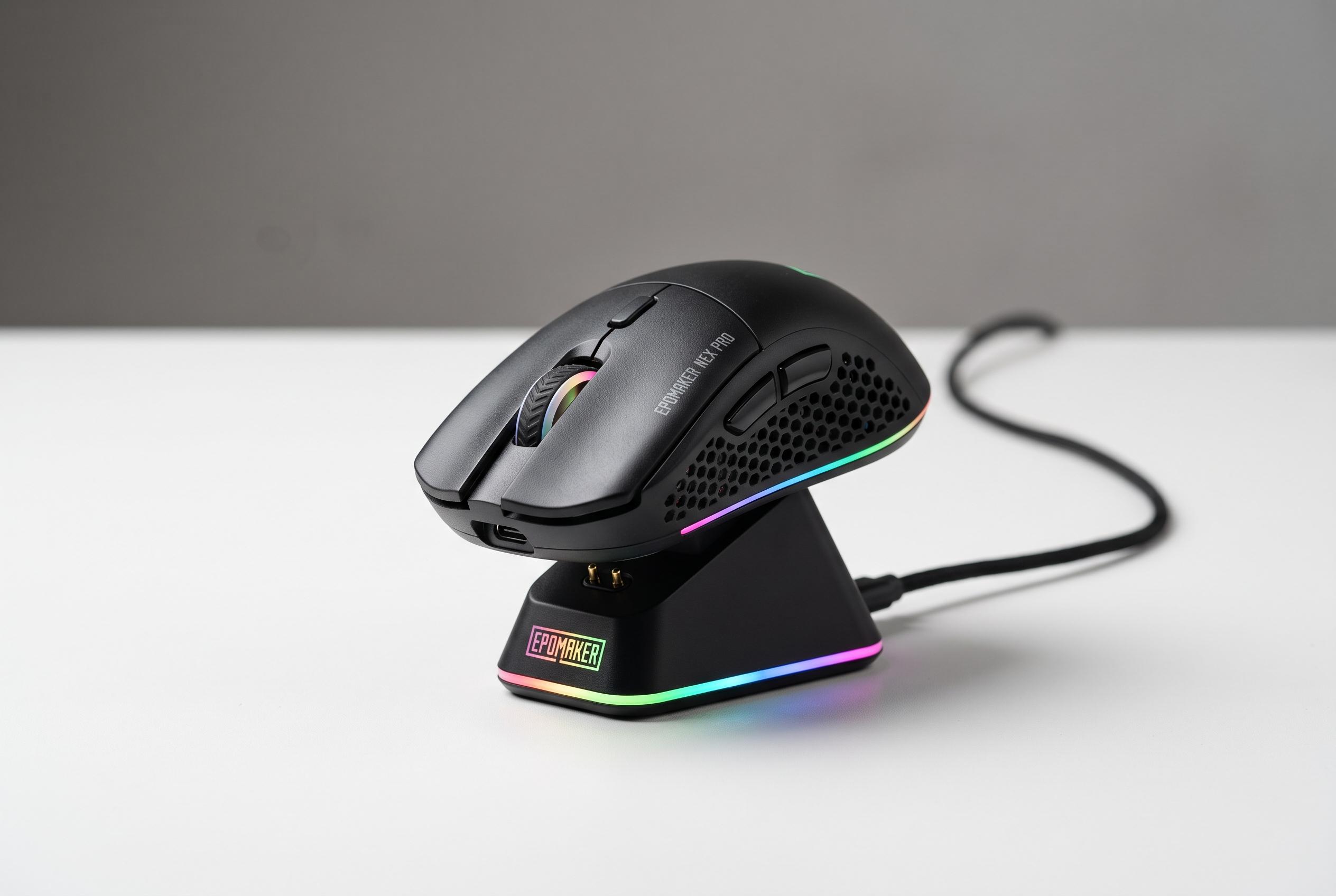
Epomaker’s NEX Pro is a clear attempt to move beyond keyboards and challenge established gaming mouse brands on performance. According to the company’s product material and multiple reviews, it is built around a 65g ABS shell, a PixArt PAW3950 sensor, a Nordic 54L MCU and tri-mode connectivity through 2.4GHz wireless, Bluetooth and USB-C. The headline specifications are aggressive, with sensitivity rising to 42,000 DPI and polling rates reaching 8,000Hz. That places it firmly in the category of mice aimed at players who want speed without giving up control.
In use, the shape is designed for right-handed players with medium to large hands. Reviewers consistently describe a pronounced rear hump and an ergonomic profile that supports longer sessions, particularly for palm and claw grips. The shell is rigid rather than hollow or skeletal, which helps it feel stable rather than fragile, and the 65g weight keeps movement light. A few testers noted that the matte surface can feel slippery without the supplied grips, but those grips are included in the box and improve purchase on both the sides and main buttons.
The charging dock is one of the NEX Pro’s most distinctive features. Epomaker says it includes an RGB base and battery/status display, and outside reviews say the dock is as practical as it is decorative. That matters because the mouse is wireless-first, and the dock reduces friction in everyday use. Compatibility is broad too, covering Windows, macOS, Linux, PS4 and PS5, while the browser-based configuration software avoids the need to install a separate desktop application.
Performance is where the mouse appears to justify its premium positioning. In fast, competitive games, the high polling rate and low-latency wireless mode are intended to make cursor movement feel more immediate, while the sensor’s tracking range should suit rapid flicks and fine adjustments alike. In slower, precision-driven play, the same hardware is meant to provide clean low-speed control without obvious smoothing or loss of tracking. Several reviews describe the NEX Pro as a strong balance of speed and restraint, with value depending partly on whether a player will actually benefit from 8,000Hz operation.
The broader conclusion is that Epomaker has built a mouse that looks less like an experiment and more like a serious bid for the upper end of the gaming peripheral market. Its strengths are obvious: lightweight construction, a capable sensor, a versatile shape and a dock that makes charging genuinely convenient. Its limitations are more situational. The extreme polling rate will matter most to competitive players, while casual users may never notice it. Even so, the NEX Pro comes across as a technically ambitious mouse that is easier to recommend than many first-generation attempts in this space.
Disclaimer: This content is intended for informational purposes only. Readers are advised to exercise their own judgement, conduct due diligence, or consult a qualified expert before acting on any information provided.