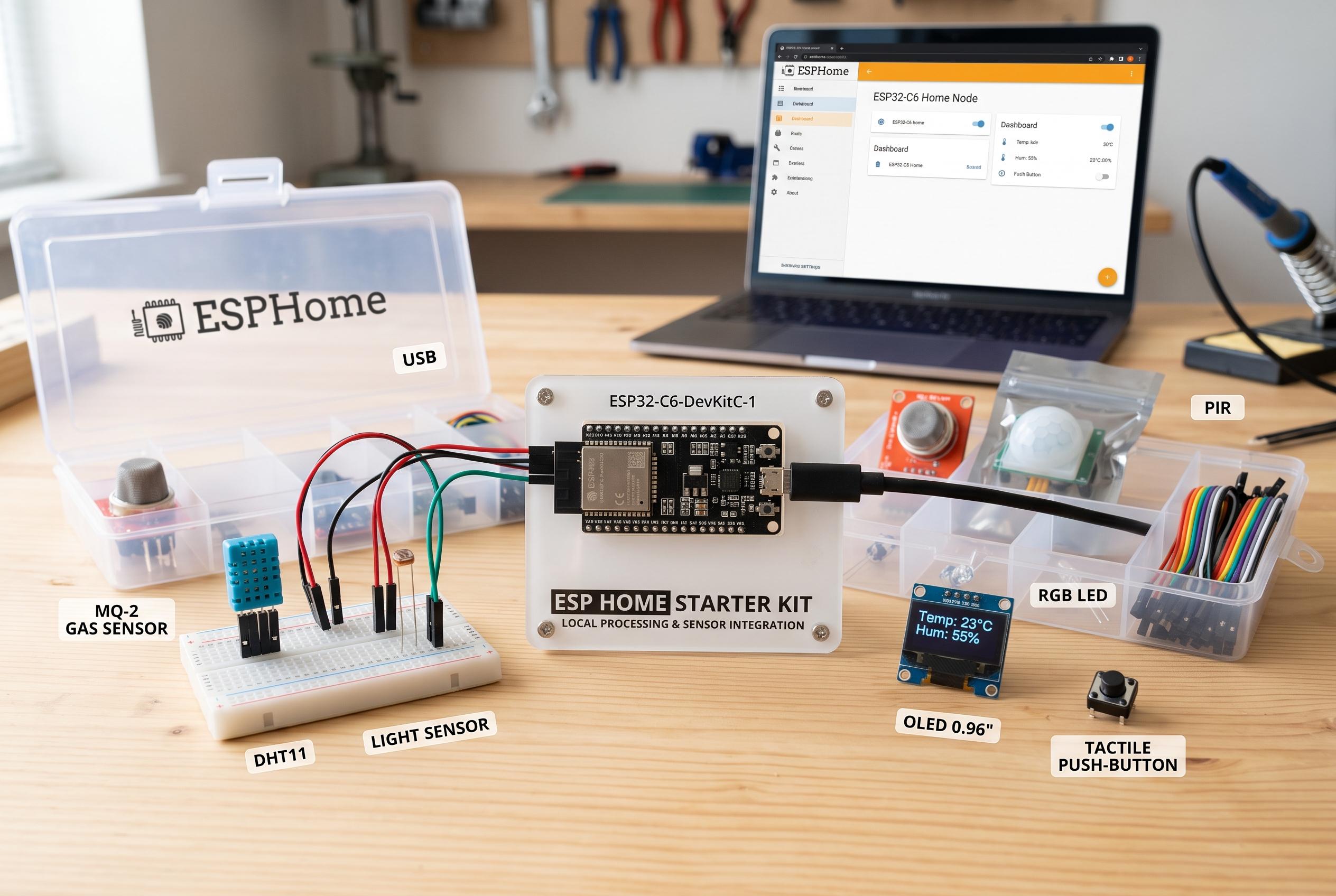

The new ESP Home Starter Kit leverages the powerful ESP32-C6 microcontroller to lower barriers for home automation, emphasising local processing, user-friendly setup, and educational potential for families and enthusiasts seeking customisable, less proprietary smart device solutions.
The ESP Home Starter Kit is being positioned as a more approachable way into smart home hardware, combining preselected components with software designed to reduce the amount of coding required. Smart Home Solver, which highlighted the kit, says it is built around the ESP Home platform and aimed at users who want to assemble useful devices without having to start from scratch.
At the centre of the package is Espressif’s ESP32-C6, a microcontroller that supports Wi-Fi 6, Bluetooth 5.3, Zigbee and Thread, according to Espressif’s product overview. That mix gives the board more flexibility than a basic Wi-Fi-only device and makes it suitable for low-power connected projects, particularly in homes where multiple standards may need to coexist.
The kit also includes a motion sensor, a temperature and humidity sensor, an LED and buzzer combination and ribbon cables for assembly. Those parts are enough to cover common automation tasks such as presence detection, environmental monitoring and simple alerting. Comparable ESP32-C6-based boards from other manufacturers also pair the chip with onboard sensors, LEDs and USB-C programming connections, underlining how the platform has become a practical base for compact connected devices.
Setup is intended to be guided by the ESP Home Device Builder app, which generates YAML configuration automatically while still allowing manual editing for more advanced users. That matters because ESP Home has become popular precisely by lowering the barrier to entry for device configuration while keeping the underlying code accessible when users want more control.
A major selling point is local automation. Instead of depending on cloud services, the kit can run without an internet connection, which improves resilience if Wi-Fi fails and keeps data handling closer to the home. Smart Home Solver also notes that it can act as a Bluetooth proxy for Home Assistant, extending the reach of that platform for nearby devices.
The appeal is not only technical. The kit is also pitched as a learning tool for individuals and families, especially those using it to understand how sensors, triggers and automations work in practice. That aligns with a broader trend in the smart home market, where open-source ecosystems such as ESP Home and Home Assistant continue to attract users who want more transparency, more customisation and less dependence on proprietary platforms.
Disclaimer: This content is intended for informational purposes only. Readers are advised to exercise their own judgement, conduct due diligence, or consult a qualified expert before acting on any information provided.