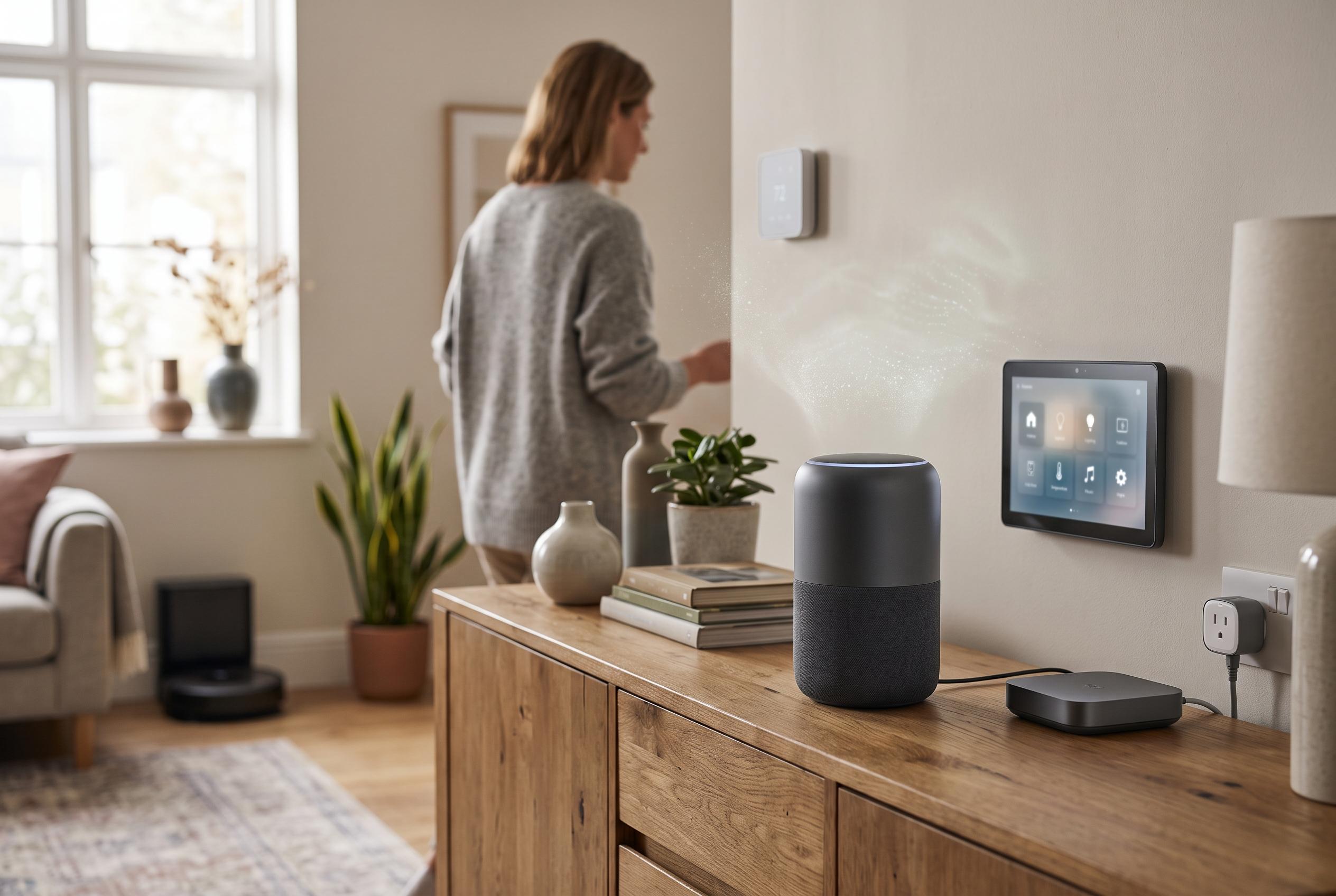

Google’s latest smart speaker signals a strategic shift towards home automation, leveraging the new Gemini AI for more natural interactions and centralised smart home control, marking its first major hardware update in years.
Google Home Speaker marks a clear shift in how Google wants a smart speaker to be used. Rather than selling it as a pure audio product, the company is positioning the device as a fixed Gemini terminal for the home: always plugged in, always listening for commands, and designed to sit at the centre of a Google Home setup. At 1,399 kroner in Norway, or $99.99 in the US, it is also Google’s first genuinely new smart speaker in years, following a long gap since the Nest Audio era.
The hardware is modest but purposeful. Google has moved away from the elongated Nest Audio shape and towards a compact, near-spherical design that invites comparison with Apple’s HomePod mini. It uses a single 58 mm full-range driver, three far-field microphones, Wi-Fi 6, Bluetooth 5.4 and Thread 1.3, while also acting as a Matter controller and Thread border router. Google’s own blog says the speaker was built around Gemini for Home, with support for more natural, multi-step requests and deeper smart home control.
That is where the product becomes more interesting than as a speaker alone. Gemini is much more tolerant of incomplete phrasing, follow-up instructions and chained requests than the older Google Assistant. In practice, that means a user can turn on a light and then say “dim it a little” without repeating the device name, or ask for several actions at once. Tom’s Guide and Android Central both note that this conversational behaviour is the main advance, although Android Central also reported that some routine tasks can still feel inconsistent at times.
Sound quality is respectable for the size, but the limits of the single-driver design are obvious. The speaker is fine for background music, podcasts or kitchen radio, and its 360-degree output is useful in small rooms. But both Tom’s Guide and SoundGuys said it does not compete with larger smart speakers on bass, detail or overall fullness, and Google’s older Nest Audio still has the edge if music is the priority. Digital Trends described the unit as a stronger smart home companion than a serious hi-fi product.
The smart home side is where the value proposition becomes clearer. For homes already built around Google Home, Matter and Thread, the speaker can serve as a practical control point for lights, cameras, thermostats and routines without forcing the user back to a phone. Google is also bundling six months of Google Home Premium Standard for qualifying new users who buy the speaker by 30 September 2026, but the advanced Gemini features then move behind a subscription. That reinforces the sense that this is less a traditional speaker than a piece of always-on home infrastructure.
For households with little smart home gear, the case is weaker. A phone or tablet already offers microphone access, speaker output and the same assistant layer, without the need for another mains-powered device. But for users with a sizeable Google-based setup, the Home Speaker looks like a sensible, if narrowly focused, control hub.
Disclaimer: This content is intended for informational purposes only. Readers are advised to exercise their own judgement, conduct due diligence, or consult a qualified expert before acting on any information provided.