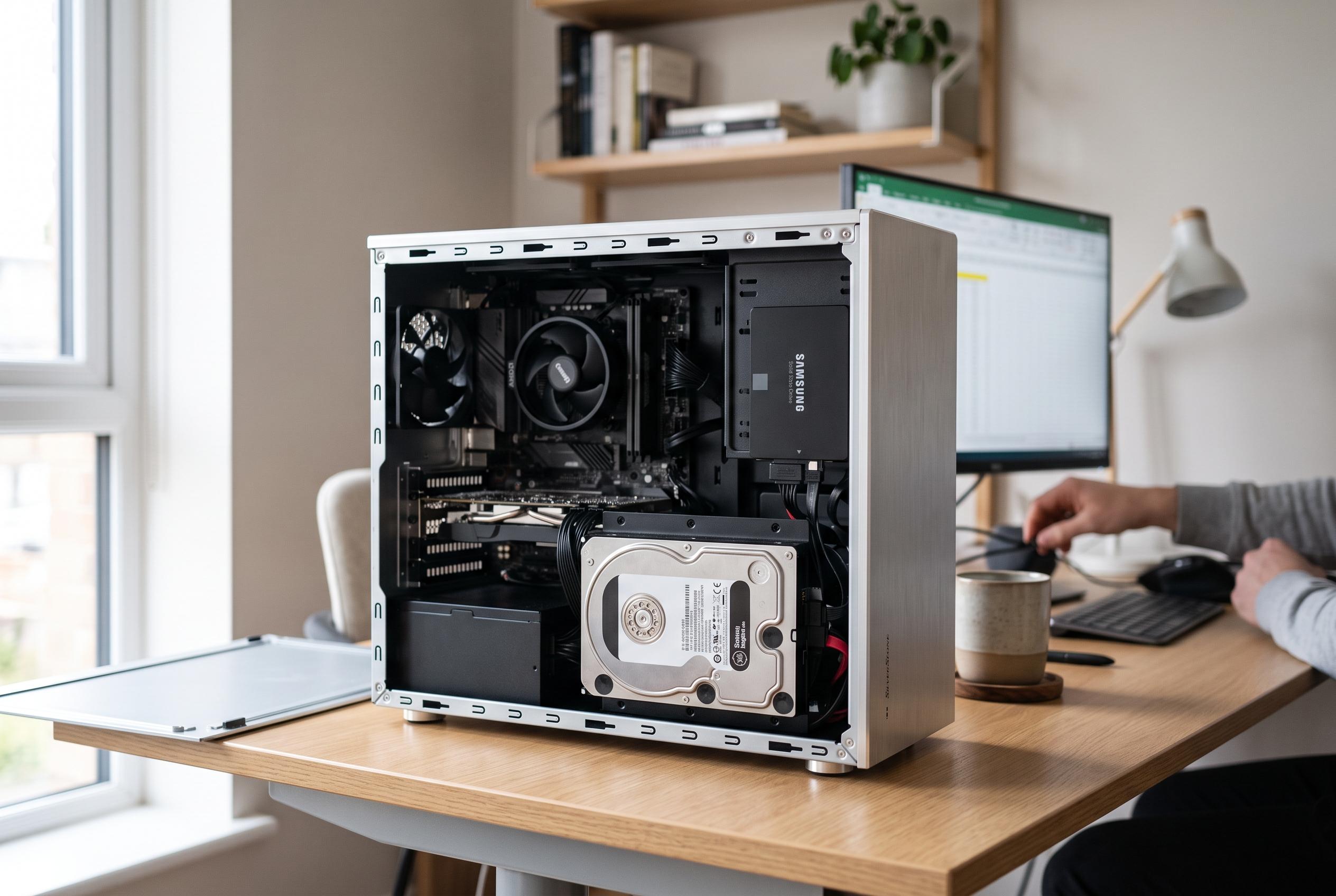

The resurgence of hard disk drives in budget PC builds signals a shift driven by persistent NAND flash shortages caused by AI data centre demand, challenging the dominance of SSDs in the market.
For years, hard disk drives seemed destined for the footnotes of PC building, pushed aside by faster solid-state storage. But the latest market shift suggests they are not going away. According to recent reporting, the cost and availability of NAND flash are rising enough to make large-capacity HDDs attractive again for budget-conscious builders who need bulk storage rather than speed.
The broader problem is the artificial intelligence boom. Tom’s Hardware reported that memory shortages linked to AI data centre demand are already distorting component costs for smaller device makers, with some firms saying memory now accounts for a striking share of the bill of materials. That pressure is not limited to DRAM. SSD pricing has also remained elevated as NAND supply is pulled towards server and enterprise demand, leaving fewer drives for retail channels and the consumer PC market.
Industry executives have warned that the squeeze may not ease quickly. Phison’s chief executive, Pua Khein-Seng, has said NAND supply is unlikely to fully catch demand until around 2030, while SK hynix chief executive Kwak Noh-Jung has indicated that the memory shortage could persist through the end of that year. TrendForce, by contrast, sees some relief in NAND earlier, with one forecast pointing to an easing by late 2027, though that does not necessarily mean a return to normal pricing across the board.
For PC builders, the practical effect is straightforward. A system that once relied almost entirely on SSDs may now be split between a smaller, faster boot drive and a cheaper mechanical disk for media, archives and game libraries. That is a familiar pattern from an earlier era, but it is being revived for a different reason: not performance preference, but supply pressure.
Disclaimer: This content is intended for informational purposes only. Readers are advised to exercise their own judgement, conduct due diligence, or consult a qualified expert before acting on any information provided.