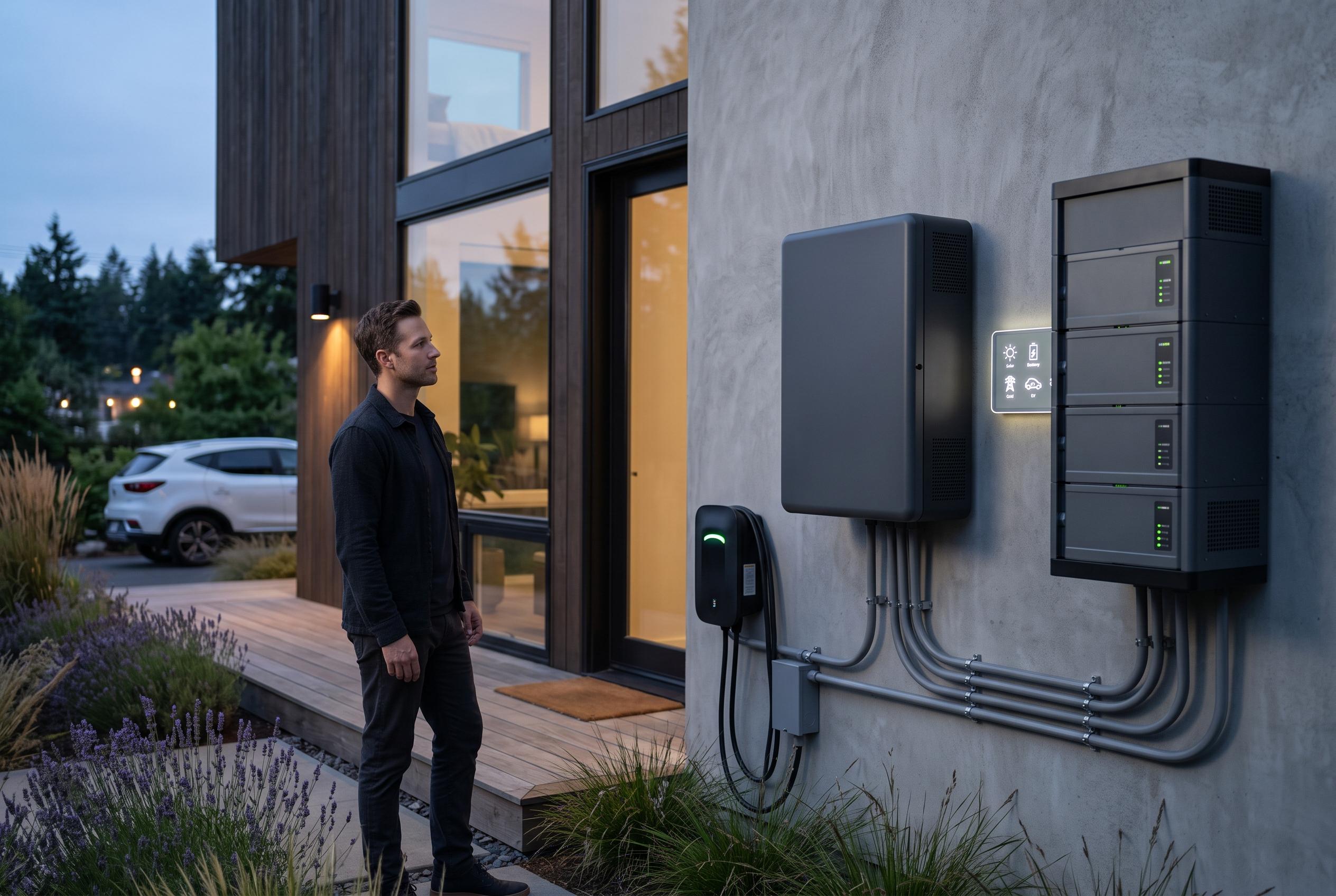

As the market for home battery systems matures, a range of innovative options now challenge Tesla’s Powerwall, offering modularity, EV integration, and longer warranties to meet growing homeowner demand for resilient, flexible energy solutions.
Tesla’s Powerwall may still set the benchmark for home storage, but the market around it has matured quickly. As more households look for resilience against outages, higher bills and grid strain, a growing number of battery systems now offer similar backup functions with different strengths, from modular expansion to EV integration and longer warranty cover. Electrek’s round-up highlights that the choice is no longer simply between buying a Powerwall or doing without.
Among the more flexible options is Anker’s SOLIX X1, which SolarReviews describes as a modular system that begins at 5 kWh and can scale to 30 kWh per unit, with multiple systems combined for far larger installations. The design uses LiFePO4 cells, supports a wide temperature range and can be stacked to suit changing household demand, making it more adaptable than many fixed-capacity rivals.
BLUETTI’s EP800 takes a different route. According to the company, it is an all-in-one storage system built around the EP800 inverter and B500 battery packs, with installation intended to be straightforward and the system able to operate with solar or independently from it. That gives it appeal for buyers who want backup power and time-of-use savings without committing immediately to rooftop solar.
Enphase positions its IQ Battery 5P as part of a broader home-energy ecosystem, tying storage to microinverters and EV charging. The system is aimed at homeowners who want a more complete platform rather than a single battery cabinet, and its off-grid framing underlines how home storage is increasingly being packaged as part of a wider energy-management stack.
FranklinWH’s aPower S follows the Powerwall model of combining battery and inverter into one clean unit. Each module stores 15 kWh of usable energy and can be paired with others for larger properties, while integration with existing solar systems and virtual power plant programmes adds another layer of flexibility. GM Energy, meanwhile, is pushing a more tightly integrated EV-plus-home-backup proposition, with a 10.6 kWh system sold directly through GM and designed to work with its vehicle ecosystem.
Perhaps the most technically distinctive alternative is Sigenergy V2X, which Electrek says has become a more practical route for owners of certain EVs to use their car as household backup power. That matters because bidirectional charging remains limited across much of the market. At the premium end, Villara’s VillaGrid+ stands out for its lithium-titanium-oxide chemistry and a 20-year warranty, which EnergySage says makes it one of the strongest batteries available, even if its price is well above the Powerwall’s. The broader picture is clear: for homeowners comparing storage systems in 2026, Tesla is still the reference point, but no longer the only serious option.
Disclaimer: This content is intended for informational purposes only. Readers are advised to exercise their own judgement, conduct due diligence, or consult a qualified expert before acting on any information provided.