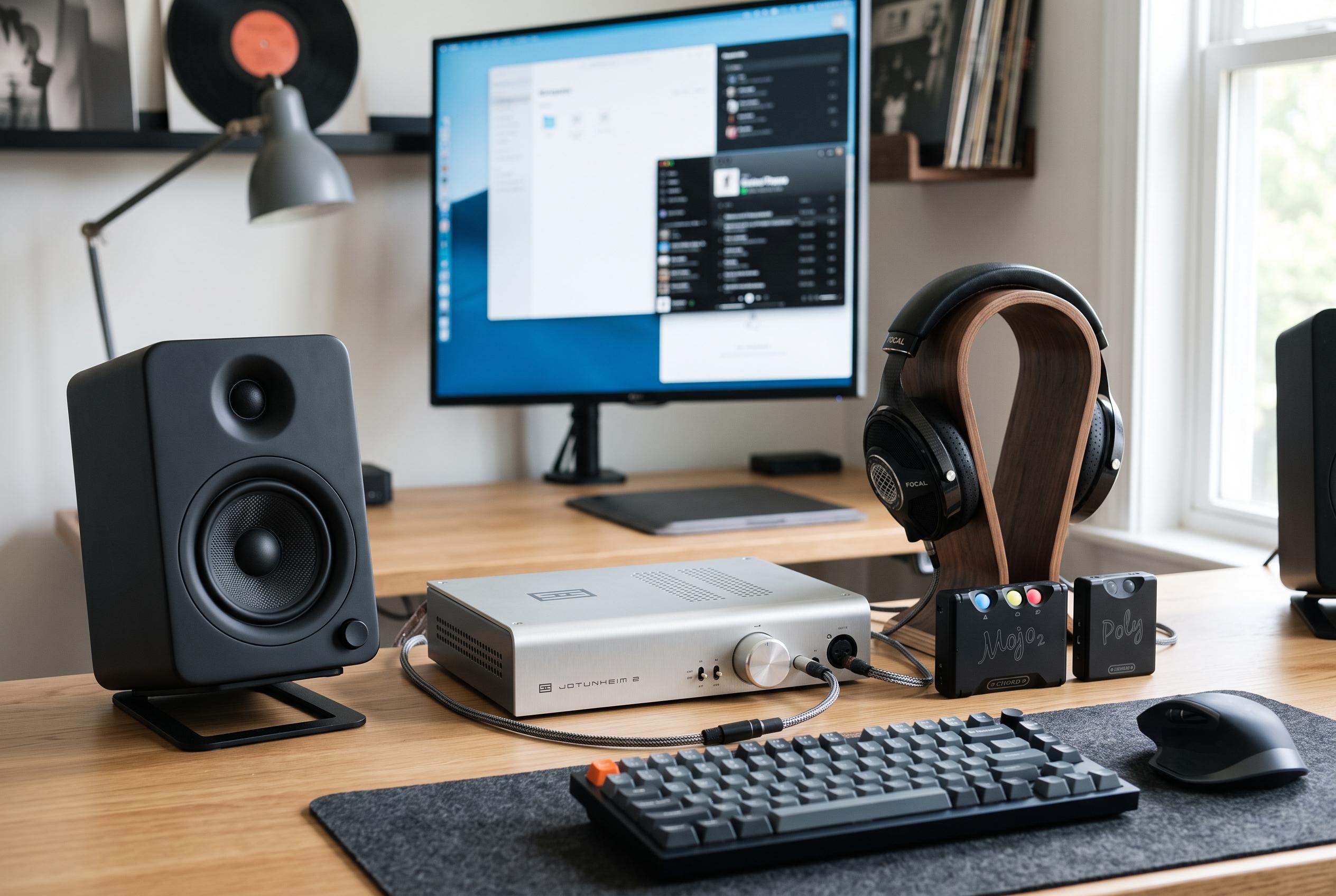

While many desktop and laptop manufacturers focus on processors and design, recent advancements in audio hardware and accessories are enabling enthusiasts to significantly upgrade their computer sound, ranging from external speakers to high-res DACs and wireless solutions.
For many desktop PCs and laptops, sound quality is an afterthought. Manufacturers tend to prioritise processors, graphics and battery life over audio hardware, which leaves built-in speakers and headphone outputs sounding merely adequate rather than impressive. That is less true on some newer laptops, where companies such as HP, Samsung and Apple have invested more in tuning and speaker design, but the limits of a thin chassis remain hard to escape.
The most straightforward upgrade is still a pair of external speakers. TechRadar notes that models with integrated digital-to-analogue converters can deliver cleaner playback than basic analogue setups, while wireless systems are convenient for desk use. Wi-Fi speakers generally outperform Bluetooth alternatives because they have greater bandwidth, and a separate subwoofer can add weight and depth without taking up much visible space. Crutchfield makes a similar case for turning a computer into part of a proper listening system rather than treating it as a temporary source.
Headphones are another strong option, especially where space is limited. A portable USB DAC can improve sound from a computer’s built-in audio output, and TechRadar’s DAC round-up shows how even compact devices can support hi-res playback. For more demanding listeners, a dedicated headphone amplifier or a DAC-and-amp combination can provide better control and detail. RTINGS also notes that many wireless headphones now offer their own equalisation controls through companion apps, which can store settings on the headset itself and keep them active across devices.
A computer can also feed into a home audio system with very little effort. Crutchfield says a simple 3.5mm-to-RCA lead is enough for a basic connection, while a USB DAC gives a cleaner path into a receiver or powered speakers. Best Sounds explains that most DACs can connect to speakers through RCA, or through balanced XLR connections on higher-end equipment. Wireless links are possible too, whether through Bluetooth speakers or USB transmitters paired with remote receivers.
Software and file quality matter as well. EQ tools can correct for room acoustics, and loudness apps can push weak built-in speakers further, though excessive use can cause distortion and long-term damage. What Hi-Fi warns that DAC owners often overlook power supply quality, filters and output options, all of which can affect the result. Beyond that, the simplest gains often come from practical habits: close unnecessary programmes, keep cables in good condition, reduce vibration near speakers, and use lossless or hi-res formats such as FLAC, WAV, AIFF or ALAC when possible.
Disclaimer: This content is intended for informational purposes only. Readers are advised to exercise their own judgement, conduct due diligence, or consult a qualified expert before acting on any information provided.