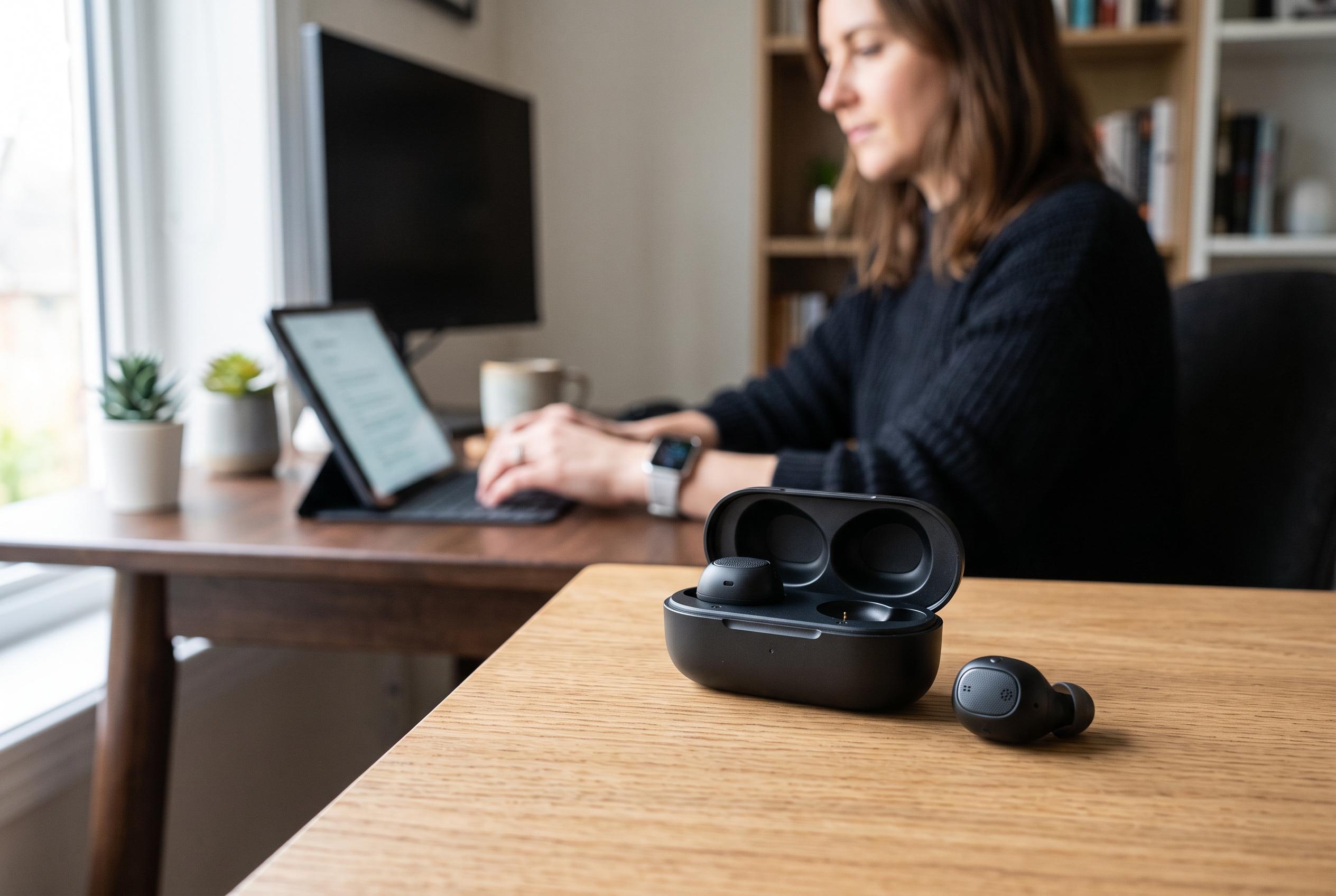

Huawei launches the FreeBuds Neo, a mid-market true-wireless earbud with unique interoperability, advanced noise cancellation, and customisable spatial audio, aiming to compete with premium models across devices and ecosystems.
Huawei has used its 2 September 2026 launch event in Munich to introduce FreeBuds Neo, a new true-wireless earbud range that is being pitched as much on cross-platform convenience as on sound. The earbuds are scheduled to reach the UK on 23 September at £119.99 through the Huawei Store, Amazon, Argos, Very and selected retail partners, with a £20 introductory discount running until 26 October.
The company is treating Neo as a distinct series rather than as a straight successor to an existing FreeBuds model. That matters because the clearest commercial angle is interoperability. Johanna Romero wrote in PhoneArena that Huawei is targeting people moving between “an iPhone, a Galaxy S26 Ultra and a Windows laptop”, while Huawei’s Nordic launch material says the earbuds can stay connected to two devices at once even when those devices use different operating systems. Huawei did not announce US pricing or a US release date at the launch.
On the hardware side, Huawei is emphasising fit and wearability almost as strongly as acoustics. The earbuds weigh about 4.8g each and sit in what the company calls a “mini shuttle case”. On its global product page, Huawei says the fit work was informed by research on 150 ear profiles and more than 10,000 ear samples worldwide, with pressure redistributed across the in-ear structure to make longer listening sessions more comfortable. The same material says the stem design leaves a 60% touch area for taps and swipes. Frandroid reported that Huawei had used real ear morphology data in shaping the buds, reinforcing the company’s comfort-first message.
Noise cancellation is one of the more ambitious claims at this price. Huawei says the FreeBuds Neo use a dual-channel acoustic design with a C-shaped tube and vent system, backed by a third-generation audio chip and adaptive algorithms. According to the company, the earbuds analyse environmental noise up to 400,000 times per second, with processing latency as low as 8 microseconds. Huawei quotes an average full-frequency active noise cancellation depth of 30dB and says suppression can peak at 55dB in specific bands. Those figures come from Huawei’s own laboratory testing rather than independent measurements, but they show how aggressively the company wants this model to compete.
The audio specification is also more elaborate than the price might suggest. Huawei says the buds use a new Turbo driver and markets the result as “Authentic Live Sound”. Huawei’s product materials and regional launch releases describe an ultra-wide 10Hz to 48kHz range, while support for higher-bitrate audio splits along ecosystem lines: up to 990kbps over LDAC on compatible non-Huawei devices, and up to 2.3Mbps lossless transmission only when paired with selected Huawei phones or tablets. For calls, Huawei says three microphones and a bone-conduction microphone are used to keep speech intelligible, with the company claiming performance in background noise up to 95dB and winds up to 9 metres per second.
Spatial processing is another headline feature, and here Huawei is trying to avoid the usual ecosystem lock. The company says “Unlimited Spatial Audio” is handled by processing inside the earbuds themselves, which in principle lets the effect work regardless of source device or content type. Frandroid reported that this creates a 360-degree soundstage independent of phone brand, while Huawei’s support material says users can switch between head-tracked and fixed listening modes. Huawei is also promoting an FPS gaming mode intended to sharpen directional cues such as footsteps and gunfire.
Practical controls are woven through the rest of the package. Huawei says the earbuds support double-tap, triple-tap, swipe and press-and-hold gestures, and its Audio Connect app is used for settings such as noise control, battery checking and earbud location. The company has also promised watch-based controls through a future over-the-air update, allowing some compatible Huawei watches to handle pairing, battery checks and sound-mode changes without taking out a phone. Broad compatibility is part of the pitch: Huawei says the earbuds work across Android, iOS and Windows, rather than keeping the richer feature set entirely inside its own device family.
Battery life and regional rollout help place the product more precisely. Huawei says the buds can last up to 10 hours on a charge with noise cancellation off, or 6.5 hours with it on, with total playback of up to 40 hours when the case is included. France is due to get the FreeBuds Neo first, on 17 September, at €129 with a launch promotion cutting that to €109, according to Frandroid. In the Nordics, Huawei’s regional press material says the recommended price is DKK 999 and that Swedish sales will begin on 12 October. There is also a small discrepancy over finishes: UK and global materials list four colours, including Nebula Pink, while the Nordic release mentions only silver, white and black, suggesting colour availability may vary by market.
Taken together, the FreeBuds Neo look less like a stripped-back flagship imitation than a mid-market attempt to solve a specific user problem: people who want one pair of earbuds for mixed-device use without giving up active noise cancellation, spatial audio and higher-bitrate wireless playback. The compromise is familiar. Huawei is promising openness across platforms, but the most ambitious codec performance still depends on Huawei hardware, and some convenience features will arrive later through software updates. Even so, at just under £120 in the UK, the new model gives Huawei a more pointed answer to buyers weighing AirPods, Galaxy Buds and other mainstream wireless options.
Disclaimer: This content is intended for informational purposes only. Readers are advised to exercise their own judgement, conduct due diligence, or consult a qualified expert before acting on any information provided.