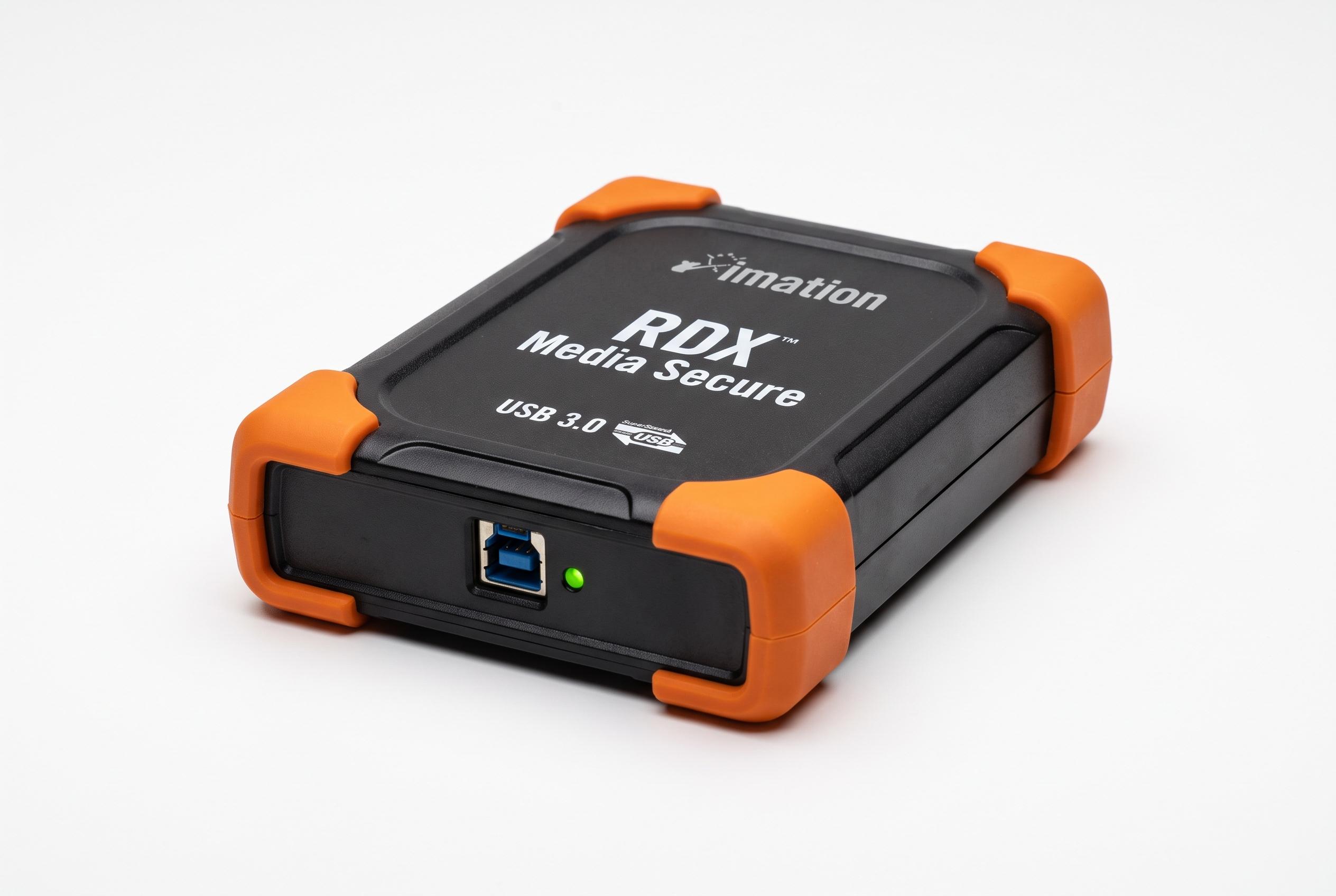

While outdated as a primary backup solution, Imation’s RDX Media Secure remains valuable for organisations with existing hardware, highlighting enduring offline backup strategies amid evolving storage technology.
Imation’s RDX Media Secure USB 3.0 belongs to an earlier era of small-business backup hardware, but its design still makes sense in one narrow respect: it treats removable disk media as a transportable, offline backup set rather than as an ordinary USB drive. StorageReview’s 2013 review found that the unit paired a USB 3.0 dock with cartridge-based storage, offering a more structured way to rotate, carry and store backups than a conventional external hard drive. The same review also noted the device’s automatic encryption and straightforward setup, qualities that made it appealing to small and medium-sized businesses looking for secure backup hardware.
The hardware itself was built for resilience rather than portability. According to StorageReview, the dock used a metal chassis with protective rubber bumpers, while the removable cartridge format was intended to survive repeated handling and off-site movement. That physical design explains why RDX was positioned as a tape-like alternative: the point was not raw interface speed, but the operational discipline of swapping cartridges, labelling them, and keeping one or more copies away from the primary system.
Performance, however, was never the system’s strongest claim. StorageReview said the product did not fully match the manufacturer’s theoretical speed figures, even though it remained usable for backup workloads. The more important limitation in 2026 is not only speed, but the age of the surrounding software and support stack. Historical installation flows depended on legacy backup software and older runtime components, which means buyers cannot assume the original setup process will work cleanly on modern Windows environments.
That makes the product most relevant to organisations that already own a working RDX ecosystem. For those users, the value lies in continuity: existing docks, known-good cartridges and documented recovery procedures may still support an inexpensive offline backup workflow. For everyone else, the comparison set is now broader and often more practical. A modern USB hard drive, NAS system, cloud backup service or LTO tape library may offer better support, easier recovery or lower cost, depending on the scale of the data and the need for rotation, encryption and off-site storage.
The key point is that RDX Media Secure was never just about USB 3.0. It was a cartridge-based backup method designed to separate active storage from removable media management, and that remains its main strength. But in 2026, its appeal is largely historical: useful for owners of existing hardware, less compelling as a fresh purchase, and unsuitable as a single-point backup strategy for critical data.
Disclaimer: This content is intended for informational purposes only. Readers are advised to exercise their own judgement, conduct due diligence, or consult a qualified expert before acting on any information provided.