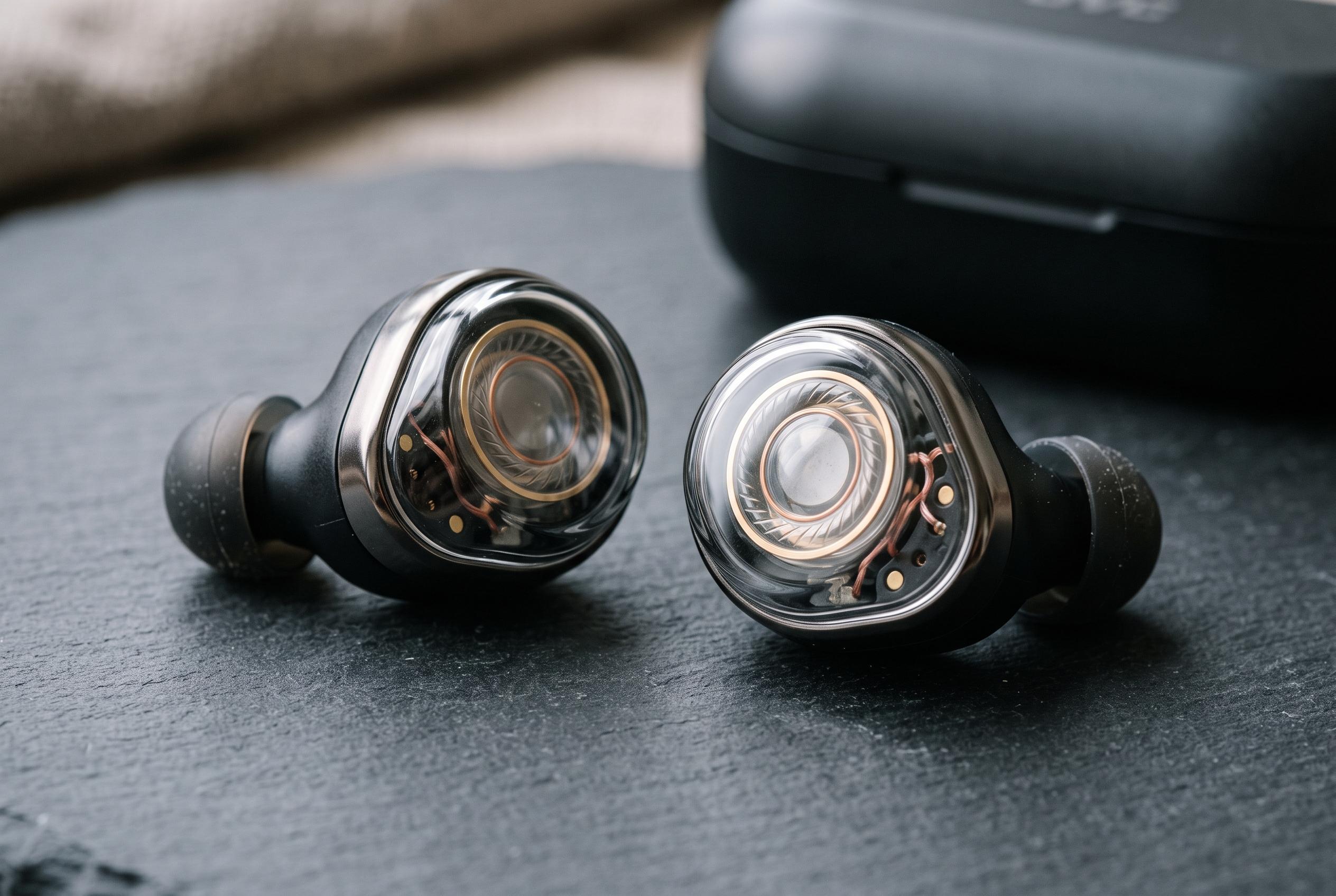

An exclusive look at JVC Kenwood’s GLASS Core Pro, which introduces industry-first glass diaphragms and impressive battery life, signalling a significant shift in the high-end wireless earbud market overshadowing traditional brands.
The most interesting development in this corner of the wireless-earbuds market is not another iterative update from an established premium brand, but JVC Kenwood’s late arrival. The GLASS Core Pro is the newest of the three models under discussion, having been launched in Japan in June 2026 as part of the company’s 80th-anniversary line. That matters because it brings a distinctly different engineering brief to a category usually dominated by app features and noise-cancelling claims: a 10mm glass-diaphragm dynamic driver paired with a MEMS unit, driven in a two-way bi-amp configuration, alongside K2 upscaling, spatial-audio support and unusually long quoted endurance.
AV Watch’s review of the Kenwood explains why the model stands apart from the brand’s cheaper sibling. The standard GLASS Core uses only the 10mm glass driver, while the Pro adds the MEMS element, physical buttons and extra processing intended to lift treble detail and spatial information. Kenwood’s own materials describe the glass diaphragm as an industry first in wireless earbuds, though that is a company claim rather than an independent industry ruling. What is easier to verify is the stamina: up to 14.5 hours from the earbuds with noise cancelling off, or 12 hours with it on, plus a case total reaching 49 hours. In a field where premium models often accept shorter battery life in exchange for compact size, that is a meaningful differentiator.
Bowers & Wilkins takes almost the opposite approach with the Pi8. Independent reviews have treated it less as a technical curiosity than as a refined flagship. What Hi-Fi praised the earbuds’ dedicated DAC/DSP stage, 12mm carbon-cone drivers and support for Bluetooth 5.4, aptX Adaptive and aptX Lossless, while also noting IP54 protection, a 15-minute top-up for roughly two hours of listening and one of the most useful charging-case tricks in the segment: wired retransmission from a USB-C or 3.5mm source to the earbuds. WIRED, approaching the product from a broader consumer-technology angle, argued that the Pi8’s sound quality matters more than its noise cancelling and judged the redesign a success after the awkwardness of earlier Bowers & Wilkins earbuds. Pricing, however, has not been entirely stable across coverage, with Audio46 listing the model at $499 and WIRED reviewing it at $399 in the US.
The Noble Audio FoKus Rex5 is the most overtly audiophile proposition of the three, and also the most uncompromising. TechRadar says it has been on sale since November 2024 at $449, using a five-driver arrangement in each earbud: one 10mm dynamic driver, one 6mm planar magnetic driver and three balanced armatures. That specification is rare in a true wireless design and helps explain why the Rex5 is repeatedly described as fast, detailed and highly resolving. It also includes Bluetooth 5.4, multipoint, aptX Adaptive, LDAC and Audiodo hearing calibration. Noble’s own product page says the QCC3091 chip can store the listener’s personal hearing profile in the earbuds after setup, so the custom tuning does not depend on the app remaining open. The drawback, according to both TechRadar and Noble’s own published figures, is endurance: around seven hours without ANC, five with it.
That trade-off runs through almost every review. TechRadar found the Noble exceptionally revealing but light in low-end body, warning that the bass balance will not satisfy every listener. Lyd & Billede reached a similar conclusion from a more hi-fi-focused European perspective, describing the Pi8 as warmer and more forgiving, and the Rex5 as quicker, more controlled and ultimately the most detailed and dynamic of the premium models it compared. The same Danish review also added an important caveat about Audiodo: personal correction can improve tonal balance, but if the EQ differs too much between left and right ears it may blur the stereo image. That is a more useful warning than the usual claim that personalised audio is automatically better.
The soundstage question is where the commentary becomes most divided. Audio46 heard the Rex5 as the more expansive and analytical earbud, with the Pi8 presenting music in a denser, bass-led way. Major HiFi, by contrast, judged the Pi8 to have the broader and more engrossing stage, while casting the Rex5 as slightly more intimate but stronger at placing instruments in discrete positions. Those views are not completely irreconcilable: several reviewers agree that the Noble is the sharper tool for picking out detail, while the Pi8 tends to sound more unified and immediately enjoyable. What changes between reviewers is whether that cohesion is heard as welcome musical organisation or as a narrower perspective than the Rex5.
Day-to-day usability follows a clearer pattern. The Pi8 is widely treated as the most polished all-rounder, especially for people who will use the case retransmission feature, want straightforward touch controls and value strong call handling. Major HiFi went so far as to call it the better smartphone companion. The Rex5 offers deeper personalisation and more ambitious internal hardware, but reviewers are less convinced by its ANC and battery life than by its sonic capability. Lyd & Billede said outright that noise reduction is stronger in rival Sennheiser and Sony models, and TechRadar described Noble’s cancellation as good rather than class-leading. The Kenwood, meanwhile, appears to have the strongest isolation of this trio, and AV Watch’s reviewer was notably positive about the decision to use physical buttons instead of touch surfaces, arguing that it reduces accidental commands.
For buyers trying to choose rather than admire specifications, the split is fairly simple. The GLASS Core Pro makes the best case if endurance, isolation and novel driver design matter most. The Pi8 looks strongest as a luxury everyday earbud, combining mature tuning, a compact shell and a genuinely useful case feature. The FoKus Rex5 is the specialist choice: the most technically ambitious, arguably the most revealing, but also the least forgiving in price, fit and bass balance. What this comparison really shows is that spending close to $500 no longer buys one definition of “premium”. It buys a decision about priorities.
Disclaimer: This content is intended for informational purposes only. Readers are advised to exercise their own judgement, conduct due diligence, or consult a qualified expert before acting on any information provided.