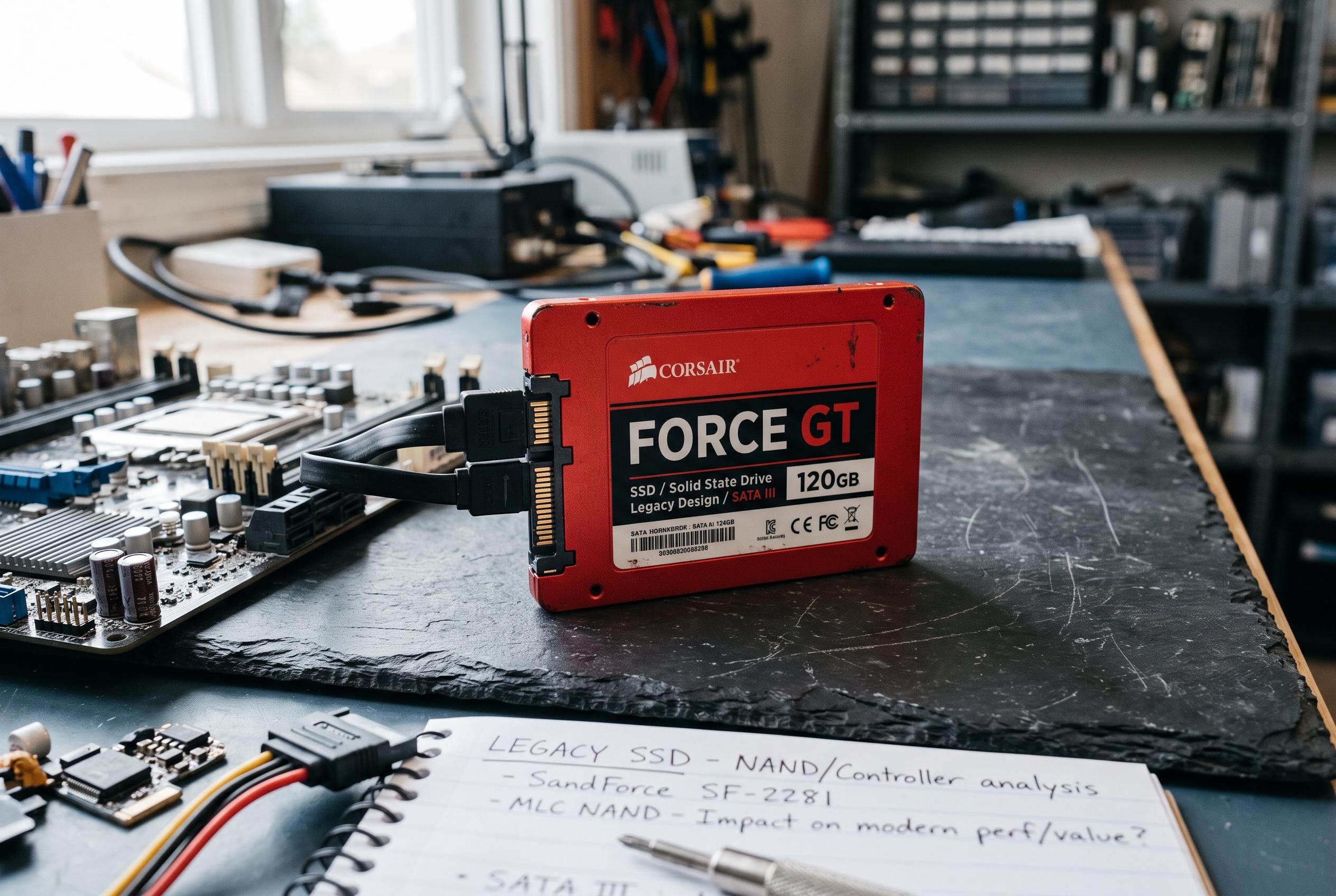

Fifteen years after its launch, the Corsair Force GT exemplifies how early SSDs balanced performance and value, with NAND and controller choices shaping their enduring relevance.
Fifteen years ago, Corsair’s Force GT stood out less for its looks than for what sat behind its bright red casing. In a market where solid-state drives were still proving their worth to enthusiasts, the company paired SandForce’s SF-2281 controller with synchronous 25nm NAND from Micron and sold the drive as a high-speed option for users who wanted flagship performance in a SATA device.
Corsair rated the drive at up to 555MB/s for reads and 515MB/s for writes, with as many as 85,000 IOPS for random access. StorageReview’s review of the 120GB and 240GB versions similarly identified the SF-2281 controller, 25nm synchronous NAND and a bright red metal shell, with the line also offered in 60GB, 120GB and 240GB capacities. In practice, the smaller 120GB model used in ComputerBase’s test was the version most affected by capacity-related limits, particularly on sustained writes.
Benchmark results showed why SandForce-based SSDs were often compared so closely at the time. ComputerBase found the Force GT effectively matched the Mach Xtreme MX-DS Turbo, which used the same controller and memory, while a version of the Extremememory XLR8 Express with faster NAND held a slight lead. In more realistic tests, the Corsair drive could lead on sequential reads but slipped back on writes and random workloads, leaving it broadly on par with its controller twin rather than meaningfully ahead of the field.
The more important question was value. ComputerBase concluded that the Force GT delivered strong overall performance, but the real-world difference versus cheaper rivals was limited. Crucial’s m4, which TechSpot and Tom’s Hardware described as an important mainstream SSD of the period, was slower in some tests but priced more aggressively. That made Corsair’s premium harder to justify, especially when the practical benefit of the faster drive was small. The Force GT was quick, but by 2011 standards it was also a reminder that controller and NAND choice mattered more than branding alone.
Disclaimer: This content is intended for informational purposes only. Readers are advised to exercise their own judgement, conduct due diligence, or consult a qualified expert before acting on any information provided.