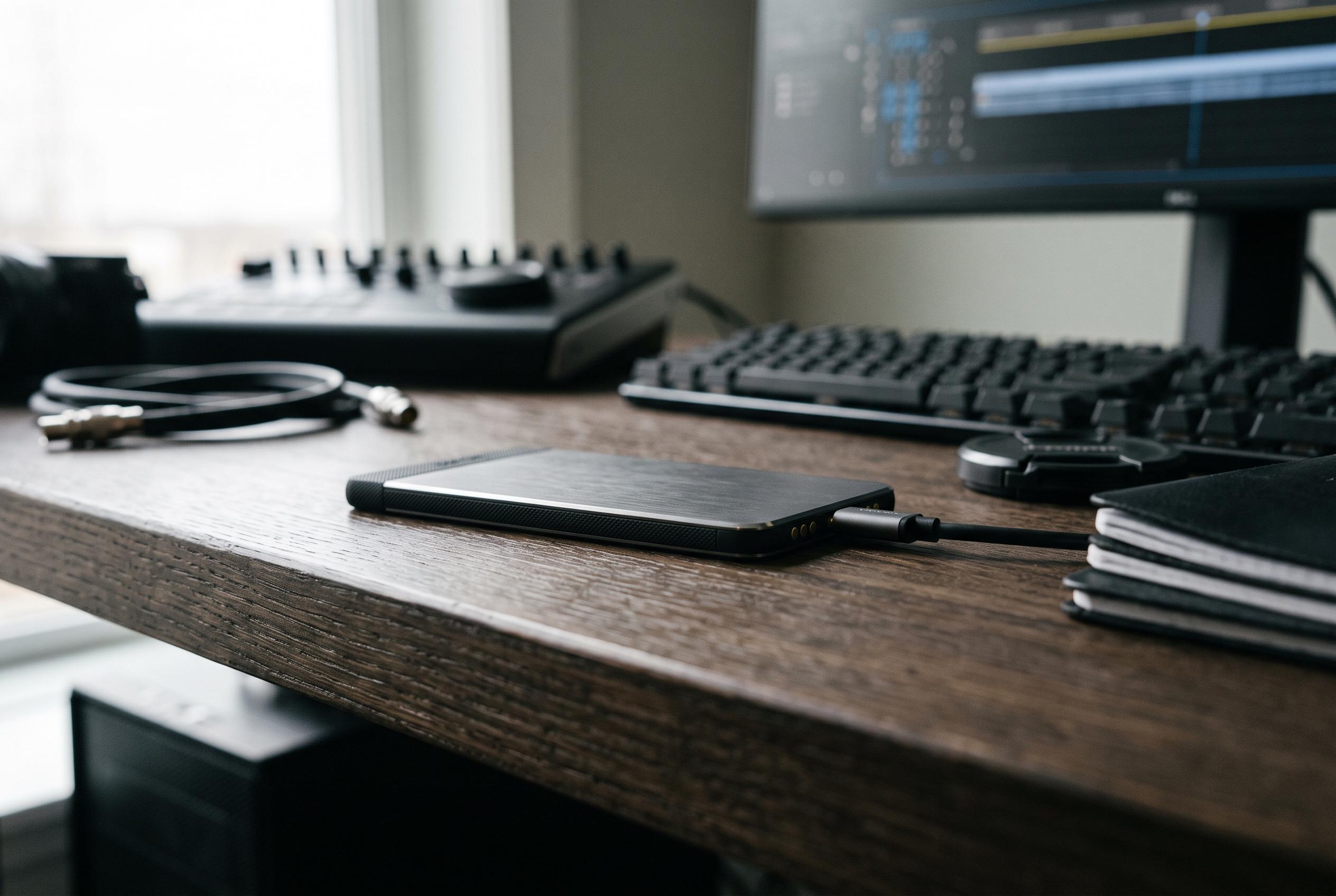

Lexar introduces the Muse Ultra-Slim Portable SSD at IFA 2026, emphasising its design trade-offs for mobile video creators with its ultra-thin profile and unique magnetic pogo-pin interface.
Lexar has used IFA 2026 and its 30th-anniversary celebrations to introduce a portable SSD that stands out less for raw throughput than for the design trade-off behind it. The new Muse Ultra-Slim Portable SSD is aimed squarely at phone-based video recording, measures 3.8mm at its thickest point, and dispenses with a standard USB-C socket in favour of a magnetic pogo-pin interface connected through a bundled SnapLink cable.
That unusually thin body is central to Lexar’s pitch. The company says the drive uses a precision-machined unibody metal enclosure, a custom ultra-thin PCB, high-density NAND stacking and an integrated internal structure to fit either 512GB or 1TB into an 80 x 48mm card-like shell whose edges taper to 1mm. Lexar is quoting read speeds of up to 1,050MB/s and write speeds of up to 1,000MB/s, which places the Muse broadly in line with mainstream 10Gbps external SSDs despite its far slimmer profile.
The product is being marketed more as a capture accessory than as a general external drive. In its launch material, Lexar says the Muse can record Apple ProRes 4K video at up to 120fps directly from compatible iPhones, and several early reports said the box includes a magnetic sleeve or case so the SSD can sit on the back of a handset during filming. Tom’s Hardware reported that the drive is also intended to work with Macs, Android devices and PCs, while Lexar says it supports iPhone, iPad, Mac and other USB-C hardware. TechRadar framed the device as especially relevant to mobile creators who want external recording without carrying a thicker drive.
That narrow use case also explains the biggest compromise. TechSpot reported that there is not enough space in the chassis for a conventional USB-C receptacle, so Lexar has adopted a proprietary SnapLink magnetic data connection built around pogo pins and N52-grade neodymium magnets. The included lead terminates in USB-C and ships with a Type-A adapter, but reviewers immediately focused on the drawback of turning an ordinary storage device into one that depends on a custom cable. TechRadar said the magnetic link “might not be the most robust”, while Tom’s Hardware noted that the connector hardware appears bulky beside the SSD itself.
Android Central was more sceptical still, arguing that the Muse is “so thin that it doesn’t have a USB-C port” and may be less practical than the category it is trying to disrupt. That objection goes beyond aesthetics. Portable SSDs are typically valued for interchangeability as much as for speed, and a standard cable can be replaced almost anywhere. A proprietary lead becomes an essential part of the product. TechSpot also pointed out that sustained transfer behaviour has yet to be independently tested, leaving open the question of how closely Lexar’s quoted peak figures will translate into longer real-world recording sessions.
Lexar is also making a superlative claim that launch-day coverage did not independently settle. The company describes the Muse as the “world’s thinnest portable SSD”, but Phototrend said it had not verified that assertion against every competing product on the market. Even so, the publication’s comparison with Lexar’s own SL500M gives a clear sense of the reduction in size: that older model is listed at 7.8mm at its thickest point and 4.8mm at its thinnest. On that basis, the Muse looks less like a routine redesign and more like a deliberate attempt to create a specialised storage format for phone rigs and lightweight mobile shooting.
Availability is scheduled for the fourth quarter of 2026 in 512GB and 1TB capacities. Lexar has not published official pricing in its launch release, but Tom’s Hardware said company representatives at IFA were targeting roughly US$230 for the 512GB model and US$380 for the 1TB version. If that guidance proves accurate, buyers will be paying not for class-leading transfer rates, but for an unusually slim enclosure, magnetic phone mounting and a creator-focused workflow that trades universal simplicity for minimum thickness.
Disclaimer: This content is intended for informational purposes only. Readers are advised to exercise their own judgement, conduct due diligence, or consult a qualified expert before acting on any information provided.