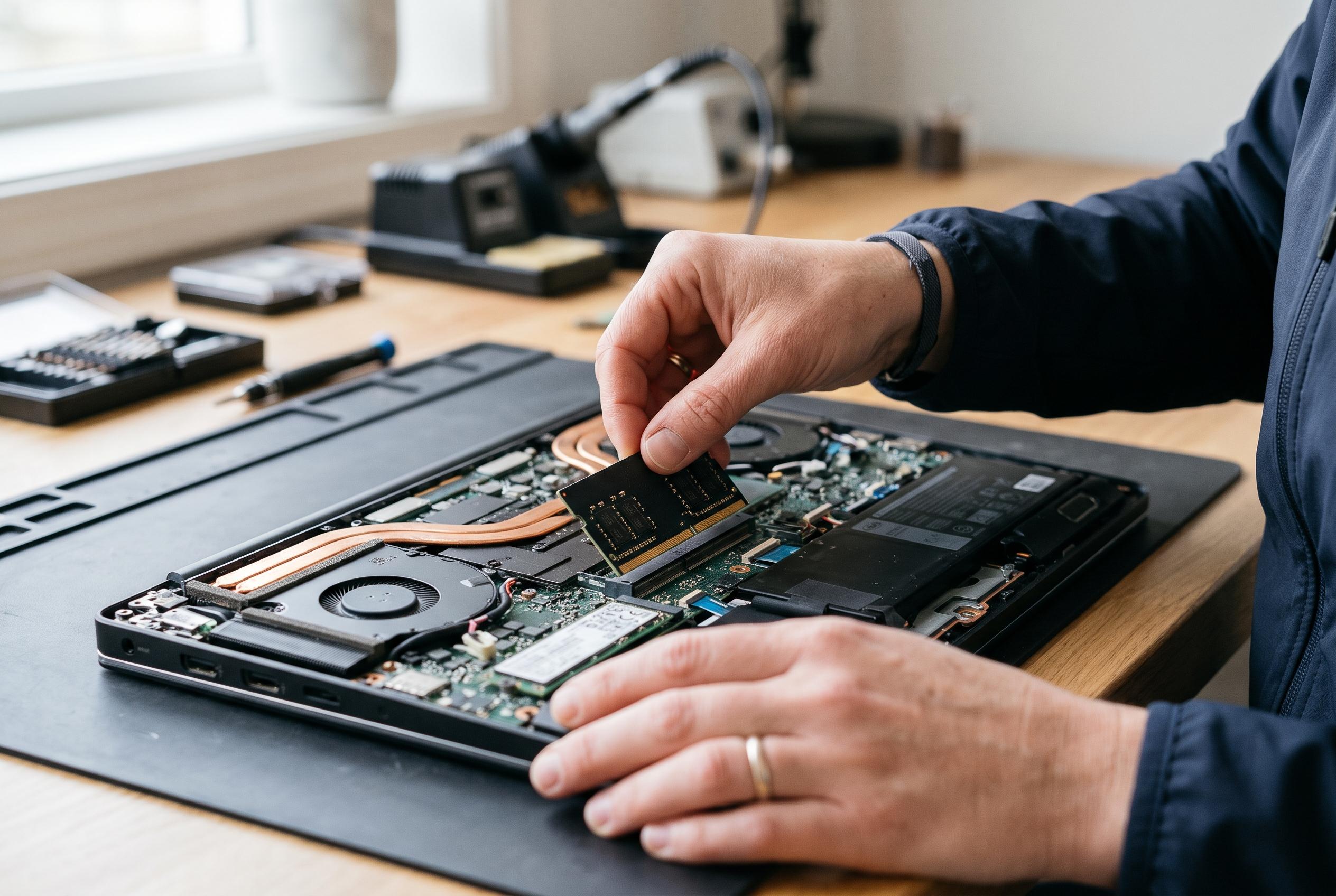

The slim, removable memory format promises a more repairable alternative to soldered RAM, but support, performance and pricing still depend heavily on the laptop.
LPCAMM2 is emerging as one of the more practical attempts to reconcile two demands that have long pulled laptop design in opposite directions: thinness and repairability. Unlike soldered LPDDR5X, which is fixed to the motherboard, LPCAMM2 places low-power memory chips on a removable module that sits flat against the board and connects through a compression-style interface. Industry explainers from Micron, Tom’s Hardware and other memory guides describe it as a form factor intended to preserve high bandwidth while avoiding the permanence of soldered RAM and the bulk of older SO-DIMM layouts.
The distinction matters because LPCAMM2 is not a universal memory standard in the way many buyers might expect. It is a module format, not a new class of DRAM, and it is not interchangeable with standard SO-DIMMs or with soldered LPDDR configurations. Guides from RAMPricesUSA and ITechGuides both stress that compatibility depends on the laptop maker, the board layout and the processor’s memory controller. In other words, the module may be removable, but that does not mean any LPCAMM2 stick will work in any machine that supports the format.
Performance is also shaped by the host system rather than by the module alone. Micron’s own technical material says LPCAMM2 can support LPDDR5X speeds up to 9,600 MT/s, but laptop vendors set their own operating ceilings according to platform limits. Lenovo’s ThinkPad P1 Gen 7 and Framework’s Laptop 13 Pro illustrate that point: the same memory family can run at different rates depending on the processor and product configuration. That makes the specification sheet more important than the module label when comparing machines.
Upgradeability, meanwhile, is real but conditional. Framework’s documentation shows a straightforward service process in which the user removes a cover, loosens captive screws and lifts the module away from its pegs, rather than desoldering anything from the board. The company also says some models can support up to 96GB on a single LPCAMM2 slot, although that figure is specific to particular configurations and does not imply that high-capacity modules are widely available or supported across the market. Practical servicing is therefore easier than with soldered RAM, but it remains a model-by-model proposition.
Pricing is where the promise of modularity meets the wider memory market. Reports cited by WindowsForum and Framework’s own updates show that LPCAMM2 costs have moved sharply in response to wider LPDDR supply pressures, with some shipments repriced, substituted or delayed. Framework said in September that it had secured limited quantities of Micron modules at lower cost and passed some of those savings through to preorders, but it also warned that prices could rise again if supply tightened. The wider lesson is that removable memory does not escape the volatile economics of advanced DRAM. For buyers, that means LPCAMM2 should be judged as a repair and upgrade feature first, and only secondarily as a path to cheaper memory.
Disclaimer: This content is intended for informational purposes only. Readers are advised to exercise their own judgement, conduct due diligence, or consult a qualified expert before acting on any information provided.