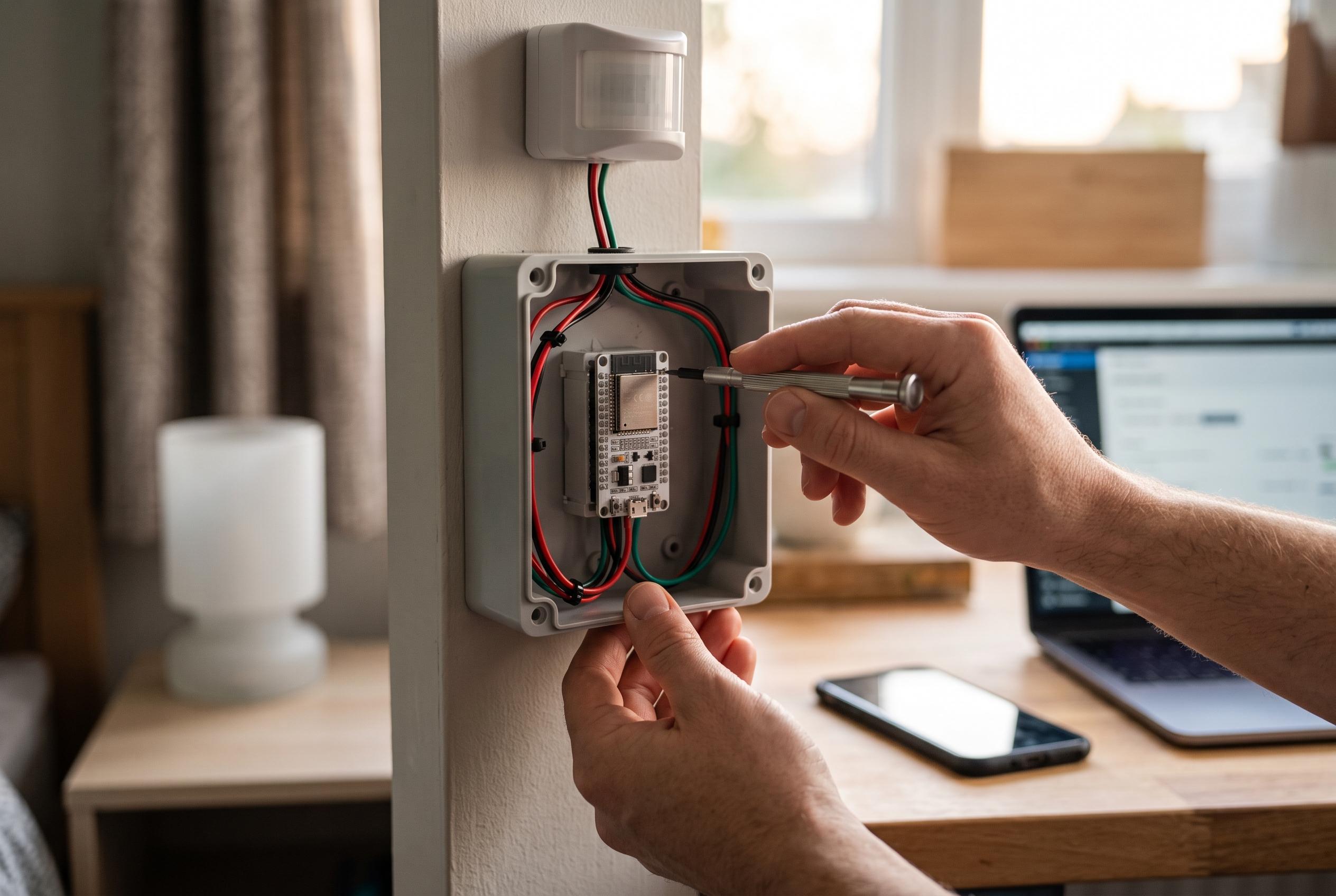

Latest ESP32 models and DIY projects highlight a shift towards more versatile, privacy-focused home automation solutions, from sunrise alarms to presence sensing and private voice assistants.
ESP32 boards have become attractive building blocks for home projects because they are inexpensive, versatile and increasingly capable. Recent buying guides from BotMonster and esp32.co.uk note that newer variants such as the ESP32-C6, C5 and H2 add support for standards including Matter, Thread and Zigbee, while the ESP32-S3 remains a practical choice for microphone-driven projects and on-device voice features. That combination makes the platform suitable for experimental smart home devices without committing to a full proprietary ecosystem.
One of the most immediately useful projects is a sunrise alarm. Instead of waking to a harsh buzzer, an ESP32 can drive an addressable LED strip through WLED and gradually raise brightness and warmth over a set period before your alarm time. A how-to guide published by Horizn Sunrise recommends an SK6812 RGBW strip for a more convincing daylight effect, while Home Assistant’s WLED integration supports common LED chipsets such as WS2812B, WS2811 and SK6812. In practice, that means the system can be tied to Home Assistant routines, next-alarm data from a phone, or a fixed schedule.
A second project replaces crude motion detection with presence sensing. Traditional PIR sensors only notice coarse movement, which is why they often switch lights off when someone is still reading or working. By pairing an ESP32 with a 24GHz mmWave module, such as the LD2410, it is possible to detect very small movements, including breathing or a hand turning a page. That makes lighting control noticeably more reliable in rooms where people remain still for long periods. ESPHome is especially useful here because it allows detailed tuning to reduce false triggers and adapt the sensor to the layout of a specific room.
For users who are uncomfortable with cloud-based assistants, an ESP32-S3 can be the front end for a private voice system. The board can run a small wake-word model locally, so the trigger phrase never has to be sent to an external service. After that, commands can be passed to a local PC or single-board computer for transcription, language processing, text-to-speech or home automation. The result is not meant to match premium commercial speakers in noisy environments, but it is a credible alternative for local control, especially when privacy is the priority.
Another low-cost project is a laundry notifier for a standard washing machine. By attaching an ESP32 and an accelerometer or vibration switch to the side of the appliance, the system can detect when the machine stops shaking and send a message to phones in the house. Using a delayed-off filter in ESPHome helps avoid false alerts during pauses in the wash cycle. More advanced versions can keep sending reminders until the laundry is collected, or use NFC to identify which household member loaded the machine. The broader lesson is that many useful automations do not require new appliances; they require a small amount of hardware, careful configuration and a clear problem to solve.
Disclaimer: This content is intended for informational purposes only. Readers are advised to exercise their own judgement, conduct due diligence, or consult a qualified expert before acting on any information provided.