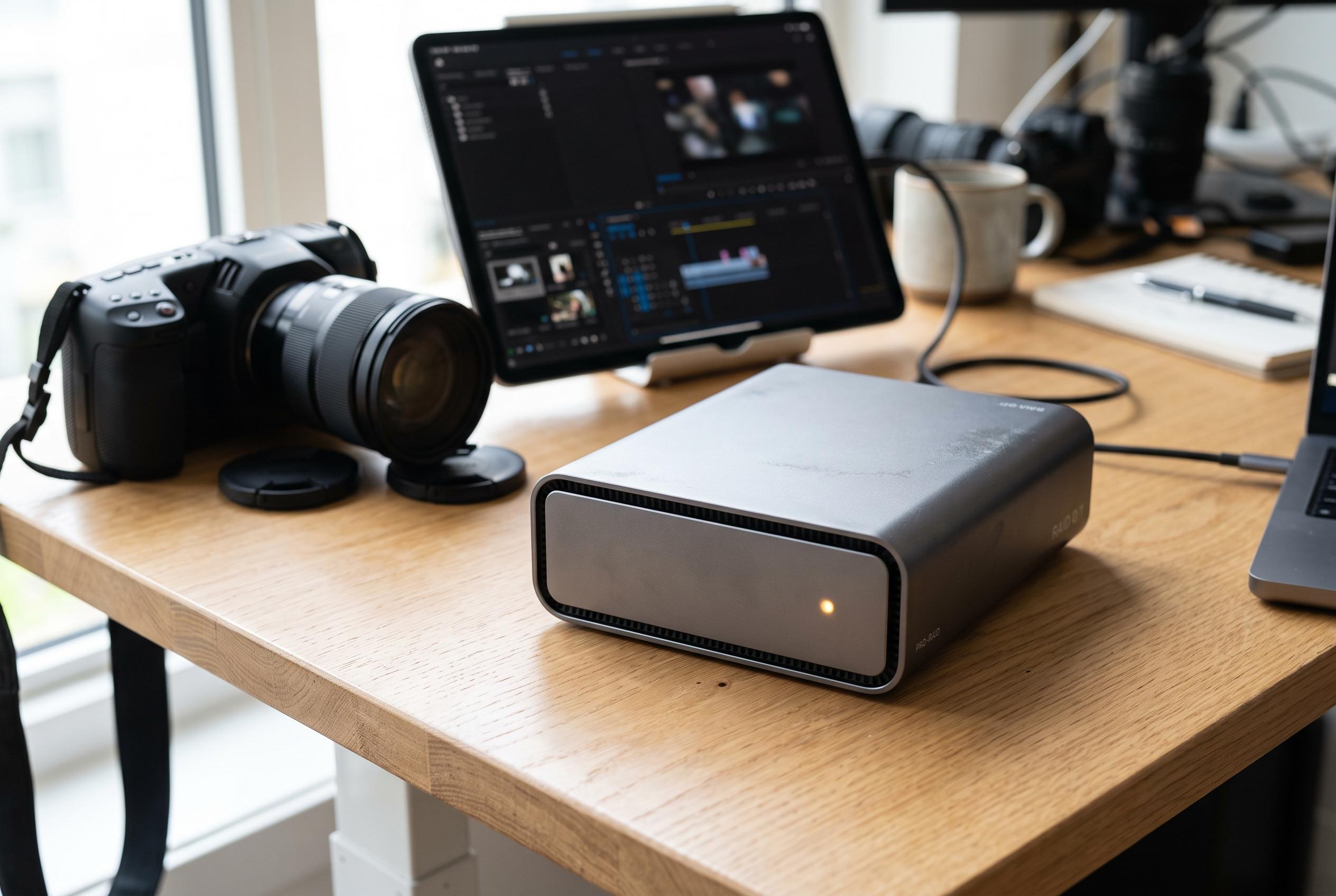

The latest portable RAID enclosures offer enhanced performance with support for USB 3.2 Gen 2, NVMe, and expanded configurations, transforming how creators and small businesses manage data backups and media workflows.
Portable RAID enclosures remain a practical middle ground between a single external drive and a full network storage system. For creators, small offices and home users, they offer local redundancy, faster access and more control over how drives are combined. The latest round of products is especially diverse, ranging from compact dual-bay units for SATA SSDs to larger four-bay boxes that can handle heavier media workloads and more ambitious backup plans.
The most capable all-round models now lean heavily on USB 3.2 Gen 2 and, in some cases, NVMe support. In its review of the UGREEN NASync DXP4800 Plus, IT Pro found that hardware has become far more generous even in small-business storage, with 10GbE networking, dual M.2 slots and expandable memory. That broader trend matters for portable RAID buyers too: faster interfaces and better cooling increasingly decide whether an enclosure is merely convenient or genuinely useful for sustained file transfers.
For users repurposing older drives, speed is still worth matching to the hardware inside the box. Tom’s Hardware reported that older SATA SSDs and even older NVMe drives can deliver useful performance when paired with the right enclosure, particularly at 10Gbps and 20Gbps. That makes a strong case for buying an enclosure that fits the drive type you already own, rather than overspending on a more advanced unit than your workflow can use.
Among the two-bay options, the TerraMaster D2-320 stands out for straightforward performance and simple expansion, with RAID 0, RAID 1, JBOD and Single modes over a 10Gbps USB 3.2 Gen 2 connection. The Vantec Nexstar GX is a more compact choice for 2.5-inch drives, while MAIWO’s dual-bay cases focus on tool-free handling and portable RAID 1 mirroring. These smaller enclosures suit users who want a light, desk-friendly backup device without moving to a larger chassis.
When capacity and RAID flexibility matter more, the four-bay class becomes more attractive. The ORICO 9848RU3 supports eight RAID modes, including RAID 5 and RAID 10, and is aimed at users who need more configuration choices. CENMATE’s four-bay enclosure offers similar ambition with USB A/C 3.0 and eSATA, while WAVLINK adds higher-capacity storage plus HDMI output for systems that can use it. Best SSD Finder’s roundup similarly highlights larger four- and five-bay products as sensible choices for users building more serious desktop DAS setups.
The main buying decision still comes down to workload. RAID 1 is the safer option for simple redundancy, RAID 0 is the faster option for scratch storage, and JBOD remains useful when each disk should stay separate. USB 3.0 is still acceptable for basic use, but 10Gbps or better is the clearer choice for SSD-based arrays or media work. Cooling, drive compatibility and whether the enclosure is really meant for travel or for a fixed desk are just as important as the RAID mode list.
Disclaimer: This content is intended for informational purposes only. Readers are advised to exercise their own judgement, conduct due diligence, or consult a qualified expert before acting on any information provided.