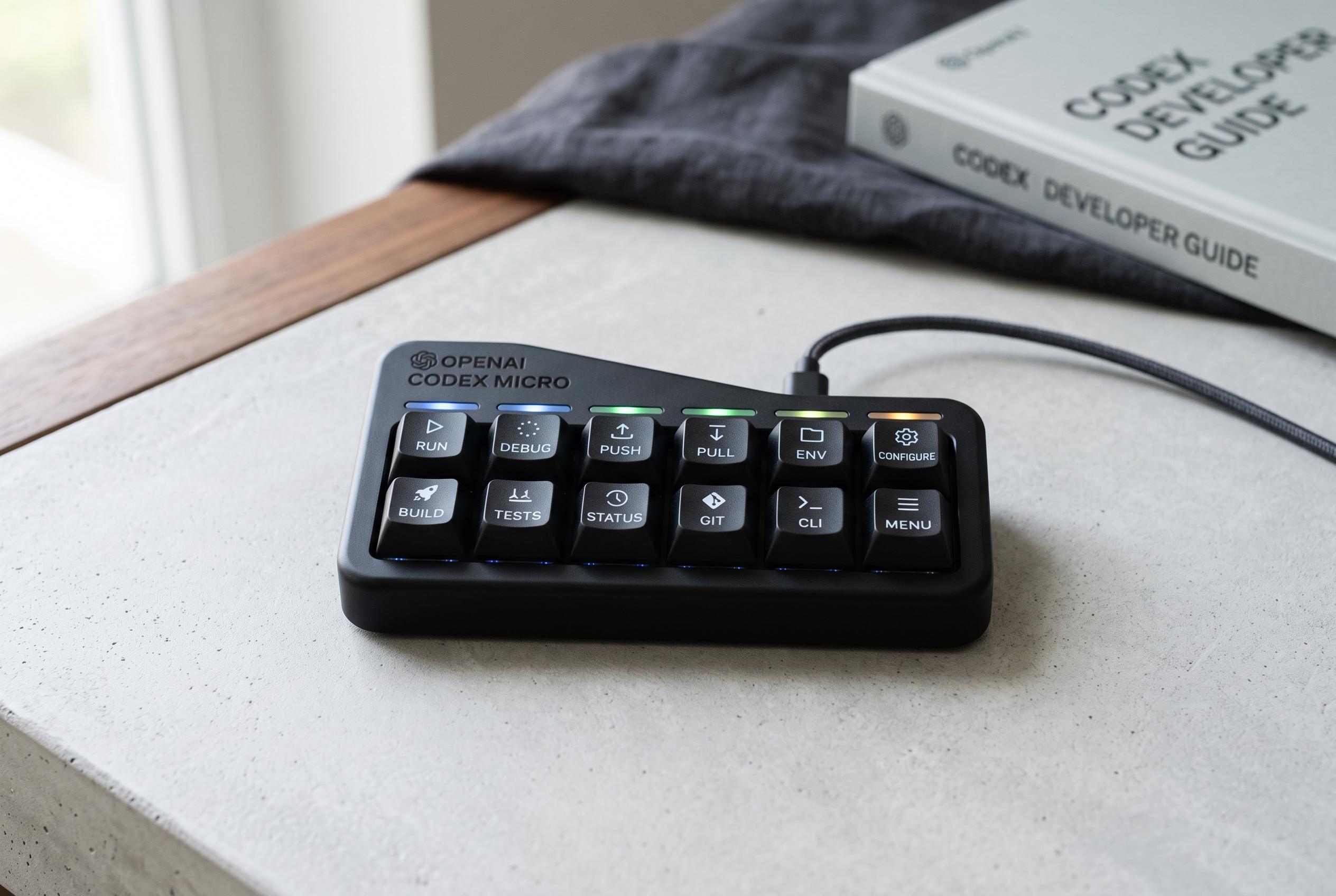

OpenAI unveils the $230 Codex Micro, a compact control device for developers that combines programmable keys and status lighting to streamline AI workflows, amid mixed reactions and limited initial availability.
OpenAI’s Codex Micro is an odd piece of kit: part macro pad, part status display and part statement of intent about where AI coding tools may be headed. According to PCMag, the $230 device is the product of a collaboration with keyboard maker Work Louder, and it arrived just as OpenAI folded its standalone Codex app into the ChatGPT desktop app and widened its agent ecosystem to include Chat, Work and Codex. Tom’s Hardware described it as OpenAI’s first branded hardware, while other reports placed its release on 15 July 2026.
At its core, the Codex Micro is not meant to replace a keyboard. It is a compact control surface built for developers and other heavy users of agentic software, with 13 programmable mechanical keys, a rotary encoder, a joystick and layered controls that let one pad trigger many actions. According to Tom’s Hardware and a guide published by Layer3 Labs, it is built on Work Louder’s Creator Micro 2 platform and supports Bluetooth and USB-C, with compatibility across macOS, Windows and Linux. In practice, it is designed to speed up repetitive tasks, switch between AI workflows and expose Codex functions without forcing users back into menus.
The most distinctive feature is its status lighting. PCMag said six translucent keys show whether an agent is thinking, complete, waiting for input, idle or in error, while the edge lighting also signals when voice input is active. That gives users a way to track multiple background jobs at once, which is useful when several coding threads are running in parallel. The same hardware also includes a dedicated voice button, though the keypad itself does not contain a microphone; it simply triggers the host machine’s mic.
The device also leans heavily into customisation. Tom’s Hardware reported that it ships with 32 keycaps, including blank ones, while PCMag noted that some are labelled with shorthand such as “YOLO” and “YEET” for more aggressive automation. One mode can bypass manual approvals entirely, while another stages changes, commits them and opens a pull request. The rotary encoder can be used to adjust reasoning depth, effectively letting users trade speed for compute. That kind of control may appeal to developers watching token usage as closely as workflow efficiency.
Still, the Codex Micro has clear limits. PCMag found setup more cumbersome than expected because configuration is split between the ChatGPT app and Work Louder’s Input software, which makes the experience feel less seamless than the hardware suggests. TechRadar also said reactions online have been mixed, with critics questioning the price and arguing that similar functionality can be built more cheaply with other macro pads. Even so, the device has already sold out in limited release, suggesting there is at least a niche market for a physical controller designed around AI agents rather than traditional computing tasks.
Disclaimer: This content is intended for informational purposes only. Readers are advised to exercise their own judgement, conduct due diligence, or consult a qualified expert before acting on any information provided.